
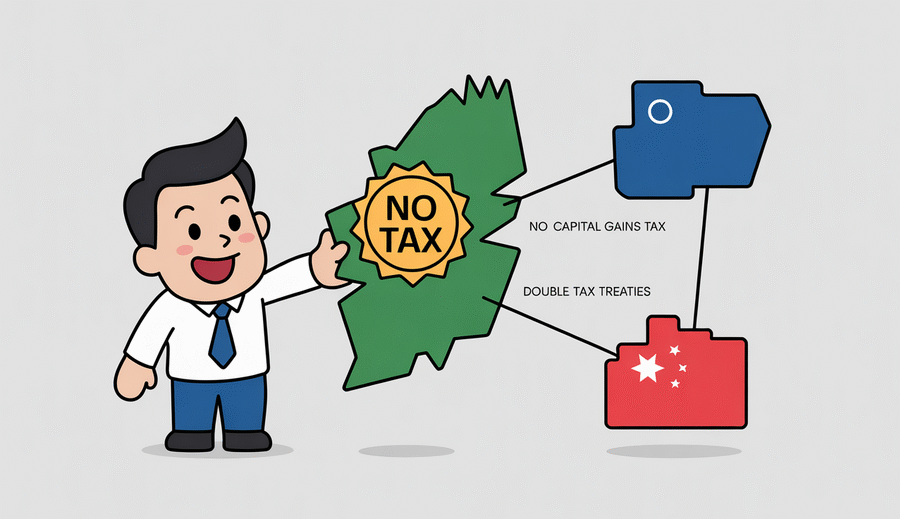
📋 Key Facts at a Glance
- No Capital Gains Tax: Hong Kong does not impose a general capital gains tax under its territorial tax system
- Extensive Treaty Network: Hong Kong has comprehensive double tax agreements with 45+ jurisdictions worldwide
- Unique Treaty Structure: Most Hong Kong DTTs lack specific capital gains articles, aligning with domestic tax policy
- Profits Tax Rates: Corporations pay 8.25% on first HK$2M, 16.5% on remainder; unincorporated businesses pay 7.5%/15%
- Territorial Principle: Only Hong Kong-sourced profits are taxable, creating significant advantages for international investors
Imagine selling a multi-million dollar investment portfolio and keeping 100% of the gains. While this sounds like a fantasy in most developed economies, it’s a reality in Hong Kong. The city’s unique territorial tax system, combined with its extensive double tax treaty network, creates a powerful advantage for international investors and businesses. But how does this work in practice, and what strategic opportunities does it present in today’s global tax landscape?
Hong Kong’s Capital Gains Advantage: The Territorial Tax System
Hong Kong operates on a territorial basis of taxation, a system fundamentally different from the worldwide or residence-based models used by most OECD countries. Under this principle, only income considered to arise in or be derived from Hong Kong is subject to profits tax. This creates one of Hong Kong’s most significant competitive advantages: capital gains are generally not taxed.
This approach stands in stark contrast to many developed economies. For example, the United States taxes capital gains at rates up to 20% (plus potential state taxes), while the United Kingdom imposes capital gains tax at rates up to 28% for residential property and 20% for other assets. Singapore, while often compared to Hong Kong, has specific capital gains tax rules for certain transactions.
What This Means for Investors and Businesses
The absence of capital gains tax provides several strategic advantages:
- Simplified Investment Structures: No need for complex tax planning around capital gains realization
- Enhanced Returns: Investors keep 100% of capital appreciation, improving overall investment performance
- Attractive Holding Company Location: Hong Kong entities can hold international assets without capital gains tax implications locally
- Predictable Tax Environment: Clear rules reduce compliance complexity and tax uncertainty
Hong Kong’s Double Tax Treaty Network: Strategic Protection
Hong Kong has proactively developed one of Asia’s most extensive double tax treaty (DTT) networks, with comprehensive agreements covering over 45 jurisdictions. These treaties serve as critical tools for preventing double taxation and providing certainty for cross-border business activities.
| Key Treaty Partners | Primary Benefits |
|---|---|
| Mainland China | Reduced withholding taxes on dividends, interest, royalties |
| United Kingdom | Comprehensive coverage including business profits and dividends |
| Singapore | Strategic Asian partnership with reduced withholding rates |
| Japan | Advanced economy with comprehensive treaty provisions |
| United States | Limited agreement covering shipping and air transport |
The Unique Capital Gains Approach in Hong Kong’s DTTs
Here’s where Hong Kong’s approach becomes particularly interesting: most of its double tax treaties do not include specific articles dedicated to capital gains taxation. This is a deliberate alignment with Hong Kong’s domestic tax policy, which doesn’t tax capital gains. The practical effect is that taxing rights over capital gains realized by Hong Kong residents from treaty partner countries are typically governed by the domestic laws of those partner countries, without specific treaty allocation rules.
Strategic Implications for International Investors
The combination of no capital gains tax and extensive treaty protection creates powerful opportunities for international tax planning:
Holding Company Structures
Hong Kong holding companies can be used to:
- Hold international investments and realize capital gains tax-free in Hong Kong
- Benefit from reduced withholding taxes on dividends, interest, and royalties through DTTs
- Consolidate regional investments under a single tax-efficient jurisdiction
- Facilitate cross-border mergers and acquisitions
Investment Fund Considerations
For fund managers and institutional investors:
- Hong Kong-based funds can distribute capital gains to investors without local tax withholding
- The absence of capital gains tax simplifies performance calculations and reporting
- DTT network provides protection against double taxation on cross-border investments
- Family Investment Holding Vehicle (FIHV) regime offers 0% tax on qualifying income with HK$240 million minimum AUM
Comparative Analysis: Hong Kong vs. Singapore
While both jurisdictions offer attractive tax regimes, their approaches to capital gains in double tax treaties differ significantly:
| Aspect | Hong Kong | Singapore |
|---|---|---|
| Capital Gains Tax | Generally not taxed | Specific rules for certain transactions |
| DTT Capital Gains Articles | Typically absent | Often included with specific allocation rules |
| Corporate Tax Rate | 8.25% on first HK$2M, 16.5% on remainder | 17% with various exemptions |
| DTT Network Size | 45+ comprehensive agreements | 90+ comprehensive agreements |
| Withholding Tax on Dividends | 0% (no withholding tax) | 0% for most cases |
Modern Challenges: Substance Requirements and Anti-Avoidance
The international tax landscape has evolved significantly, with increased focus on economic substance and anti-avoidance measures:
Economic Substance Requirements
To legitimately claim treaty benefits, Hong Kong entities must demonstrate adequate economic substance:
- Physical Presence: Genuine office space and infrastructure
- Qualified Personnel: Employees with appropriate expertise and decision-making authority
- Operational Activities: Core income-generating activities conducted in Hong Kong
- Management and Control: Strategic decisions made by directors in Hong Kong
- Adequate Expenditure: Operating expenses commensurate with business activities
Principal Purpose Test (PPT) and BEPS Measures
Hong Kong has implemented BEPS measures including:
- Principal Purpose Test: Treaty benefits can be denied if obtaining the benefit was one of the principal purposes of an arrangement
- Foreign-Sourced Income Exemption (FSIE): Phase 2 implemented January 2024, requiring economic substance for exempt foreign-sourced income
- Global Minimum Tax: Hong Kong enacted Pillar Two legislation effective January 1, 2025, applying 15% minimum tax to large MNEs
Practical Steps for Leveraging Hong Kong’s Advantages
To effectively utilize Hong Kong’s tax advantages for international investments:
- Establish Genuine Substance: Set up proper offices, hire qualified staff, and conduct real business activities in Hong Kong
- Obtain Tax Residency Certificate: Apply for TRC from the Inland Revenue Department before claiming treaty benefits
- Review Treaty Coverage: Check specific DTT provisions with target investment jurisdictions
- Document Business Purpose: Maintain clear records demonstrating commercial rationale beyond tax benefits
- Monitor Compliance: Stay updated on evolving international tax standards and Hong Kong regulations
- Consider FIHV Regime: For family offices, evaluate eligibility for the 0% tax regime with HK$240 million minimum AUM
✅ Key Takeaways
- Hong Kong’s territorial tax system generally exempts capital gains from taxation, providing significant advantages for investors
- The extensive double tax treaty network (45+ jurisdictions) offers protection against double taxation on cross-border income
- Most Hong Kong DTTs lack specific capital gains articles, aligning with domestic non-taxation of capital gains
- Economic substance requirements are critical for legitimate treaty benefit claims in today’s international tax environment
- Strategic use of Hong Kong holding companies can optimize international investment structures while complying with global standards
- The evolving landscape (FSIE, Global Minimum Tax) requires ongoing compliance monitoring and adaptation
Hong Kong’s unique position at the intersection of territorial taxation and extensive treaty protection continues to offer compelling advantages for international investors and businesses. While the global tax landscape evolves with initiatives like BEPS 2.0 and the Global Minimum Tax, Hong Kong’s fundamental advantages remain intact when combined with genuine economic substance and proper compliance. For investors seeking to optimize cross-border structures while navigating increasingly complex international tax rules, Hong Kong represents a sophisticated and strategically valuable jurisdiction that balances tax efficiency with global compliance standards.
📚 Sources & References
This article has been fact-checked against official Hong Kong government sources and authoritative references:
- Inland Revenue Department (IRD) – Official tax rates, allowances, and regulations
- Rating and Valuation Department (RVD) – Property rates and valuations
- GovHK – Official Hong Kong Government portal
- Legislative Council – Tax legislation and amendments
- IRD Comprehensive Double Taxation Agreements – Official DTT network information
- IRD Certificate of Resident Status – Tax Residency Certificate guidance
- IRD FSIE Regime – Foreign-Sourced Income Exemption rules
- OECD BEPS – Base Erosion and Profit Shifting framework
Last verified: December 2024 | Information is for general guidance only. Consult a qualified tax professional for specific advice.

 Chinese
  English