
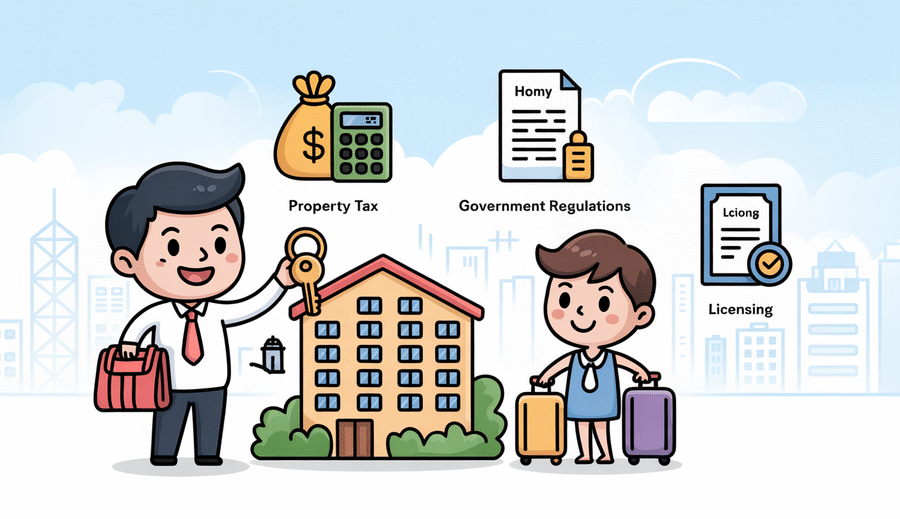
Key Facts About Short-Term Rentals in Hong Kong
- Unlicensed short-term rentals (less than 28 consecutive days) are illegal in Hong Kong
- Penalties: Up to HKD 500,000 fine and 3 years imprisonment (increased from HKD 200,000 and 2 years)
- Property Tax rate: 15% on net assessable value (rental income minus 20% standard allowance)
- Hotel Accommodation Tax: 3% from January 1, 2025
- Licensing authority: Office of the Licensing Authority, Home Affairs Department
- License validity: 12 to 84 months, subject to renewal
Understanding Short-Term Rental Regulations in Hong Kong
Operating short-term rental properties in Hong Kong involves navigating complex legal requirements and significant tax implications. For landlords considering platforms like Airbnb or other short-term accommodation services, understanding the regulatory framework is essential to avoid serious legal and financial consequences.
What Constitutes a Short-Term Rental?
Under Hong Kong law, a short-term rental is defined as any accommodation provided for a fee for periods of less than 28 consecutive days. This definition is critical, as it determines whether a property falls under the Hotel and Guesthouse Accommodation Ordinance (Cap. 349).
IMPORTANT: Operating any premises as short-term accommodation for less than 28 consecutive days without proper licensing is illegal and constitutes a criminal offense.
Legal Framework: Hotel and Guesthouse Accommodation Ordinance
The Hotel and Guesthouse Accommodation Ordinance (HAGAO, Cap. 349) is the primary legislation governing short-term rentals in Hong Kong. This law mandates that any premises offering sleeping accommodation for a fee for periods shorter than 28 consecutive days must possess a valid hotel or guesthouse license issued by the Office of the Licensing Authority within the Home Affairs Department.
The 28-Day Exemption Rule
Properties are exempt from licensing requirements only if:
- All accommodation is exclusively provided for a minimum of 28 consecutive days per letting
- No waiver, refund, or reduction of fees will be made if the letting is shortened to less than 28 consecutive days for any reason
- These terms are clearly stated in the rental agreement
Penalties for Unlicensed Operation
The Hong Kong government has significantly strengthened enforcement against unlicensed short-term rentals. Recent amendments to the HAGAO have increased penalties substantially:
- Fine: Up to HKD 500,000 (increased from HKD 200,000)
- Imprisonment: Up to 3 years (increased from 2 years)
- Criminal record: Conviction results in a permanent criminal record
Additionally, enforcement officers now have enhanced powers, including the ability to apply for search warrants and use reasonable force to enter premises for investigation purposes.
Licensing Requirements for Short-Term Rentals
Obtaining a hotel or guesthouse license is a rigorous process that requires compliance with multiple regulatory standards.
Application Process
To legally operate a short-term rental property, landlords must:
- Submit an application to the Office of the Licensing Authority, Home Affairs Department
- Ensure building compliance: The premises must meet specific building safety standards
- Meet fire safety requirements: Comprehensive fire safety measures must be implemented
- Obtain necessary consents: This includes written approval from the landlord (if applicable) and compliance with the building’s Deed of Mutual Covenant (DMC) or management regulations
License Validity and Renewal
- Licenses are valid for periods ranging from 12 to 84 months
- License holders must apply for renewal 3 to 6 months before expiration
- All establishments must obtain a license before commencing operations
Practical Challenges
In practice, obtaining the required license is extremely difficult for most residential properties. The strict building and fire safety requirements typically cannot be met by standard residential units, which explains why platforms like Airbnb face significant challenges in Hong Kong’s market. Many residential buildings’ DMCs explicitly prohibit commercial use, including short-term rentals.
Tax Implications for Short-Term Rental Income
Landlords operating short-term rentals (whether licensed or considering licensing) must understand their tax obligations under Hong Kong’s tax system.
Property Tax
For individuals receiving rental income where the rental activities do not constitute a business, the income is subject to Property Tax rather than Profits Tax.
Property Tax Calculation:
- Tax rate: 15% flat rate
- Taxable base: Net assessable value
- Standard allowance: 20% of gross rental income (after deducting rates paid) for repairs and outgoings
- Actual expenses: Not deductible; only the standard 20% allowance applies regardless of actual expenses incurred
Example Calculation:
Gross rental income: HKD 210,000
Less rates paid: HKD 2,000
Adjusted gross income: HKD 208,000
Less 20% allowance: HKD 41,600
Net assessable value: HKD 166,400
Property Tax at 15%: HKD 24,960
Profits Tax (For Business Operations)
If the rental activities constitute a business rather than simple property letting, the income becomes subject to Profits Tax instead of Property Tax.
Profits Tax Rates:
- Individuals: 15% standard rate (with concessionary rate of 7.5% on first HKD 2 million of profits, subject to conditions)
- Corporations: 16.5% standard rate
Key Advantage for Corporations: Companies carrying on a trade, profession, or business in Hong Kong can apply in writing for exemption from Property Tax, as the rental income will be assessed under Profits Tax instead. This allows the deduction of actual expenses incurred, which may be beneficial if expenses exceed 20% of gross rental income.
Hotel Accommodation Tax (HAT)
Effective from January 1, 2025, the Hong Kong government has reintroduced the Hotel Accommodation Tax at a rate of 3% on accommodation charges.
Landlord Responsibilities:
- Collect the 3% HAT from guests on top of accommodation charges
- Remit the collected tax to the Inland Revenue Department
- Maintain proper records of all accommodation transactions
- This applies to all licensed short-term accommodation providers
Provisional Tax System
Hong Kong operates a provisional tax system, meaning landlords must pay tax in advance. Tax assessments typically include:
- A final tax assessment for the current year based on actual rental income
- A provisional tax assessment for the following year based on the previous year’s rental income
- Provisional tax paid is credited against the final tax payable when assessed
Compliance Requirements
All landlords receiving rental income must:
- Register with the Inland Revenue Department (IRD)
- Maintain accurate records of all rental income and transactions
- File annual tax returns accurately and on time
- Report all rental income regardless of amount
Given the complexity of Hong Kong’s tax system and the potential for both Property Tax and Profits Tax assessments, landlords are strongly advised to consult with qualified tax advisors or certified public accountants.
Additional Considerations for Tenants
Tenants considering operating short-term rentals face additional hurdles beyond those affecting property owners:
- Landlord approval: Written consent from the landlord is mandatory
- Lease agreement terms: Most tenancy agreements explicitly prohibit subletting or commercial use
- Building regulations: Compliance with the building’s DMC or homeowners’ association rules is required
- Licensing: Even with landlord approval, the necessary hotel/guesthouse license must still be obtained
- Legal consequences: Operating without proper approvals can result in lease termination, eviction, and legal penalties
Why Short-Term Rental Platforms Struggle in Hong Kong
The stringent regulatory environment has made it nearly impossible for platforms like Airbnb to operate legally in Hong Kong at scale. Unlike cities such as Tokyo, Paris, and other major tourist destinations that have implemented specific short-term rental registration systems and regulations, Hong Kong has maintained its strict licensing requirements under HAGAO without creating an alternative framework for home-sharing platforms.
The practical reality is that most residential properties cannot meet the building and fire safety standards required for hotel/guesthouse licensing, effectively making legal short-term rental operations impossible for the vast majority of residential property owners.
Key Takeaways
- Unlicensed short-term rentals are illegal: Operating accommodation for less than 28 consecutive days without a proper license is a criminal offense with severe penalties
- Penalties are substantial: Up to HKD 500,000 fine and 3 years imprisonment, plus a permanent criminal record
- Licensing is challenging: Obtaining a hotel/guesthouse license requires meeting strict building and fire safety standards that most residential properties cannot satisfy
- Tax compliance is mandatory: Rental income is subject to Property Tax at 15% on net assessable value, with a standard 20% allowance for repairs and outgoings
- Hotel Accommodation Tax applies: From January 1, 2025, licensed operators must collect and remit 3% HAT on all accommodation charges
- Long-term rentals are exempt: Properties rented exclusively for 28 consecutive days or more do not require licensing and avoid HAT obligations
- Professional advice is essential: Given the legal and tax complexities, consult with legal professionals and tax advisors before considering short-term rental operations
- Tenants face additional restrictions: Beyond licensing requirements, tenants must obtain landlord approval and comply with lease terms and building regulations
Disclaimer: This article provides general information about Hong Kong’s short-term rental regulations and tax obligations. It should not be considered legal or tax advice. Laws and regulations are subject to change, and individual circumstances may vary. Always consult with qualified legal and tax professionals before making decisions regarding property rental operations.

 Chinese
  English