
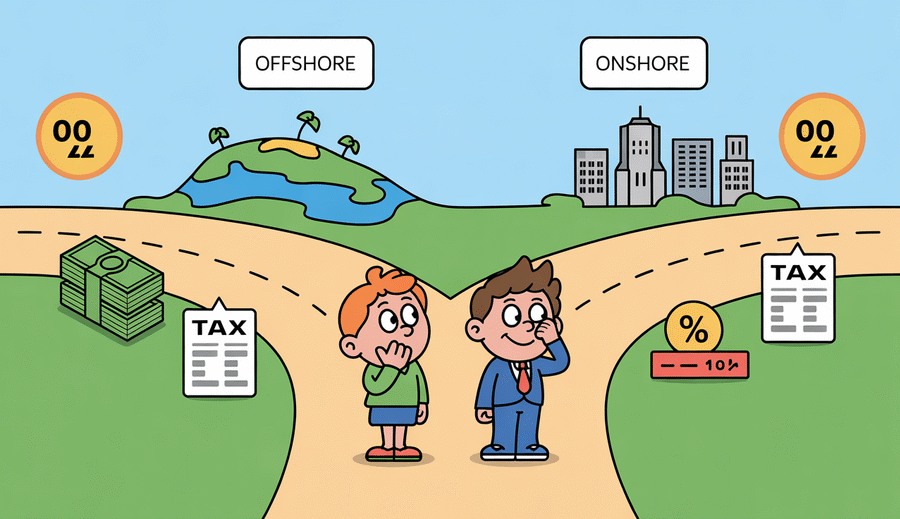
Offshore vs. Onshore Family Offices in Hong Kong: A Tax Comparison
Key Facts: Hong Kong Family Office Taxation
- Territorial Tax System: Only Hong Kong-sourced income is taxable; foreign-sourced income generally exempt
- FIHV Regime: 0% tax rate for qualifying Family Investment Holding Vehicles managed by eligible single family offices (effective from 1 April 2022)
- FSIE Regime: Economic substance requirements apply to foreign-sourced income for MNE entities (effective from 1 January 2023, refined from 1 January 2024)
- No Capital Gains Tax: Hong Kong does not impose capital gains tax, wealth tax, or inheritance tax
- Minimum AUM Threshold: HKD 240 million (approximately USD 30 million) for FIHV tax concessions
- Substance Requirements: Minimum 2 qualified full-time employees and HKD 2 million operating expenditure for eligible single family offices
- Pillar Two Implementation: Hong Kong Minimum Top-up Tax (HKMTT) effective from 1 January 2025 for MNE groups with consolidated revenues of EUR 750 million or more
Introduction: Hong Kong’s Rise as a Family Office Hub
Hong Kong has emerged as one of Asia’s leading family office jurisdictions, competing directly with Singapore for ultra-high-net-worth families seeking tax-efficient wealth management structures. The territory’s appeal stems from its unique combination of a territorial tax system, strategic geographic location, robust legal framework, and the recently introduced Family Investment Holding Vehicle (FIHV) tax concession regime.
For families establishing wealth management structures in Hong Kong, one of the most critical decisions involves choosing between offshore and onshore structures—or a hybrid approach combining both. This choice has significant implications for tax efficiency, regulatory compliance, operational flexibility, and long-term wealth preservation. This comprehensive guide examines the tax treatment of offshore versus onshore family office structures in Hong Kong, analyzing the implications under the territory’s territorial taxation principle, the FIHV regime, the Foreign-Sourced Income Exemption (FSIE) regime, and the newly implemented Pillar Two global minimum tax rules.
Understanding Hong Kong’s Territorial Taxation Principle
The Foundation of Hong Kong’s Tax System
Hong Kong operates on a territorial source principle of taxation, which fundamentally differentiates it from jurisdictions that tax on a residence or worldwide income basis. Under this principle, profits tax is charged only on profits that arise in or are derived from Hong Kong, regardless of where the company is incorporated or the residence of its beneficial owners.
This territorial approach creates significant opportunities for family offices, as income generated outside Hong Kong—including foreign-sourced dividends, interest, capital gains, and royalties—is generally not subject to Hong Kong profits tax. However, determining the source of profits requires careful analysis of where the core income-generating activities are performed, not merely where contracts are signed or payments are received.
Offshore Tax Exemption for Non-FIHV Entities
Both offshore and onshore companies can potentially claim offshore tax exemption on international earnings, provided they meet specific criteria established by the Inland Revenue Department (IRD). To qualify for offshore tax exemption, companies must file an Offshore Tax Claim (OTC) with the IRD to obtain “offshore status.”
Unlike some jurisdictions where offshore status is automatically granted to specific company types, Hong Kong requires a detailed verification process. The OTC review typically takes at least six months but can provide tax exemption validity for 3-5 years once approved. The key test is whether the profits in question arise from activities carried on outside Hong Kong—a determination that depends on the specific facts and circumstances of each case, including where contracts are negotiated and concluded, where goods are sourced and delivered, and where services are performed.
The FIHV Tax Concession Regime: A Game-Changer for Onshore Structures
Legislative Framework and Effective Date
On 19 May 2023, the Inland Revenue (Amendment) (Tax Concessions for Family-owned Investment Holding Vehicles) Ordinance 2023 was gazetted, marking a significant development in Hong Kong’s family office landscape. The FIHV regime offers a 0% tax rate on assessable profits of qualifying FIHVs derived from qualifying transactions and incidental transactions, with the tax concessions applying retrospectively to any years of assessment commencing on or after 1 April 2022.
This regime was specifically designed to promote family-owned investment activities in Hong Kong and provide certainty that investment profits will be exempted from profits tax where specific conditions are met. Importantly, there is no pre-approval process or application requirement—families can self-declare that they meet the conditions and claim the tax concessions.
Qualifying Criteria for FIHVs
To qualify for the FIHV tax concessions, several conditions must be satisfied:
Entity Structure: The FIHV can be a group of persons (corporate or unincorporated) or a legal arrangement, including corporations, partnerships, and trusts. Critically, there is no requirement for the FIHV to be a Hong Kong entity—offshore vehicles formed in the British Virgin Islands, Cayman Islands, or Bermuda may be utilized, allowing families to benefit from flexible offshore corporate frameworks while accessing Hong Kong’s tax concessions.
Family Ownership: At least 95% of the beneficial interest must be held by family members at any time during the year. This threshold can be reduced to 75% if at least 20% of the remaining interest is held by charitable institutions. However, the percentage of beneficial interest held by unrelated parties (other than charitable entities) cannot exceed 5%.
Management and Control: The FIHV must be normally managed or controlled in Hong Kong during the assessment period. This central management and control requirement is crucial for establishing the necessary nexus with Hong Kong.
Minimum Asset Threshold: The aggregate value of specified assets managed by the eligible single family office (SFO) for the FIHV must be at least HKD 240 million (approximately USD 30 million).
Eligible Single Family Office Requirements
The FIHV must be managed by an eligible single family office that meets substantial activities requirements:
Entity Requirements: The SFO must be a private company (incorporated in or outside Hong Kong) and is not required to obtain a license if it only serves the family.
Employment Requirements: The SFO must have at least two qualified full-time employees in Hong Kong. These employees must be adequately qualified to carry out investment management activities for the FIHV. Importantly, there is no requirement for employees to be Hong Kong citizens or permanent residents, and non-residents may fulfill this requirement.
Expenditure Requirements: The SFO must incur minimum total operating expenditure of HKD 2 million for carrying out investment activities in Hong Kong. This expenditure can include employee salaries, office rent, professional fees, and other operational costs related to core income-generating activities.
Outsourcing Permitted: The employee and expenditure requirements can be satisfied through outsourcing arrangements with third-party service providers, provided such outsourcing is not intended to circumvent the substantial activities requirements and the SFO maintains oversight and control of the investment activities.
Qualifying Transactions and Asset Scope
Investment profits from qualified assets can be exempted from profits tax under the FIHV regime. Qualified assets include most typical financial assets families invest in, such as:
- Securities (stocks, bonds, debentures)
- Futures contracts and foreign exchange contracts
- Deposits with authorized financial institutions
- Shares or interests in collective investment schemes
- Over-the-counter derivative products
- Exchange-traded commodities
Incidental income from holding qualified assets, such as interest from bonds, can also be exempted from profits tax. Originally, this incidental income was subject to a 5% threshold (meaning it could not exceed 5% of total income). However, in November 2024, the Financial Services and the Treasury Bureau (FSTB) issued a Consultation Paper proposing to remove this 5% threshold on incidental income and expand the scope of qualifying assets to include virtual assets such as cryptocurrencies and digital tokens—a significant enhancement that reflects Hong Kong’s ambition to become a leading digital asset hub.
Interaction with FSIE Regime
A crucial advantage of the FIHV regime is its interaction with the Foreign-Sourced Income Exemption (FSIE) regime. Qualifying FIHVs are excluded from the FSIE regime, meaning they do not need to meet the economic substance requirements that would otherwise apply to foreign-sourced income. This exclusion provides significant certainty and simplification for family offices operating under the FIHV framework.
The FSIE Regime: Substance Requirements for Non-FIHV Structures
Background and EU Compliance
The Inland Revenue (Amendment) (Taxation on Specified Foreign-sourced Income) Ordinance 2022, enacted on 23 December 2022, introduced Hong Kong’s FSIE regime to address concerns from the European Union and other international bodies about potential tax avoidance through Hong Kong’s territorial tax system. The regime applies to foreign-sourced income accrued to and received in Hong Kong by members of multinational enterprise (MNE) groups, effective from 1 January 2023.
The FSIE regime was subsequently refined through the Inland Revenue (Amendment) (Taxation on Foreign-sourced Disposal Gains) Ordinance 2023, enacted on 8 December 2023, which expanded the scope of assets subject to the regime to cover disposal gains from all types of property (including immovables and movables), effective from 1 January 2024. On 20 February 2024, Hong Kong was removed from the EU watchlist regarding international tax cooperation, confirming that the FSIE regime meets international standards.
Scope of Application
The FSIE regime applies to four types of foreign-sourced income:
- Dividends: Foreign-sourced dividend income
- Interest: Foreign-sourced interest income
- Intellectual Property Income: Income from the use of intellectual property rights
- Disposal Gains: Gains or profits from the sale or disposal of equity interests, immovables, movables, and all other property
Critically, the FSIE regime applies only to MNE entities—entities that are part of a multinational enterprise group. Individuals and local companies that do not belong to an MNE group are not subject to the FSIE regime. This distinction is important because it means that family investment vehicles structured to avoid MNE group classification may not be subject to FSIE requirements.
Economic Substance and Other Exceptions
To benefit from exemption under the FSIE regime for foreign-sourced income, MNE entities must satisfy one of three exceptions depending on the type of income:
Economic Substance Requirement: For foreign-sourced interest, dividends, or disposal gains, the entity must conduct adequate economic activities in Hong Kong in relation to the receipt of the foreign-sourced income. This requires having adequate employees, premises, and operating expenditure in Hong Kong to carry out core income-generating activities (CIGAs) related to the income.
Nexus Requirement: For foreign-sourced IP income, the entity must satisfy a nexus approach that links the IP income to research and development expenditure incurred in Hong Kong.
Participation Requirement: For foreign-sourced dividends or disposal gains from equity interests, the entity must hold at least 5% of the equity interests for a continuous period of at least 12 months and the investee company must not derive more than 50% of its assets or income from immovable properties.
Implications for Family Offices
For family offices that do not qualify for or choose not to operate under the FIHV regime, the FSIE regime presents significant compliance challenges. The economic substance requirements demand genuine operational presence in Hong Kong, not merely nominal structures. This has increased the incentive for family investment holding vehicles to restructure and come within the FIHV framework, which provides certainty that disposal gains and other investment income will not be subject to profits tax under the refined FSIE regime.
The IRD has clarified that interest income derived by a fund or FIHV from foreign debt instruments may be exempt if the entity meets the economic substance requirement under the FSIE regime by virtue of the investment business activities being conducted in Hong Kong, and the interest income is derived from or incidental to activities that produce exempted or concessionary profits.
Offshore Structures in the Hong Kong Family Office Ecosystem
Use of Offshore Vehicles within FIHV Regime
One of the most attractive features of Hong Kong’s FIHV regime is that there is no requirement for the family trust, single family office, or FIHV to be Hong Kong entities. This flexibility allows families to utilize offshore structures formed in jurisdictions such as the British Virgin Islands, Cayman Islands, or Bermuda, while still benefiting from Hong Kong’s tax concessions.
The use of offshore companies as the single family office, FIHV, and investment holding companies provides several advantages:
Flexible Corporate Framework: Offshore jurisdictions like the BVI and Cayman Islands offer sponsor-friendly corporate legal frameworks with simplified governance requirements, confidentiality protections, and efficient administration.
Stamp Duty Exemption: Using offshore companies exempts share transfers from Hong Kong stamp duty, which would otherwise apply to transfers of Hong Kong company shares at a rate of 0.2% (0.1% for each of the seller and buyer). This can result in significant savings during sales or reorganizations involving share transfers.
Asset Protection: Offshore structures, particularly when combined with trusts established in jurisdictions with robust trust laws, can provide enhanced asset protection and succession planning benefits.
Privacy Considerations: While Hong Kong has implemented beneficial ownership reporting requirements, offshore structures in certain jurisdictions may offer additional privacy protections for families concerned about confidentiality.
Pure Offshore Structures vs. FIHV Hybrid Approach
Families must weigh the benefits of pure offshore structures against hybrid approaches that incorporate the FIHV regime:
Pure Offshore Approach: Families may establish investment holding structures entirely offshore (e.g., BVI or Cayman companies holding global investments) and claim offshore tax exemption in Hong Kong if the investment activities are conducted outside Hong Kong. This approach minimizes Hong Kong substance requirements but requires careful structuring to ensure that management and control activities do not inadvertently create Hong Kong tax exposure. The challenge lies in demonstrating that the profits are offshore-sourced, particularly if key investment decisions are made by Hong Kong-resident family members or advisors.
FIHV Hybrid Approach: Families can utilize offshore vehicles (e.g., a Cayman Islands company as the FIHV or SFO) but ensure that the management and control requirements and substantial activities criteria for the FIHV regime are satisfied in Hong Kong. This approach provides tax certainty through the 0% FIHV tax rate while maintaining the flexibility and benefits of offshore corporate structures. The FIHV regime explicitly permits this hybrid approach, provided the central management and control of the FIHV is exercised in Hong Kong and the SFO meets the employee and expenditure requirements.
Key Considerations for Offshore Structures
When utilizing offshore structures within a Hong Kong family office framework, families should consider:
Substance Requirements: While offshore vehicles offer flexibility, the economic substance laws in many offshore jurisdictions now require adequate local presence. Families should ensure compliance with both Hong Kong requirements (for FIHV qualification or offshore tax exemption) and offshore jurisdiction requirements (to maintain good standing and avoid adverse tax consequences in other jurisdictions).
Treaty Access: Offshore companies in jurisdictions without tax treaties may not benefit from reduced withholding tax rates on dividends, interest, and royalties. Families should consider whether intermediate holding companies in treaty jurisdictions might be beneficial for certain investments, while remaining mindful of anti-treaty shopping rules and principal purpose tests.
Regulatory Considerations: Offshore structures must comply with applicable regulations, including anti-money laundering requirements, economic substance rules, and beneficial ownership reporting. Hong Kong also requires disclosure of beneficial ownership information for certain entities, regardless of where they are incorporated.
Onshore Hong Kong Structures: Advantages and Considerations
Benefits of Full Hong Kong Incorporation
While the FIHV regime permits offshore entities, families may choose to establish fully onshore Hong Kong structures for various reasons:
Regulatory Credibility: Hong Kong companies are subject to robust regulatory oversight by the Companies Registry and other authorities, which may provide greater credibility with financial institutions, counterparties, and regulators.
Banking Access: Hong Kong-incorporated entities may find it easier to open and maintain bank accounts in Hong Kong, particularly as banks worldwide have become more cautious about offshore structures due to anti-money laundering concerns.
Treaty Network: Hong Kong has an expanding network of comprehensive double taxation agreements (currently over 45 jurisdictions), which can provide beneficial withholding tax rates and elimination of double taxation for outbound and inbound investments.
IP Holding: For families with intellectual property assets, Hong Kong offers an attractive IP regime with preferential tax treatment for qualifying IP income.
Simplified Compliance: Onshore structures may simplify compliance and reporting, particularly as international transparency standards continue to evolve.
Tax Implications for Onshore Structures
Hong Kong companies are subject to profits tax on Hong Kong-sourced profits at the standard rate of 16.5% (or 8.25% for the first HKD 2 million under the two-tier profits tax regime). However, qualifying FIHVs benefit from 0% tax on qualifying transactions, effectively eliminating this tax burden for investment income.
For onshore entities not qualifying for FIHV treatment, the territorial source principle still applies, meaning that foreign-sourced income may be exempt provided the offshore source can be demonstrated. However, MNE entities must also consider FSIE regime requirements for foreign-sourced income received in Hong Kong.
Comparative Analysis: Offshore vs. Onshore Structures
Tax Efficiency Comparison
| Criteria | Offshore Structure | Onshore Structure (Non-FIHV) | FIHV Regime (Offshore or Onshore) |
|---|---|---|---|
| Tax Rate on Investment Income | 0% if offshore-sourced; requires OTC approval | 0% if offshore-sourced; 16.5% on HK-sourced income | 0% on qualifying transactions |
| Certainty | Depends on OTC determination; fact-specific | Depends on source determination | High certainty; self-declaration |
| HK Substance Required | Minimal (to avoid HK-sourcing) | Depends on activities; FSIE if MNE | 2 employees; HKD 2M expenditure |
| Minimum AUM | None | None | HKD 240 million |
| FSIE Regime Applies | If MNE entity receiving foreign income in HK | If MNE entity receiving foreign income in HK | Excluded from FSIE regime |
| Stamp Duty on Share Transfers | Exempt (offshore shares) | 0.2% on HK shares | Exempt if offshore shares used |
| Access to DTA Network | Limited (depends on jurisdiction) | Full access (45+ treaties) | Depends on entity jurisdiction |
| Banking Relationships | May face scrutiny; AML concerns | Generally easier access | Depends on entity jurisdiction |
Substance Requirements Comparison
The substance requirements vary significantly between different structures:
Pure Offshore Structure (Non-FIHV): To maintain offshore tax status, the structure should minimize Hong Kong substance. Key investment decisions, contract negotiations, and management activities should occur outside Hong Kong. If significant activities occur in Hong Kong, the structure risks having profits sourced to Hong Kong and becoming taxable at 16.5%.
Onshore Structure (Non-FIHV): For MNE entities receiving foreign-sourced income in Hong Kong, the FSIE regime requires adequate economic substance—employees, premises, and operating expenditure—to conduct core income-generating activities in Hong Kong. The specific requirements depend on the nature and scale of activities but generally require more than minimal presence.
FIHV Structure: Clear minimum requirements: at least 2 qualified full-time employees and HKD 2 million operating expenditure. These requirements can be satisfied through outsourcing to third-party service providers, provided the SFO maintains oversight and control. The FIHV regime strikes a balance between requiring genuine Hong Kong presence and avoiding overly burdensome requirements that would deter families.
Pillar Two Global Minimum Tax: Implications for Family Offices
Hong Kong’s Implementation Timeline
Hong Kong enacted legislation to implement Pillar Two of the OECD BEPS 2.0 initiative, with the law gazetted on 6 June 2025. The Hong Kong Minimum Top-up Tax (HKMTT) and the Income Inclusion Rule (IIR) are retroactively effective from 1 January 2025, while implementation of the Undertaxed Profits Rule (UTPR) is postponed subject to further studies.
Scope and Thresholds
The HKMTT applies to multinational enterprise (MNE) groups with consolidated revenues of EUR 750 million or more (approximately USD 830 million or HKD 6.5 billion). This threshold means that the vast majority of family offices will not be subject to Pillar Two, as most family wealth, while substantial, does not constitute an MNE group meeting this revenue threshold.
The rules affect all Hong Kong constituent entities of in-scope MNE groups, regardless of ownership interest, while providing relief mechanisms to avoid double taxation.
Impact on Large Family Offices
For the relatively small number of family offices that are part of MNE groups exceeding the EUR 750 million consolidated revenue threshold—typically families with substantial operating businesses in addition to investment portfolios—Pillar Two introduces important considerations:
Minimum Effective Tax Rate: The HKMTT ensures that Hong Kong constituent entities of in-scope MNE groups are subject to a minimum effective tax rate of 15% on their profits. This means that even income qualifying for the FIHV 0% tax rate could potentially be subject to top-up tax if the group’s effective tax rate in Hong Kong falls below 15%.
Safe Harbours: The OECD has developed safe harbours to relieve in-scope MNE groups from performing full GloBE calculations when certain conditions are met. Hong Kong has adopted the transitional Country-by-Country Reporting Safe Harbour, the transitional UTPR Safe Harbour, the QDMTT Safe Harbour, and the Simplified Calculations Safe Harbour for non-material constituent entities to reduce compliance burden.
Compliance Requirements: In-scope MNE groups must file an annual top-up tax return within 15 months (extended to 18 months for a transition year) after the end of the fiscal year. As part of Hong Kong’s tax digitalization initiative, entities of in-scope MNE groups are mandated to e-file their profits tax returns for years of assessment beginning on or after 1 April 2025.
Policy Review: The Hong Kong government has indicated it will perform periodic reviews of the effectiveness of local tax incentives, including the FIHV regime, for large multinational groups subject to minimum taxation under Pillar Two. This suggests potential future refinements to ensure Hong Kong’s family office incentives remain competitive in the Pillar Two environment.
Practical Impact Assessment
For most family offices, Pillar Two will have no direct impact because they do not constitute MNE groups with EUR 750 million or more in consolidated revenues. Family investment vehicles typically do not have “revenues” in the traditional sense but rather investment income, and the EUR 750 million threshold is measured by consolidated group revenues, not assets under management.
However, families with operating businesses that exceed this threshold should carefully analyze whether their family office investment vehicles are considered part of the same MNE group for Pillar Two purposes. Proper structuring to separate operating businesses from passive investment activities may be advisable to ensure that investment income continues to benefit from the FIHV 0% tax rate without Pillar Two top-up tax complications.
Strategic Recommendations for Family Offices
Choosing the Optimal Structure
The choice between offshore, onshore, and hybrid structures depends on several family-specific factors:
For Families with AUM Above HKD 240 Million: The FIHV regime typically provides the optimal solution, offering tax certainty at 0% rates combined with flexible structuring options. Families can utilize offshore vehicles for the FIHV and SFO while establishing the required Hong Kong substance through employees and operating expenditure (which can be outsourced). This approach combines the best of both worlds: offshore flexibility and Hong Kong tax benefits.
For Families with AUM Below HKD 240 Million: Families below the FIHV threshold must rely on traditional offshore tax exemption or territorial source principles. Pure offshore structures with minimal Hong Kong substance may be appropriate if investment activities genuinely occur outside Hong Kong. Alternatively, establishing a Hong Kong-based investment manager with employees and operations allows the family to claim offshore source for foreign investments while building toward eventual FIHV qualification as assets grow.
For Families Part of Large MNE Groups: Families whose wealth is connected to operating businesses exceeding EUR 750 million in consolidated revenues should carefully structure to separate passive investment activities from operating businesses where possible, ensuring that Pillar Two minimum taxation does not unexpectedly apply to investment income that would otherwise qualify for FIHV benefits.
For Families Prioritizing Privacy: While Hong Kong has implemented beneficial ownership reporting and transparency measures, utilizing offshore trusts and companies in jurisdictions with strong confidentiality protections can provide additional privacy. The FIHV regime accommodates such structures provided the management and control requirements are satisfied in Hong Kong.
Structuring Best Practices
Regardless of the specific approach chosen, families should consider these best practices:
Document Decision-Making: Maintain clear records of where investment decisions are made, contracts are negotiated, and management activities occur. This documentation is crucial for supporting offshore source claims or demonstrating satisfaction of FIHV management and control requirements.
Establish Genuine Substance: Whether for FIHV qualification, FSIE compliance, or offshore jurisdiction economic substance rules, ensure that substance requirements are genuinely satisfied with real employees, actual expenditure, and substantive activities—not merely paper compliance.
Regular Review and Rebalancing: Tax laws, international standards, and family circumstances evolve. Conduct annual reviews of family office structures to ensure continued compliance and optimization, particularly given the recent enhancements proposed to the FIHV regime and the implementation of Pillar Two.
Professional Guidance: Family office structuring involves complex interactions between Hong Kong tax law, offshore jurisdiction requirements, international tax standards, and family-specific objectives. Engage experienced Hong Kong tax advisors, offshore counsel, and family office specialists to ensure optimal structuring.
Upcoming Enhancements to Monitor
On 25 November 2024, the Financial Services and the Treasury Bureau issued a Consultation Paper outlining proposed enhancements to the FIHV tax concession regime, with the consultation closing on 3 January 2025. The proposed enhancements include:
- Expanding the scope of qualifying assets to include virtual assets (cryptocurrencies and digital tokens)
- Removing the 5% threshold on incidental income
- Potential refinements to substance requirements and qualifying transaction definitions
These enhancements, if implemented, will further increase the attractiveness of the FIHV regime and provide families with greater flexibility in asset allocation and investment strategies.
Conclusion
Hong Kong’s family office ecosystem offers exceptional flexibility for structuring wealth management vehicles, whether through pure offshore structures, fully onshore Hong Kong entities, or hybrid approaches combining both. The introduction of the FIHV tax concession regime in 2023 has fundamentally changed the landscape, providing a clear pathway to 0% taxation on investment income for qualifying families while maintaining the flexibility to utilize offshore corporate vehicles.
The choice between offshore and onshore structures depends on asset levels, family objectives, substance considerations, and international tax developments such as Pillar Two. For most families with assets exceeding HKD 240 million, the FIHV regime provides optimal tax efficiency and certainty, particularly when combined with offshore vehicles to maximize flexibility and minimize stamp duty. Families below this threshold can still achieve favorable tax treatment through careful application of Hong Kong’s territorial taxation principle and offshore source exemptions.
The continued refinement of Hong Kong’s family office framework, including the proposed enhancements to expand qualifying assets and remove incidental income thresholds, demonstrates the government’s commitment to maintaining Hong Kong’s position as a leading global family office hub. Combined with Hong Kong’s strategic location, robust legal system, sophisticated financial services infrastructure, and gateway access to mainland China and Asian markets, these tax advantages position Hong Kong as an increasingly attractive destination for ultra-high-net-worth families seeking efficient, flexible, and sophisticated wealth management solutions.
Key Takeaways
- FIHV Regime Provides Tax Certainty: The 0% tax rate on qualifying transactions offers superior certainty compared to traditional offshore tax exemption claims, which depend on fact-specific source determinations.
- Offshore Vehicles Compatible with FIHV: Families can utilize BVI, Cayman, or Bermuda entities as FIHVs and single family offices while benefiting from Hong Kong tax concessions, provided management and control requirements are satisfied in Hong Kong.
- Substance Requirements Are Manageable: The FIHV regime’s requirement for 2 employees and HKD 2 million expenditure can be satisfied through outsourcing, making compliance accessible for most families.
- FSIE Regime Excludes FIHVs: Qualifying family investment holding vehicles are excluded from foreign-sourced income exemption regime requirements, simplifying compliance and avoiding economic substance tests that would otherwise apply to MNE entities.
- Pillar Two Limited Impact: The EUR 750 million consolidated revenue threshold means most family offices are not subject to Hong Kong’s Minimum Top-up Tax, though large families with operating businesses should assess potential application.
- AUM Threshold Is Critical: The HKD 240 million minimum asset threshold for FIHV qualification is a key consideration in choosing structures; families approaching this level should plan for FIHV compliance.
- Proposed Enhancements Increase Attractiveness: The expansion to include virtual assets and removal of the 5% incidental income threshold will significantly enhance the FIHV regime’s competitiveness and flexibility.
- Hong Kong Competes Effectively with Singapore: Hong Kong’s FIHV regime offers lighter compliance obligations compared to Singapore’s 13O and 13U schemes while providing similar tax benefits and stronger ties to mainland China markets.
- Professional Structuring Is Essential: The complexity of interactions between Hong Kong tax law, offshore jurisdictions, FSIE requirements, and international standards necessitates expert guidance for optimal family office structuring.
- Regular Review Ensures Continued Compliance: Tax laws and family circumstances evolve; annual structural reviews ensure ongoing compliance and optimization, particularly given recent regulatory developments.
Disclaimer: This article provides general information about Hong Kong tax laws and family office structures as of December 2024. Tax laws are subject to change, and their application depends on specific facts and circumstances. Families considering Hong Kong family office structures should seek professional advice from qualified Hong Kong tax advisors, legal counsel, and family office specialists before making any decisions.
Last Updated: December 2024

 English
  Chinese