
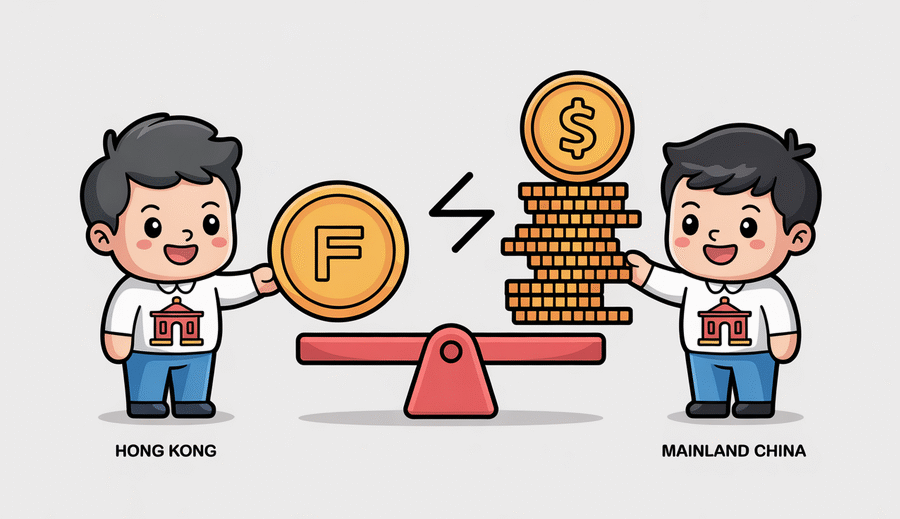
Key Facts: Property Tax Comparison
- Hong Kong Property Tax Rate: 15% on net assessable value (rental income minus 20% statutory allowance)
- Mainland China Rental Income Tax: 20% flat rate on rental income (with deductions based on monthly amount)
- Hong Kong Standard Deduction: 20% statutory allowance for repairs and outgoings, plus rates and irrecoverable rent
- China Deduction Method: CNY 800 if monthly rent ≤ CNY 4,000; 20% of gross receipt if monthly rent > CNY 4,000
- Additional China Tax: Urban Real Estate Tax at 12% on annual rental income (for foreign investors)
- Double Taxation Agreement: Hong Kong-China DTA provides preferential treatment for cross-border investments
Understanding Property Tax Systems: Hong Kong vs Mainland China
Property investors operating across Hong Kong and Mainland China face distinctly different tax regimes. While both jurisdictions tax rental income, their approaches to rates, deductions, and compliance requirements vary significantly. Understanding these differences is crucial for optimizing tax efficiency and ensuring compliance in cross-border property investments.
Core Tax Structures Compared
Hong Kong’s Property Tax Framework
Hong Kong employs a straightforward Property Tax system levied on owners of land or buildings within the territory. The tax is charged at a standard rate of 15% on the net assessable value (NAV) of the property, not the gross rental income.
The net assessable value is calculated as follows:
Net Assessable Value = Rent Receivable – Rates Paid by Owner – 20% Statutory Allowance
The 20% statutory allowance is automatically granted to cover repairs and outgoings, meaning property owners are effectively taxed on 80% of their rental income (after deducting rates). This results in an effective tax rate of approximately 12% on gross rental income.
Key deductions allowed:
- Government rates paid by the property owner
- Irrecoverable rent (confirmed during the tax year)
- 20% statutory allowance for repairs and maintenance
Important to note: If rental activities constitute a business, or if the property is owned by a corporation, the income may be subject to Profits Tax (8.25% for the first HKD 2 million, then 16.5%) instead of Property Tax. Corporations can apply for exemption from Property Tax if they’re already paying Profits Tax on the rental income.
Mainland China’s Rental Income Tax System
Mainland China treats rental income as part of Individual Income Tax (IIT) for individual property owners. The system is more complex, with different rates and deductions depending on the rental amount and the taxpayer’s residency status.
Standard tax rate: 20% flat rate on rental income
However, the deduction mechanism differs significantly from Hong Kong:
- If monthly rental income ≤ CNY 4,000: Deduct CNY 800, then apply 20% tax rate
- If monthly rental income > CNY 4,000: Deduct 20% of gross receipt, then apply 20% tax rate
Example calculation for monthly rent of CNY 10,000:
Taxable income = CNY 10,000 – (CNY 10,000 × 20%) = CNY 8,000
Tax payable = CNY 8,000 × 20% = CNY 1,600
Additionally, foreign investors and certain entities must pay Urban Real Estate Tax at 12% on annual rental income, significantly increasing the total tax burden for non-residents.
Detailed Comparison: Hong Kong vs Mainland China
| Aspect | Hong Kong | Mainland China |
|---|---|---|
| Tax Rate | 15% on net assessable value | 20% flat rate on rental income |
| Statutory Allowance | 20% automatic deduction | CNY 800 (if rent ≤ CNY 4,000) or 20% (if rent > CNY 4,000) |
| Effective Tax Rate | ~12% on gross rental income | 16% on gross rental income (after 20% deduction) |
| Additional Property Taxes | None (no capital gains tax) | Urban Real Estate Tax: 12% on rental income (for foreign investors) |
| Deductible Expenses | Rates, irrecoverable rent, 20% statutory allowance (actual expenses not deductible) | Standard deduction only (CNY 800 or 20% depending on amount) |
| Tax Year | April 1 – March 31 | January 1 – December 31 |
| Assessment Basis | Income accrued during tax year | Monthly or transaction basis |
| Corporate Rental Income | Subject to Profits Tax (8.25%/16.5%) with exemption from Property Tax | Subject to Corporate Income Tax (25%) |
| Capital Gains Tax | None | Applicable on property sales |
| Stamp Duty on Purchase | Progressive rates: HKD 100 to 4.25% (effective Feb 26, 2025) | Varies by location and property type |
Key Differences Highlighted
1. Simplicity vs Complexity
Hong Kong offers a simpler, more predictable tax structure. The flat 15% rate on net assessable value (after a standard 20% deduction) means property owners can easily calculate their tax liability. There’s no need to track actual repair expenses, as the statutory allowance is automatic.
Mainland China employs a tiered deduction system that varies based on monthly rental amounts. While the headline rate of 20% appears higher than Hong Kong’s 15%, the effective rates can be comparable depending on the deduction method applied. However, foreign investors face the additional 12% Urban Real Estate Tax, significantly increasing their overall tax burden.
2. Treatment of Expenses
A critical difference lies in how expenses are handled:
- Hong Kong: Does not allow deduction of actual repair and maintenance expenses. Instead, the 20% statutory allowance is given regardless of actual costs incurred. This can be advantageous for properties requiring minimal maintenance but disadvantageous for properties with high maintenance costs.
- Mainland China: Provides a standard deduction (CNY 800 or 20%) without considering actual expenses. This standardized approach simplifies compliance but doesn’t reflect the economic reality of individual properties.
3. Personal Assessment Alternative (Hong Kong Only)
Hong Kong taxpayers have the option to elect for Personal Assessment, which allows them to:
- Consolidate all income sources (employment, business, property)
- Offset business losses against property rental income
- Claim home loan interest deduction (up to HKD 100,000 per year, or HKD 120,000 for taxpayers with children born after October 25, 2023)
- Benefit from progressive tax rates and personal allowances
This flexibility is not available in Mainland China, where rental income is taxed separately on a monthly basis.
4. Foreign Investor Considerations
Foreign investors face different treatment in each jurisdiction:
Hong Kong: Applies the same Property Tax rate (15%) to both residents and non-residents. There’s no additional tax burden for foreign property owners, and Hong Kong imposes no capital gains tax on property sales.
Mainland China: Subjects foreign investors to the additional 12% Urban Real Estate Tax on rental income, creating a combined tax burden of approximately 28% (16% from the 20% IIT rate after deductions + 12% Urban Real Estate Tax). This significantly impacts the after-tax returns for non-Chinese property investors.
Cross-Border Investment Considerations
Double Taxation Agreement (DTA) Benefits
The Hong Kong-Mainland China Double Taxation Agreement provides important relief for cross-border property investors:
- Preferential withholding tax rates: Hong Kong investors benefit from more favorable tax treatment compared to other foreign investors in China
- Capital gains on property-related shares: Gains from selling shares in a Mainland company whose assets comprise mainly (≥50%) of immovable property in China are taxable in China at 10% withholding tax within 3 years of transfer
- Tax credit mechanism: The 5% preferential China withholding tax rate can be offset against Hong Kong Profits Tax under the DTA
- Tax residency determination: For entities resident in both jurisdictions, tax residency is determined through mutual agreement considering place of effective management and incorporation
Structural Considerations for 2025 and Beyond
Recent developments have reshaped cross-border property investment planning:
Global Minimum Tax (Pillar Two): Effective from January 1, 2025, Hong Kong has implemented the Income Inclusion Rule (IIR) and Hong Kong Minimum Top-up Tax (HKMTT) for large multinational enterprise groups. This introduces a 15% minimum effective tax rate, potentially impacting property holding structures.
Foreign-Sourced Income Exemption (FSIE 2.0): Hong Kong’s expanded regime significantly affects the taxation of foreign-sourced passive income, including rental income from Mainland properties. Proper substance requirements must be met to maintain exemptions.
Re-domiciliation Regime: As of May 2025, Hong Kong’s new inward company re-domiciliation regime allows foreign companies to relocate to Hong Kong, but careful consideration of indirect transfer rules in China is essential to avoid unexpected tax liabilities.
Practical Structuring Tips
- Corporate vs Individual Ownership: In Hong Kong, corporate ownership may benefit from the two-tiered Profits Tax rate (8.25% on first HKD 2 million), while in China, corporate rates (25%) are higher than individual rates (20%).
- Holding Company Location: Hong Kong remains an attractive holding company location for Mainland China property investments due to the DTA benefits, but genuine substance requirements must be met.
- Timing of Income Recognition: Hong Kong taxes on an accrual basis (April-March tax year), while China taxes on a monthly/transaction basis (January-December tax year), affecting cash flow planning.
- Stamp Duty Considerations: Hong Kong’s progressive stamp duty (effective February 26, 2025) ranges from HKD 100 to 4.25%, with Special Stamp Duty (SSD) on residential property resold within 24 months.
Compliance and Reporting Requirements
Hong Kong
- Property Tax Returns: Must be filed by the first working day of May following the tax year (year ending March 31)
- Automatic Exchange of Information (AEOI): Hong Kong participates in AEOI, requiring financial institutions to report account information for tax residents of other jurisdictions
- Documentation: Maintain rental agreements, receipts for rates paid, and records of irrecoverable rent
- Personal Assessment Election: Must be claimed annually if beneficial; automatically granted in some cases
Mainland China
- Monthly Tax Obligations: Rental income tax is assessed monthly, requiring ongoing compliance throughout the year
- Residency Rules: Individuals spending more than 183 days in China are considered tax residents and taxed on worldwide income
- Additional Reporting: Foreign investors may face enhanced reporting requirements under anti-avoidance rules
- Local Variations: Some cities apply deemed tax rates on rental income that may vary from the standard 20% rate
Recent Updates and 2025 Changes
Hong Kong
- Stamp Duty Increase (Feb 26, 2025): Maximum property value for HKD 100 stamp duty increased to HKD 4 million
- Progressive Rating System (Jan 1, 2025): New progressive rating system for domestic properties
- Home Loan Interest Deduction: Increased to HKD 120,000 for taxpayers with children born after October 25, 2023
- Rates Waiver (2025-2026): First quarter rates waiver subject to HKD 500 ceiling per rateable property
Mainland China
- Expatriate Tax Preferences Extended: Preferential tax deductions for expatriates extended from 2023 to 2027
- Enhanced Substance Requirements: Increased scrutiny on corporate structures and beneficial ownership
- Standard Basic Deduction: CNY 60,000 annual standard deduction plus additional itemized deductions for eligible taxpayers
Key Takeaways
- Tax Rate Comparison: Hong Kong’s effective tax rate (~12% on gross rental income) is generally lower than Mainland China’s combined rate (16-28% depending on foreign investor status and Urban Real Estate Tax applicability)
- Simplicity vs Flexibility: Hong Kong offers a simpler, more predictable system with the Personal Assessment option for optimization, while China’s system is more complex with monthly compliance requirements
- Foreign Investor Impact: Foreign property investors in Mainland China face significantly higher tax burdens (additional 12% Urban Real Estate Tax) compared to Hong Kong, where residents and non-residents are taxed equally
- Capital Gains Advantage: Hong Kong imposes no capital gains tax on property sales, providing a significant advantage for investors focused on appreciation rather than rental yield
- DTA Benefits: The Hong Kong-China Double Taxation Agreement provides preferential treatment for Hong Kong investors in Mainland China, making Hong Kong an attractive holding company jurisdiction
- Substance Requirements Matter: The era of pure tax-driven structures is over; genuine business operations and substance are essential to maintain tax benefits, especially under FSIE 2.0 and global minimum tax rules
- 2025 Regulatory Landscape: Both jurisdictions have introduced significant changes in 2025, including Hong Kong’s global minimum tax implementation and progressive stamp duty adjustments, requiring investors to reassess their structures
- Compliance Timing: Hong Kong operates on an April-March tax year with annual filing, while China requires monthly tax compliance, affecting cash flow and administrative burden planning
Disclaimer: This article provides general information for educational purposes only and should not be construed as tax, legal, or investment advice. Tax laws and regulations are subject to change, and individual circumstances vary. Always consult with qualified tax professionals and legal advisors in both Hong Kong and Mainland China before making property investment decisions or implementing tax strategies. The information is current as of December 2025.

 English
  Chinese