
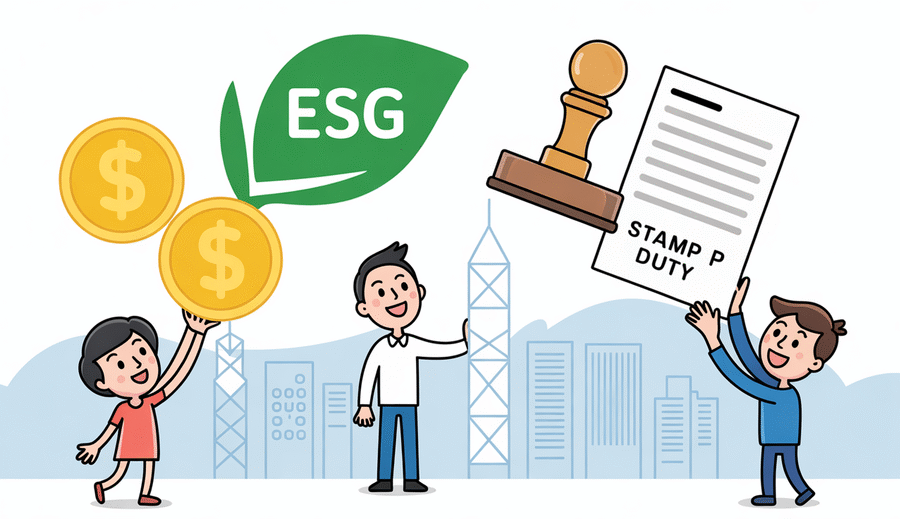
📋 Key Facts at a Glance
- Stock Stamp Duty: 0.2% total (0.1% buyer + 0.1% seller) since November 17, 2023
- ETF Exemption: All Hong Kong-listed ETFs have been fully exempt from stamp duty since February 13, 2015
- ESG Market Growth: 90% of global family offices now integrate ESG strategies into their portfolios
- Green Bond Leadership: Hong Kong has issued over HK$220 billion in government green bonds as of 2024
- Family Office Tax Concession: 0% profits tax for qualifying Family Investment Holding Vehicles (FIHV)
- Climate Disclosure: Mandatory climate-related disclosures aligned with IFRS S2 effective from January 1, 2025
Did you know that choosing the right investment structure for your ESG portfolio could save you thousands in Hong Kong stamp duty alone? As sustainable investing continues its explosive growth, savvy investors are discovering that smart tax planning can significantly enhance both their environmental impact and financial returns. Hong Kong’s unique combination of stamp duty exemptions, green finance incentives, and family office tax concessions creates powerful opportunities for ESG-focused investors.
Hong Kong’s ESG Investment Landscape: A Regional Powerhouse
Hong Kong has firmly established itself as Asia’s premier sustainable finance hub, attracting both institutional and individual investors seeking to align their portfolios with environmental, social, and governance principles. The city’s strategic position as a gateway to mainland China’s multi-trillion-dollar green investment opportunities, combined with its robust regulatory framework and government support, has created a thriving ecosystem for ESG-focused capital.
Market Growth and Family Office Adoption
The ESG investment landscape in Hong Kong has experienced remarkable growth, driven by several key trends:
- Family Office Leadership: 90% of family offices worldwide now integrate ESG strategies into their investment decisions
- Significant Allocations: Nearly 20% of family offices allocate at least half of their assets to sustainable investments
- Regional Priority: Asia-Pacific leads as the most attractive region for ESG allocations, with 42% of family offices prioritizing the area
- Fund Registration Surge: The Securities and Futures Commission (SFC) reported a 35% increase in ESG fund registrations in 2024
- ETF Expansion: Asia-Pacific ESG ETFs are growing by 10% annually and expected to reach USD 50 billion in 2025
Understanding Hong Kong Stamp Duty: The Basics
Stamp duty represents one of the most significant transaction costs for Hong Kong investors, making it crucial to understand how it applies to different investment vehicles, particularly in the ESG space.
Current Stamp Duty Framework
| Transaction Type | Stamp Duty Rate | Buyer Share | Seller Share |
|---|---|---|---|
| Hong Kong Stock Transfer | 0.2% of consideration/market value | 0.1% | 0.1% |
| ETF Transfers (all types) | Exempt | 0% | 0% |
| Tokenized ETFs | Exempt | 0% | 0% |
| Cash-Settled Derivatives | Exempt | 0% | 0% |
Additional Transaction Costs on HKEX
Beyond stamp duty, investors should be aware of other transaction fees on the Hong Kong Exchange:
- SFC Transaction Levy: 0.0027% per side
- Exchange Fee: 0.005% per side
- Settlement Fee: 0.002% per side
Stamp duty typically comprises approximately 90% of all official transaction fees on the HKEX, making the ETF exemption particularly significant for cost-conscious ESG investors.
Stamp Duty Treatment for ESG Investment Vehicles
ESG-Focused ETFs: The Complete Stamp Duty Exemption
Since February 13, 2015, all Hong Kong-listed ETFs have enjoyed full exemption from stamp duty, regardless of their investment focus. This comprehensive exemption represents a significant advantage for ESG investors and applies to:
- ESG-themed ETFs: Funds tracking environmental, social, and governance indices
- Green bond ETFs: ETFs investing in green or sustainable bonds
- Thematic sustainable ETFs: Clean energy, renewable resources, carbon reduction strategies
- Leveraged and inverse products: All derivative ETF structures included in the exemption
- Tokenized ETFs: Digital asset-based ETFs also benefit from the exemption
Non-ETF ESG Funds: Standard Stamp Duty Applies
ESG-focused mutual funds, unit trusts, and other pooled investment vehicles that are not structured as ETFs remain subject to standard stamp duty when trading Hong Kong stocks within their portfolios:
| Fund Structure | Stamp Duty Treatment | Effective Rate | Impact on Investors |
|---|---|---|---|
| ESG ETF (Exchange-Listed) | Exempt | 0% | No direct stamp duty cost |
| ESG Mutual Fund (Non-ETF) | Subject to stamp duty on stock trades | 0.2% per transaction | Indirect cost via fund expenses |
| ESG Unit Trust | Subject to stamp duty on stock trades | 0.2% per transaction | Indirect cost via fund expenses |
| Direct Stock Holdings (ESG Screened) | Subject to stamp duty | 0.2% per transaction | Direct cost to investor |
ESG Bonds and Green Bonds: Stamp Duty-Free Opportunities
Hong Kong has positioned itself as a global leader in green and sustainable bond issuance, offering unique stamp duty advantages:
- Government Green Bond Programme: Over HK$220 billion equivalent issued as of 2024, with programme scope expanded to HK$200 billion in July 2021
- Multi-Currency Options: Tranches issued in HKD, RMB, USD, and EUR targeting both institutional and retail investors
- Stamp Duty Treatment: Government bonds (including green bonds) are generally not subject to stamp duty as they do not constitute “Hong Kong stock” under the Stamp Duty Ordinance
- Tokenized Green Bonds: Hong Kong has pioneered digital bond innovation with HK$800 million issued in February 2023 and HK$6 billion multi-currency digital bond in February 2024
Government Incentives and Tax Concessions for ESG Investors
Family Investment Holding Vehicle (FIHV) Regime
Hong Kong’s FIHV regime offers powerful tax incentives for family offices engaged in ESG investing:
| Feature | Details | ESG Impact |
|---|---|---|
| Tax Rate | 0% profits tax on qualifying income | Enhances returns on sustainable investments |
| Minimum AUM | HK$240 million | Targets substantial sustainable capital |
| Substantial Activities | Required in Hong Kong | Builds local ESG expertise and employment |
| Qualifying Transactions | Specified transactions including ESG investments | Directly supports sustainable finance |
Green and Sustainable Finance Grant Scheme
Launched in May 2021 and extended through 2027, this scheme provides financial support for sustainable finance participants:
| Eligible Expense Category | Subsidy Coverage | Eligible Products |
|---|---|---|
| Bond Issuance Expenses | Partial subsidy for qualifying costs | Green bonds, sustainable bonds, transition bonds |
| External Review Services | Partial subsidy for verification and certification | All eligible bond types and loans |
| Loan Arrangement Costs | Partial subsidy for eligible expenses | Green loans, sustainable loans, transition loans |
Practical Tax Planning Strategies for ESG Investors
- Optimize Investment Structure Selection: Favor ETF structures for Hong Kong stock exposure. For a HK$1,000,000 investment, direct stock purchase incurs HK$2,000 stamp duty (0.2%), while ESG ETFs are completely exempt. Over time, this creates significant cost advantages.
- Leverage Green Bond Opportunities: Consider allocating to Hong Kong government green bonds and corporate green bonds. Bond transfers are not subject to Hong Kong stamp duty, and corporate issuers may receive subsidies through the Green and Sustainable Finance Grant Scheme.
- Monitor Portfolio Turnover for Non-ETF Funds: When investing in ESG mutual funds or unit trusts, request turnover data. High turnover amplifies stamp duty costs absorbed by the fund. Consider passive ESG strategies which typically have lower turnover and thus lower stamp duty impact.
- Utilize Family Office Tax Concessions: For high-net-worth investors, ensure family investment management entities meet FIHV eligibility criteria. The 0% profits tax rate on qualifying transactions can significantly enhance returns on ESG investments.
- Take Advantage of Grant Schemes: Institutional and sophisticated investors should investigate available subsidies before proceeding with green bond issuance or sustainable loan arrangements. The Green and Sustainable Finance Grant Scheme can materially improve the economics of issuance.
Case Study: HK$10 Million ESG Portfolio Optimization
Consider a high-net-worth individual seeking to invest HK$10 million in Hong Kong ESG-focused equities with a 5-year holding period and 20% annual turnover:
| Option | 5-Year Total Cost | Savings vs. Direct Stocks | Key Advantage |
|---|---|---|---|
| Direct Stocks (ESG Screened) | ~HK$45,000 | — | Direct control |
| ESG Mutual Fund | ~HK$750,000+ | -HK$705,000 | Professional management |
| ESG ETF Portfolio | ~HK$252,000 | -HK$207,000 | Stamp duty exemption + diversification |
The ESG ETF option provides the optimal combination of stamp duty efficiency (saving HK$40,000 in stamp duty alone), diversification, professional management, and cost-effectiveness. Over 5 years, total savings versus mutual funds exceed HK$500,000 on a HK$10 million portfolio.
Regulatory Framework and Compliance Considerations
HKEX Climate Disclosure Requirements (Effective 2025)
| Effective Date | Issuer Category | Disclosure Requirements |
|---|---|---|
| 1 January 2025 | All Listed Companies | Comply or explain basis for climate disclosures |
| Financial years from 1 January 2026 | LargeCap Issuers (Hang Seng Composite LargeCap Index) | Full mandatory disclosures aligned with IFRS S2 |
| From 2028 | Large Publicly Accountable Entities | Full sustainability reporting (IFRS S1 & S2) |
SFC Requirements for ESG Funds
The Securities and Futures Commission has established stringent disclosure requirements for funds marketing themselves with an ESG focus, effective August 2021:
- ESG Focus Definition: Clear articulation of the fund’s environmental, social, and governance objectives
- ESG Investment Strategy: Detailed methodology for selecting and weighting ESG investments
- Expected Proportion: Disclosure of the expected percentage of portfolio allocated to ESG investments
- Annual Assessment: Periodic evaluation (at least annually) of how the fund has achieved its ESG focus
- Climate Risk Integration: For fund managers of collective investment schemes, mandatory integration of climate considerations into investment decision-making
Common Pitfalls and How to Avoid Them
Pitfall 1: Assuming All ESG Funds Are Stamp Duty Exempt
The Mistake: Investors may assume that because a fund has an “ESG” label, it automatically benefits from stamp duty exemption.
The Reality: Only ETF-structured ESG funds are exempt from stamp duty. ESG mutual funds and unit trusts still incur stamp duty on their Hong Kong stock trades, indirectly impacting investor returns.
How to Avoid: Always verify the fund structure (ETF vs. mutual fund/unit trust) and review the fund’s total expense ratio to understand all embedded costs, including stamp duty impact.
Pitfall 2: Ignoring Indirect Stamp Duty Costs in Fund Selection
The Mistake: Focusing solely on management fees while overlooking trading costs embedded in fund expenses.
The Reality: A non-ETF ESG fund with 100% annual turnover incurs 0.2% in stamp duty costs (absorbed by the fund), effectively adding 20 basis points to the fund’s expense ratio. Over 10 years, this compounds significantly.
How to Avoid: Request portfolio turnover data and transaction cost analysis from fund managers. Compare total cost of ownership across ETF and non-ETF ESG options.
Pitfall 3: Failing to Leverage Government Grant Schemes
The Mistake: Institutional investors and corporations proceeding with green bond issuance or sustainable loan arrangements without investigating available subsidies.
The Reality: The Green and Sustainable Finance Grant Scheme (extended through 2027) provides meaningful subsidies for bond issuance expenses and external review services, directly reducing the cost of green finance.
How to Avoid: Engage with qualified advisors familiar with Hong Kong’s grant schemes before structuring green finance transactions. The subsidy can materially improve the economics of issuance.
✅ Key Takeaways
- ETF Structure Optimization: ESG investors can eliminate stamp duty entirely by utilizing ETF-structured products, which have been fully exempt since 2015. This applies to all Hong Kong-listed ETFs regardless of investment focus.
- Stamp Duty Represents Significant Costs: At 0.2% per transaction, stamp duty on direct stock purchases and non-ETF fund trades materially impacts long-term returns. ETF structures can save thousands annually per million invested.
- Government Support is Substantial: Hong Kong offers comprehensive incentives including the Green and Sustainable Finance Grant Scheme (extended through 2027), 0% profits tax for qualifying family offices (FIHV regime), and HK$220+ billion in government green bonds.
- Regulatory Framework is Robust: Mandatory climate disclosure aligned with IFRS S2 became effective January 1, 2025, with full sustainability reporting planned for large entities from 2028.
- Strategic Planning Delivers Value: Combining ETF stamp duty exemption with government grant schemes and family office tax concessions creates powerful tax efficiency for ESG investors.
- Professional Guidance is Essential: The complexity of stamp duty planning, ESG disclosure requirements, and grant scheme eligibility makes professional tax and investment advice valuable for optimizing outcomes.

 English
  Chinese