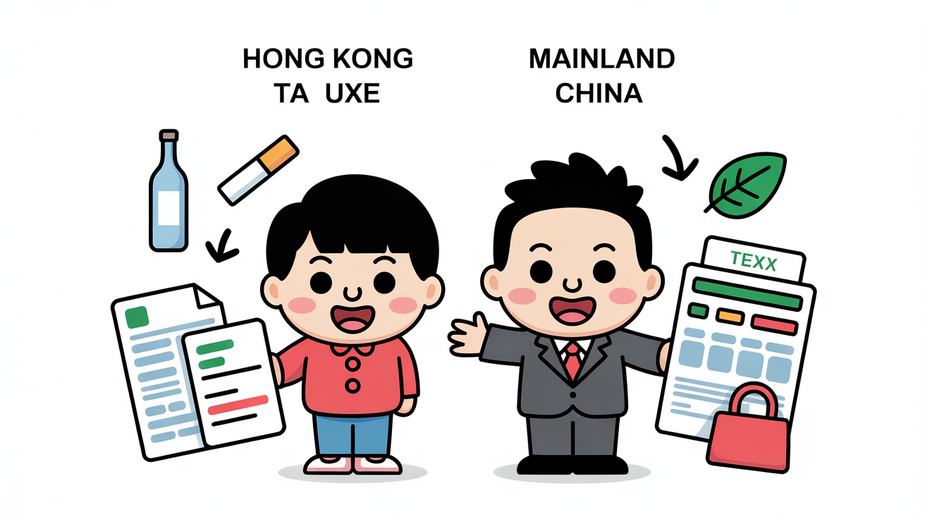
Key Differences Between Hong Kong and Mainland China’s Excise Duty Policies
📋 Key Facts at a Glance
- Hong Kong’s Free Port Status: Maintains minimal excise duties covering only 4 categories – alcohol (above 30%), tobacco, hydrocarbon oils, and methyl alcohol
- Mainland China’s Comprehensive System: Implements broad consumption tax covering 15+ categories including luxury goods, vehicles, cosmetics, and environmentally harmful products
- Tax Rate Philosophy: Hong Kong uses simple fixed rates; Mainland rates range from 1% to 56% depending on product category and policy objectives
- CEPA Advantage: Hong Kong-manufactured goods meeting origin rules qualify for zero-tariff treatment when exported to Mainland China
- Policy Direction: Hong Kong prioritizes free trade; Mainland focuses on revenue, consumption regulation, and environmental protection
Did you know that a luxury watch imported into Hong Kong faces zero excise duty, while the same watch entering Mainland China could be taxed up to 20%? This stark contrast highlights the fundamental differences between Hong Kong’s free port philosophy and Mainland China’s comprehensive consumption tax system. For businesses navigating cross-border trade between these two economic powerhouses, understanding these divergent tax approaches isn’t just academic—it’s essential for strategic planning, cost optimization, and competitive advantage. This guide breaks down both systems, their 2024-2025 updates, and practical implications for your business.
Hong Kong’s Minimalist Excise Duty System
Hong Kong proudly maintains its status as a free port, with one of the world’s most streamlined excise duty systems. Unlike most jurisdictions that use excise taxes for revenue generation and social engineering, Hong Kong’s approach is deliberately minimalist—covering only four specific commodity categories. This reflects the city’s commitment to facilitating international trade and maintaining its competitive edge as Asia’s premier trading hub.
Legal Framework and Administration
The foundation of Hong Kong’s excise duty system is the Dutiable Commodities Ordinance (Chapter 109), administered by the Hong Kong Customs and Excise Department. This comprehensive legislation defines what constitutes dutiable goods, sets tax rates, outlines licensing requirements, and establishes enforcement procedures. The system is designed to be transparent, predictable, and business-friendly—key factors in Hong Kong’s continued success as a global trade center.
Current Dutiable Commodities and Rates (2024-2025)
Hong Kong’s excise duty system covers just four categories, with rates that have remained remarkably stable over the years:
| Commodity | Duty Rate | Key Notes |
|---|---|---|
| Liquor (Spirits) | 100% of value | Applies only to beverages with alcohol content above 30% by volume. Wine and beer (below 30%) have been duty-free since February 2008. |
| Cigarettes | HK$2,506 per 1,000 sticks | All tobacco products are heavily taxed primarily for public health reasons |
| Cigars | HK$3,228 per kg | Weight-based duty calculation |
| Chinese-prepared Tobacco | HK$615 per kg | Lower rate for traditional tobacco preparations |
| Diesel (Light & Ultra-low Sulphur) | HK$2.89 per litre | Environmental and transport considerations |
| Unleaded Gasoline | HK$6.82 per litre | Fixed rate per volume (approx. US$0.87 per litre) |
| Methyl Alcohol | HK$840 per hectolitre + HK$28.10 per hectolitre for each 1% above 30% alcohol strength | Measured at 20 degrees Celsius |
Recent Policy Updates and Stability
- Trade Classification Updates (2024-2025): Regular updates to commodity classifications covering various product categories, though the core four excise duty categories remain unchanged
- Digital Goods Adaptation: Ongoing refinement of classifications for digital goods and e-commerce imports to reflect evolving global trade patterns
- Policy Stability: No significant changes to excise duty rates or categories, maintaining Hong Kong’s predictable tax environment that businesses value
Mainland China’s Comprehensive Consumption Tax System
In stark contrast to Hong Kong’s minimalist approach, Mainland China employs a sophisticated consumption tax (xiaofei shui) system that serves multiple policy objectives simultaneously. This isn’t just about revenue generation—it’s an active policy tool for regulating luxury consumption, protecting the environment, internalizing social costs, and guiding consumer behavior. The consumption tax is levied in addition to Value Added Tax (VAT) on specified categories of goods, creating a multi-layered taxation approach.
Tax Scope and Policy Objectives
China’s consumption tax applies to 15+ categories of selected goods deemed as luxury items, environmentally harmful products, or those generating significant social costs. The system is designed to:
- Generate substantial government revenue from high-value transactions
- Regulate consumption of luxury and non-essential goods
- Promote environmental protection through taxation of polluting products
- Internalize social costs associated with certain products (like tobacco and alcohol)
- Support China’s dual-carbon strategy (carbon peak before 2030, carbon neutrality before 2060)
Major Product Categories and Tax Rates (2024-2025)
| Product Category | Tax Rate Range | Calculation Method |
|---|---|---|
| Tobacco Products | 36% – 56% | Compound (ad valorem + specific) |
| Alcoholic Beverages | 5% – 20% | Ad valorem or specific, varies by type |
| High-end Cosmetics | 15% – 30% | Ad valorem |
| Jewelry and Precious Stones | 5% – 10% | Ad valorem |
| Passenger Vehicles | 1% – 40% | Based on engine displacement |
| Super-Luxury Vehicles | Additional retail stage tax | Price-based assessment |
| Motorcycles | 3% – 10% | Based on engine displacement |
| Gasoline and Diesel | Specific rates | Per unit volume |
| Yachts | 10% – 20% | Ad valorem |
| Luxury Watches | 20% | Ad valorem |
| Disposable Chopsticks | 5% | Environmental protection measure |
| Batteries and Coatings | 4% | Environmental protection measure |
CEPA: The Bridge Between Two Systems
The Mainland and Hong Kong Closer Economic Partnership Arrangement (CEPA), signed in 2003, creates a unique bridge between these two divergent tax systems. CEPA is a comprehensive free trade agreement that provides preferential access for Hong Kong products, companies, and residents to the Mainland Chinese market—including significant tax benefits.
Zero-Tariff Benefits and Economic Impact
Since CEPA’s implementation, all products manufactured in Hong Kong that meet CEPA’s rules of origin can enjoy zero-tariff treatment when exported to Mainland China. The economic impact has been substantial:
- Cumulative customs duty concessions under CEPA exceeded RMB 10.2 billion (approximately US$1.39 billion) by the end of 2024
- Total trade in goods between Mainland and Hong Kong exceeded HK$4.8 trillion (approximately US$613.92 billion) in 2024
- Zero-tariff treatment applies even to goods that would normally fall under Mainland China’s consumption tax categories when origin requirements are met
2024-2025 CEPA Enhancements
Recent CEPA developments continue to strengthen economic integration:
- Services Market Opening: Further reductions or elimination of entry thresholds for Hong Kong service providers across multiple sectors
- Greater Bay Area Innovations: “Hong Kong Capital, Hong Kong Law” and “Hong Kong Capital, Hong Kong Arbitration” arrangements in GBA pilot cities
- Cross-Border E-Commerce: New provisions facilitating digital trade and online retail between the two jurisdictions
- Professional Services: Enhanced market access for Hong Kong professionals and businesses in Mainland China
Comparative Analysis: Key Differences
| Aspect | Hong Kong | Mainland China |
|---|---|---|
| Tax Scope | Narrow – 4 categories only | Broad – 15+ categories |
| Policy Objective | Revenue (minimal), public health (tobacco) | Revenue, consumption regulation, environmental protection, social cost internalization |
| Tax Rates | Simple, fixed rates | Complex, ranging 1%-56% |
| Luxury Goods | No luxury goods tax | Comprehensive luxury taxation (15%-30% on cosmetics, jewelry, watches, etc.) |
| Vehicles | No excise duty on vehicles | 1%-40% based on displacement, plus super-luxury vehicle tax |
| Environmental Focus | Limited to fuel excise duties | Comprehensive Environmental Protection Tax plus consumption tax on harmful products |
| Wine and Beer | Zero duty since 2008 | Subject to consumption tax (5%-20%) |
| Policy Stability | Very stable, minimal changes | Active reform, frequent adjustments |
Practical Business Implications
For Exporters from Hong Kong to Mainland China
- Invest in CEPA Certification: Obtain proper CEPA origin certification to benefit from zero-tariff treatment—this can eliminate customs duties even for goods that would normally face consumption tax
- Strategic Manufacturing Location: Consider establishing qualifying manufacturing operations in Hong Kong to meet CEPA origin requirements and access zero-tariff benefits
- Understand Dual Taxation: Remember that while customs duties may be zero under CEPA, Mainland consumption tax still applies at import or production stage for covered categories
- Luxury Goods Planning: Be aware that luxury goods (cosmetics, jewelry, watches) will still face 15%-30% consumption tax even with zero customs duty under CEPA
For Importers into Hong Kong
- Leverage Tax-Free Environment: Most luxury goods, vehicles, and consumer products are duty-free in Hong Kong—a significant advantage over Mainland China
- Beverage Distribution Hub: Hong Kong’s zero duty on wine, beer, and spirits below 30% alcohol makes it ideal for beverage companies targeting Asian markets
- Re-export Opportunities: Use Hong Kong as a low-tax entrepôt for re-export to regional markets, minimizing tax exposure
- Compliance Focus: Ensure proper licensing and duty payment for the four dutiable commodities (alcohol above 30%, tobacco, hydrocarbon oils, methyl alcohol)
For Cross-Border Traders and Distributors
- Dual-System Tax Planning: Develop strategies that account for both Hong Kong’s minimal excise regime and Mainland’s comprehensive consumption tax
- Supply Chain Optimization: Analyze whether to use Hong Kong as a distribution hub or import directly into Mainland China based on total tax costs
- Vehicle Import Strategy: Hong Kong has no vehicle excise duty, while Mainland imposes 1%-40% consumption tax—a massive differential for automotive businesses
- Environmental Compliance: For batteries, coatings, and high-emission products, factor in Mainland’s environmental taxes that don’t exist in Hong Kong
✅ Key Takeaways
- Philosophical Divide: Hong Kong operates as a free port with minimal excise intervention (4 categories only), while Mainland China uses consumption tax as an active policy tool covering 15+ categories for revenue, regulation, and environmental protection
- Dramatic Tax Differentials: Businesses face vastly different tax treatments—Hong Kong imposes zero duty on luxury goods and vehicles, while Mainland rates range from 1% to 56% depending on product category
- CEPA Creates Competitive Advantage: Hong Kong-origin goods meeting CEPA requirements enjoy zero customs duty when exported to Mainland China, with cumulative duty savings exceeding RMB 10.2 billion
- Strategic Planning Imperative: Cross-border businesses must develop sophisticated strategies accounting for both systems, CEPA requirements, and supply chain optimization to minimize total tax costs
- Beverage Industry Advantage: Hong Kong’s zero duty on wine, beer, and spirits below 30% alcohol (since 2008) versus Mainland’s 5%-20% consumption tax creates significant opportunities for using Hong Kong as a regional beverage hub
- Retail Competitiveness: The absence of luxury goods taxation in Hong Kong makes it highly competitive for premium cosmetics, jewelry, watches, and vehicles, attracting both tourists and cross-border shoppers
- Environmental Tax Gap: Mainland China has implemented comprehensive environmental protection taxes aligned with dual-carbon goals, while Hong Kong’s environmental taxation remains limited to fuel excise duties
Navigating the tax landscapes of Hong Kong and Mainland China requires more than just understanding different rates—it demands strategic thinking about how these divergent systems interact, especially through frameworks like CEPA. For businesses operating across this border, the choice isn’t simply between two tax regimes, but between two fundamentally different economic philosophies: Hong Kong’s free port minimalism versus Mainland China’s comprehensive policy-driven approach. The most successful businesses will be those that don’t just comply with both systems, but strategically leverage their differences to create competitive advantages, optimize supply chains, and maximize profitability in both markets.
📚 Sources & References
This article has been fact-checked against official Hong Kong government sources and authoritative references:
- Inland Revenue Department (IRD) – Official tax rates, allowances, and regulations
- Rating and Valuation Department (RVD) – Property rates and valuations
- GovHK – Official Hong Kong Government portal
- Legislative Council – Tax legislation and amendments
- Hong Kong Customs and Excise Department – Dutiable commodities and excise duty rates
- Trade and Industry Department – CEPA regulations and trade agreements
- GovHK News – Official government announcements and policy updates
Last verified: December 2024 | Information is for general guidance only. Consult a qualified tax professional for specific advice.