
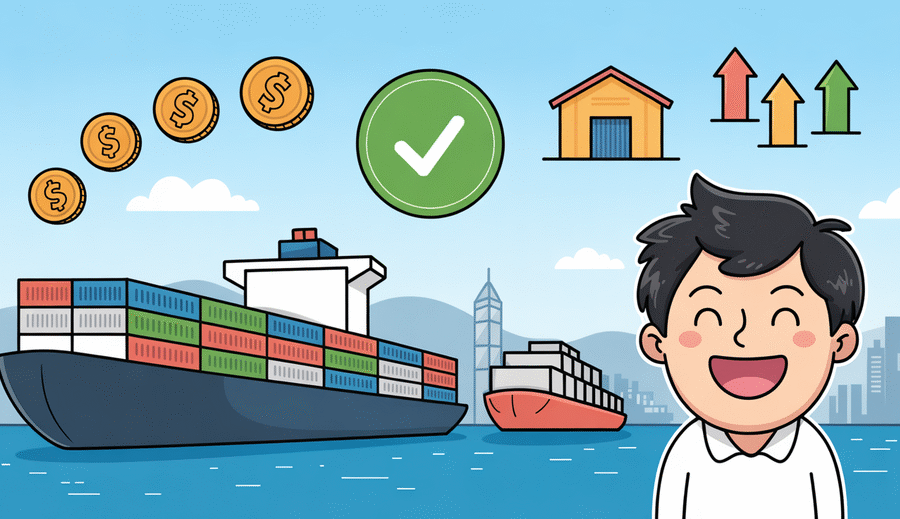
Key Facts: Hong Kong’s Free Port Status
- Zero tariffs on 99% of imported goods – all 7,805 tariff lines have applied rates of zero
- Only 4 dutiable categories: Liquor (>30% alcohol), tobacco, hydrocarbon oil, and methyl alcohol
- No VAT or GST – No value-added tax or goods and services tax on imports/exports
- Legal framework: Guaranteed by Article 116 of the Basic Law and WTO membership since 1995
- Separate customs territory under “One Country, Two Systems” framework
- Strategic location: Gateway to China’s 1.4 billion consumer market with 100 airlines serving 220 destinations
How to Leverage Hong Kong’s Free Port Status for Cost-Efficient Imports
Hong Kong’s free port status represents one of the world’s most liberal trade regimes, offering unparalleled advantages for businesses seeking cost-efficient import strategies. This comprehensive guide explains how to maximize these benefits for your international trade operations.
Understanding Hong Kong’s Free Port Framework
Legal Foundation and Current Status (2025)
Hong Kong’s status as a free port is enshrined in Article 116 of the Basic Law, the city’s mini-constitution, which explicitly states that “The Hong Kong Special Administrative Region shall be a separate customs territory” and “shall not impose any tariff unless otherwise prescribed by law.” This constitutional guarantee is reinforced by Hong Kong’s independent membership in the World Trade Organization (WTO) since 1995, building on its GATT membership from 1986.
As of 2025, Hong Kong’s government continues to affirm this commitment. Financial Secretary Paul Chan emphasized that Hong Kong’s status as an autonomous customs territory under the Basic Law and its independent WTO membership remain critical pillars of the region’s global competitiveness. Despite global tariff tensions, Hong Kong maintains its position: “The HKSAR currently does not impose, nor does it have any plans to impose, special port fees on vessels owned or operated by individual countries or regions.”
The Zero-Tariff Regime: What It Means for Importers
Hong Kong operates with zero customs tariffs on all 7,805 tariff lines, meaning virtually every category of goods enters duty-free. This creates several immediate advantages:
- No import duties: Goods can be imported without paying customs duties on entry
- No tariff quotas: No restrictions on the quantity of duty-free imports
- No surcharges: No additional fees or special assessments on imports
- No VAT/GST: No value-added tax or goods and services tax system
- Simplified documentation: Streamlined customs procedures without duty calculation requirements
The Four Dutiable Categories: Exceptions You Must Know
While Hong Kong is duty-free for 99% of goods, excise duties apply to four specific categories, regardless of whether they are imported or locally manufactured:
| Dutiable Commodity | Duty Rate Structure | Key Details |
|---|---|---|
| Liquor/Alcohol |
|
Wine and beer have been duty-free since February 27, 2008. Duties assessed based on alcoholic strength and value. |
| Tobacco | Specific rates per unit quantity (heavily taxed) | All tobacco products heavily taxed regardless of quantity or purpose. Cigarettes longer than 90mm count as multiple sticks. |
| Hydrocarbon Oil | Specific rates per liter (e.g., US$0.78/liter for unleaded gasoline) | Charged at specific rates per unit quantity. |
| Methyl Alcohol | HK$840 per hectolitre + HK$28.10 per hectolitre for every 1% above 30% strength | Duty calculated based on volume at 20°C and alcoholic strength. |
Strategic Advantages for Importers and Exporters
Hong Kong’s Role in the Global Trade Ecosystem
In 2025, Hong Kong continues to serve as a vital “accelerator” in international trade, particularly for companies accessing Asian markets. Recent data demonstrates this strategic importance:
- Growing re-export hub: Hong Kong’s re-exports to mainland China grew by 16.6% year-on-year in the first eight months of 2025, outpacing the 15.9% growth in 2024
- China trade gateway: Trade between mainland China and Hong Kong reached US$261.56 billion in the first three quarters of 2025
- Import surge: Imports from Hong Kong to the mainland soared by 86.6% year-on-year, while exports from mainland to Hong Kong rose by 12.6%
- Re-export growth: From 1995 to 2016, the value of Hong Kong re-exports increased by 217.7%, establishing it as a major re-export hub in East Asia
Eight Key Strategic Advantages
| Advantage | Benefit for Your Business |
|---|---|
| 1. Zero Import Costs | Eliminate tariff expenses on 99% of goods, reducing landed costs and improving profit margins immediately. |
| 2. Enhanced Cash Flow | No upfront duty payments means working capital stays in your business for operations and growth. |
| 3. Simplified Customs | Streamlined procedures without complex duty calculations, classifications, or tariff code disputes. |
| 4. Price Competitiveness | Lower total landed costs enable more competitive pricing in regional markets. |
| 5. Strategic Positioning | Access to 1.4 billion consumers in mainland China plus 100 airlines serving 220 global destinations. |
| 6. Duty Deferral Options | Use bonded warehouses to defer duties until goods move to final destination or avoid duties on re-exports entirely. |
| 7. FTA Network Access | Leverage Hong Kong’s expanding FTA network (CEPA, ASEAN, UK, Australia, New Zealand) for preferential access. |
| 8. Tariff Barrier Bypass | Certain high-end products can enter mainland China via Hong Kong, potentially circumventing trade barriers or tariff restrictions. |
Maximizing Bonded Warehouse Benefits
What Are Bonded Warehouses?
Bonded warehouses in Hong Kong are secure facilities where imported goods can be stored, processed, or assembled without immediate payment of customs duties. Combined with Hong Kong’s free port status, they create powerful opportunities for tax optimization and supply chain flexibility.
Five Strategic Applications of Bonded Warehousing
1. Duty Deferral for Mainland China Imports
Strategy: Store goods in Hong Kong bonded warehouse before moving to mainland China.
Benefit: Defer import duties and taxes until goods actually enter the mainland market, improving cash flow management. Duties are only payable upon final import, not upon arrival in Hong Kong.
Best for: Companies managing large shipments to China who want to stage inventory near the border.
2. Duty-Free Re-Exports
Strategy: Import goods to Hong Kong bonded warehouse, then re-export to third countries.
Benefit: Pay zero duties on goods that never enter the local market. Ideal for regional distribution hubs and transshipment operations.
Best for: Trading companies, regional distributors, and logistics providers managing multi-country supply chains.
3. Market Demand Flexibility
Strategy: Store inventory in bonded warehouse and dispatch based on real-time market demand.
Benefit: Respond quickly to market changes, reduce inventory risk, and optimize working capital by only paying duties when goods are sold.
Best for: Fashion, electronics, and seasonal goods where demand fluctuates.
4. Value-Added Processing
Strategy: Perform assembly, labeling, packaging, or quality control in bonded warehouse before final export.
Benefit: Add value to products without triggering duty payments until final destination, plus simplified customs procedures.
Best for: Manufacturers and distributors who need to customize products for different markets.
5. Strategic Inventory Positioning
Strategy: Use Hong Kong as a forward-deployed inventory location for Southern China production facilities.
Benefit: Faster order fulfillment, lower shipping costs, and proximity to major manufacturing bases. Hong Kong’s logistics ecosystem often provides more competitive rates than international alternatives.
Best for: Companies with production in the Pearl River Delta region.
Bonded Warehouse vs. Standard Import: Cost Comparison
| Factor | Bonded Warehouse Route | Direct Import to Mainland |
|---|---|---|
| Upfront Duty Payment | Deferred until mainland import | Required immediately |
| Cash Flow Impact | Minimal – duties paid only when sold | High – capital tied up in duties |
| Re-export Flexibility | Zero duties on re-exported goods | Duty refund procedures required |
| Customs Procedures | Simplified Hong Kong + mainland clearance | Complex mainland customs requirements |
| Inventory Flexibility | High – can redirect to other markets | Low – committed to mainland market |
| Storage Costs | Bonded warehouse fees apply | Mainland warehouse costs |
| Best Use Case | Multi-market distribution, uncertain demand, re-export operations | High-volume, committed mainland sales |
Step-by-Step Strategies for Cost-Efficient Importing
Strategy 1: Leveraging Hong Kong for Regional Distribution
Objective: Use Hong Kong as a duty-free hub to serve multiple Asian markets efficiently.
- Import to Hong Kong: Bring goods into Hong Kong duty-free (assuming not one of the four dutiable categories).
- Store in bonded warehouse: Keep inventory centralized in Hong Kong bonded facility.
- Monitor market demand: Track real-time demand across different Asian markets.
- Dispatch as needed: Ship to final destinations based on confirmed orders.
- Pay duties only at destination: Only incur import duties when goods enter each specific market, not upfront in Hong Kong.
- Re-export duty-free: If goods go to another country from Hong Kong, no duties are paid in Hong Kong.
Case Example: Electronics Distributor
A European electronics manufacturer uses Hong Kong to serve Southeast Asia. They import 10,000 smartphones to Hong Kong (zero duty), store them in a bonded warehouse, and dispatch orders to Singapore (2,000 units), Thailand (3,000 units), Malaysia (2,500 units), and Vietnam (2,500 units) as orders arrive.
Result: No upfront duty costs in Hong Kong, improved cash flow, faster delivery times (goods pre-positioned in region), and ability to redirect inventory if one market slows down.
Strategy 2: Using Hong Kong as a Gateway to Mainland China
Objective: Minimize upfront costs and maximize flexibility when importing to mainland China.
- Ship to Hong Kong first: Import goods to Hong Kong with zero tariffs and no VAT.
- Use bonded warehouse: Store in Hong Kong bonded facility near the mainland border.
- Defer mainland duties: Delay payment of Chinese import duties and VAT until goods actually cross the border.
- Clear only what you need: Move goods to mainland incrementally based on sales, not in bulk shipments.
- Test market before commitment: Can redirect unsold goods to other markets without paying Chinese duties.
- Leverage CEPA benefits: For qualifying Hong Kong-origin goods, access zero-tariff treatment under the Closer Economic Partnership Arrangement.
Case Example: Fashion Retailer
An Italian luxury fashion brand uses Hong Kong to test the Chinese market. They import a new collection (valued at US$500,000) to a Hong Kong bonded warehouse. Over three months, they move 60% of inventory to mainland retail stores as sales materialize, paying Chinese duties only on those goods (approximately US$300,000 worth).
Result: The remaining 40% that didn’t sell well is re-exported to other Asian markets duty-free, avoiding US$80,000+ in Chinese import duties and VAT on unsold inventory. Cash flow improved by deferring duty payments.
Strategy 3: Re-Export Trading Operations
Objective: Operate as a trading intermediary, buying and selling internationally without duty costs.
- Import to Hong Kong: Purchase goods from suppliers and import to Hong Kong (zero duty).
- Store in bonded warehouse: Keep goods in bonded facility while finding buyers.
- Add value if desired: Perform quality checks, relabeling, repackaging, or minor assembly.
- Sell to international buyers: Market goods to customers in other countries.
- Re-export duty-free: Ship directly from Hong Kong to final destination without paying any Hong Kong duties.
- Maintain competitive margins: Zero duty costs in Hong Kong increase profit margins on each transaction.
Case Example: Medical Equipment Trader
A trading company sources medical equipment from Germany and South Korea for hospitals across Southeast Asia. They import all equipment to Hong Kong (zero duty), store it temporarily, perform quality inspections and certification documentation, then re-export to Philippines, Indonesia, and Bangladesh based on purchase orders.
Result: Zero import/export duties in Hong Kong enable 15-20% lower prices versus competitors who face duty costs. The company’s re-export value grew from US$2 million to US$8.5 million over three years.
Strategy 4: Leveraging Hong Kong’s FTA Network
Objective: Access preferential tariff treatment in FTA partner countries through Hong Kong operations.
Hong Kong has established Free Trade Agreements with multiple economies, providing additional tariff advantages:
- Mainland China (CEPA): Enhanced provisions for cross-border e-commerce and zero-tariff treatment for Hong Kong-origin goods
- ASEAN: Upgraded FTA with improved market access for digital services
- United Kingdom: New FTA as of 2025
- Australia: Expanded agreement focusing on green technology imports
- New Zealand: Comprehensive trade agreement
Implementation Steps:
- Determine origin qualification: Check if your goods can qualify as “Hong Kong origin” under FTA rules.
- Establish Hong Kong operations: Set up sufficient business presence to meet origin criteria (may require local processing, assembly, or substantial transformation).
- Obtain Certificate of Origin: Apply for Hong Kong Certificate of Origin from the Trade and Industry Department.
- Export with preferential tariffs: Ship to FTA partner countries and claim reduced or zero tariff rates.
- Maintain compliance: Keep documentation proving Hong Kong origin and meet FTA requirements.
Strategy 5: Consolidation and Value-Added Services
Objective: Consolidate shipments from multiple suppliers and add value in Hong Kong before final export.
- Source from multiple suppliers: Purchase components or products from various countries/regions.
- Import all to Hong Kong: Consolidate shipments in Hong Kong (zero duty on imports).
- Perform value-added services: Assembly, kitting, quality control, testing, labeling, packaging, or documentation.
- Create finished products: Combine components into finished goods for export.
- Export as single shipment: Ship consolidated orders to final customers duty-free from Hong Kong.
- Reduce logistics costs: Single consolidated shipment typically cheaper than multiple small shipments.
Case Example: Computer Assembly Operation
A technology company imports processors from Taiwan, memory from South Korea, displays from Japan, and cases from mainland China – all to Hong Kong duty-free. They perform final assembly, testing, and quality control in a Hong Kong facility, then export finished computers to Australia, New Zealand, and ASEAN countries.
Result: Zero import duties on components, zero export duties on finished computers, and ability to claim Hong Kong origin for FTA benefits in destination markets. Total duty savings: approximately US$850,000 annually versus direct assembly in non-FTA location.
Hong Kong’s 2025 Trade Performance and Outlook
Resilience Amid Global Trade Tensions
Despite heightened global tariff tensions, Hong Kong’s free port status continues to deliver strong performance in 2025:
- Double-digit growth: Hong Kong as a transshipment hub has recorded double-digit year-on-year growth in merchandise trade over recent months
- Record China trade: Trade between mainland China and Hong Kong reached US$261.56 billion in the first three quarters of 2025
- Import surge: Imports from Hong Kong to mainland soared 86.6% year-on-year
- Export growth: Mainland exports to Hong Kong rose 12.6%, outperforming 2024 growth rates
- Re-export acceleration: Re-exports to mainland grew 16.6% year-on-year in first eight months of 2025 (vs. 15.9% in 2024)
Strategic Positioning in Changing Trade Landscape
Hong Kong’s decision to maintain its zero-tariff environment while other jurisdictions impose retaliatory measures reflects a strategic choice to preserve its economic advantages. As Financial Secretary Paul Chan noted, geopolitical tensions and tariff wars are reshaping global trade patterns, but Hong Kong’s neutrality creates opportunities:
- Companies seeking to avoid tariff impacts can route through Hong Kong
- High-end products can access mainland China via Hong Kong, potentially bypassing trade barriers
- Hong Kong serves as a stable, predictable jurisdiction amid trade uncertainty
- The city’s separate customs territory status under “One Country, Two Systems” provides unique advantages
Practical Implementation Checklist
For First-Time Importers to Hong Kong
Step 1: Verify Your Products (1-2 days)
- Confirm your goods are NOT one of the four dutiable categories (liquor >30%, tobacco, hydrocarbon oil, methyl alcohol)
- If dutiable, obtain appropriate licenses from Hong Kong Customs and Excise Department
- Review any country-specific import restrictions or prohibitions
Step 2: Register Your Business (1-2 weeks)
- Register company with Hong Kong Companies Registry if establishing local presence
- Obtain Business Registration Certificate from Inland Revenue Department
- Consider whether you need bonded warehouse license for strategic operations
Step 3: Arrange Logistics and Warehousing (1-2 weeks)
- Select freight forwarder with Hong Kong expertise
- Choose bonded warehouse provider if using duty deferral strategy
- Establish customs broker relationship for documentation
- Set up inventory management systems
Step 4: Prepare Documentation (Ongoing)
- Commercial invoice showing value of goods
- Packing list with detailed contents
- Bill of lading or air waybill
- Certificate of origin (if claiming FTA benefits)
- Import/export declaration forms
- Any product-specific certifications or permits
Step 5: Import and Clear Customs (1-3 days)
- Submit import declaration to Hong Kong Customs
- Pay any applicable duties if goods are in dutiable categories
- Clear goods through customs (typically very fast for non-dutiable items)
- Transport to warehouse or bonded facility
Step 6: Optimize Your Supply Chain (Ongoing)
- Monitor inventory levels and market demand
- Evaluate re-export opportunities to other markets
- Review FTA opportunities for Hong Kong-origin goods
- Assess whether value-added processing in Hong Kong makes sense
- Continuously compare bonded warehouse vs. direct import costs
Common Pitfalls to Avoid
1. Assuming ALL goods are duty-free
Always verify your products are not in the four dutiable categories. Failure to obtain proper licenses for dutiable goods can result in penalties.
2. Neglecting origin documentation for FTA benefits
If you want to claim preferential tariffs under Hong Kong’s FTAs when exporting, you must properly document Hong Kong origin from the start.
3. Underestimating bonded warehouse requirements
Bonded warehouses have specific licensing, compliance, and operational requirements. Work with experienced providers.
4. Failing to plan for mainland China customs
While Hong Kong import is easy, moving goods to mainland China still requires proper documentation and duty payment planning.
5. Overlooking re-export documentation
Maintain clear records showing goods were imported to Hong Kong and re-exported to demonstrate no local consumption occurred.
Cost Savings Calculator: Hong Kong vs. Alternative Routes
| Scenario | Via Hong Kong Free Port | Direct to High-Tariff Market | Potential Savings |
|---|---|---|---|
| US$1M electronics to China Store in HK bonded, sell 70% to China, re-export 30% |
|
|
~$39,000 (30%) Plus better cash flow |
| US$500K machinery for Southeast Asia Regional distribution to 5 countries |
|
|
~$15,000 (30%) Freight consolidation savings |
| US$2M fashion goods Test Asian markets before committing |
|
|
$100,000+ in deferred/avoided duties Plus massive cash flow benefit |
Note: Actual savings depend on product category, destination countries, duty rates, and business model. Consult with customs specialists for precise calculations.
Key Takeaways
- Hong Kong’s free port status is constitutionally guaranteed by the Basic Law and WTO membership, providing long-term stability for trade planning.
- Zero tariffs apply to 99% of goods – only liquor above 30% alcohol, tobacco, hydrocarbon oil, and methyl alcohol are dutiable.
- No VAT or GST significantly reduces total tax burden compared to most other jurisdictions.
- Bonded warehouses enable duty deferral until goods move to final destination, dramatically improving cash flow.
- Re-export operations pay zero duties on goods that transit through Hong Kong without local consumption.
- Strategic location provides access to 1.4 billion mainland consumers plus 100 airlines to 220 global destinations.
- Hong Kong’s FTA network (CEPA, ASEAN, UK, Australia, New Zealand) offers additional preferential access for qualifying goods.
- 2025 performance demonstrates resilience with double-digit trade growth and 86.6% surge in imports to mainland China.
- Use Hong Kong for regional distribution to defer duties, maintain flexibility, and respond to market demand in real-time.
- Value-added processing in Hong Kong can qualify goods for FTA benefits while avoiding duties on components.
- Implementation is straightforward with simplified customs procedures, no complex duty calculations, and fast clearance times.
- Cost savings can reach 30%+ annually through combination of zero duties, duty deferral, re-export flexibility, and optimized logistics.
Sources:
- Hong Kong’s Continuing Free Port Status – Charltons Law
- What is Hong Kong’s free-port status – South China Morning Post
- Types and Duty Rates – Hong Kong Customs and Excise Department
- Dutiable Commodities – GovHK
- Hong Kong as a Regional Trading Hub – Acclime
- How U.S. Manufacturers Can Leverage Bonded Warehouses in Asia – Dimerco
- Hong Kong’s strategic role in supporting China’s trade – CGTN
- New Opportunities from the Reshaping of Regional Trade – Hong Kong Financial Secretary

 English
  Chinese