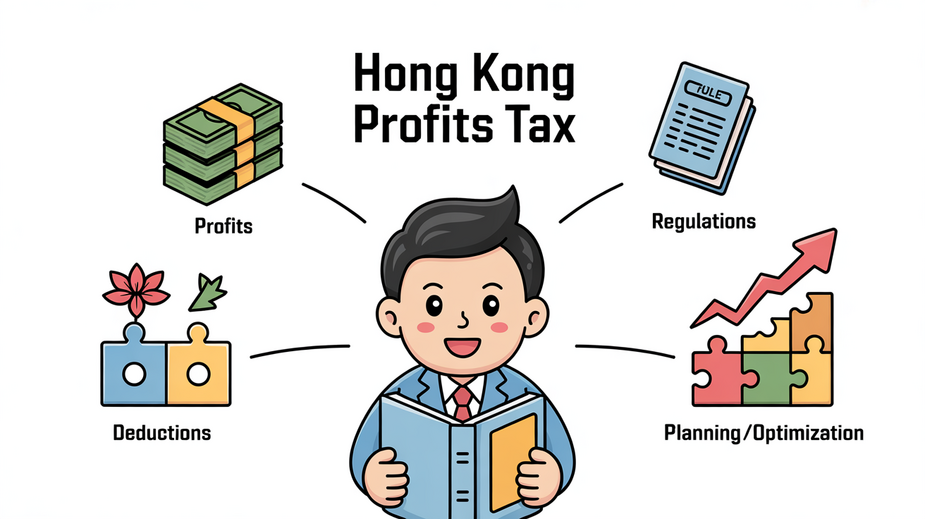
Hong Kong Profits Tax for Professional Services Firms: Special Rules and Deductions
📋 Key Facts at a Glance
- Tax Rates: Corporations pay 8.25% on first HK$2M, 16.5% on remainder; unincorporated firms pay 7.5% on first HK$2M, 15% on remainder
- Territorial Basis: Only Hong Kong-sourced profits are taxable – offshore income may be exempt
- Record Keeping: Must maintain financial records for 7 years to support tax positions
- Global Minimum Tax: Hong Kong enacted 15% minimum tax effective January 1, 2025 for large MNEs
Did you know that professional services firms in Hong Kong could be paying more tax than legally required simply by missing strategic deductions? In today’s competitive landscape, where consulting, legal, accounting, and advisory firms operate on tight margins, understanding Hong Kong’s unique tax framework isn’t just about compliance—it’s a strategic advantage that directly impacts your bottom line. This comprehensive guide explores how to navigate the territorial source principle, maximize legitimate deductions, avoid common pitfalls, and leverage tax planning for sustainable growth.
Why Tax Compliance is Your Firm’s Financial Foundation
For professional services firms in Hong Kong, tax compliance transcends administrative duty—it’s the bedrock of financial stability and long-term sustainability. Effective tax management protects your firm from avoidable financial risks while optimizing your tax position to preserve working capital and fuel growth. The consequences of non-compliance extend far beyond immediate penalties, potentially triggering cascading effects that undermine your firm’s competitive position.
| Compliance Aspect | Potential Impact | Sustainability Link |
|---|---|---|
| Non-compliance & Errors | Financial penalties, interest charges (8.25% from July 2025) | Direct profit erosion, cash flow strain |
| Overlooked Deductions | Higher tax burden than legally required | Reduced net margins, limited reinvestment capacity |
| Inconsistent Reporting | Increased audit risk, operational disruption | Reputational damage, client trust erosion |
Mastering Hong Kong’s Territorial Source Principle
Hong Kong’s territorial tax system operates on a simple but crucial principle: only profits “arising in or derived from” Hong Kong are subject to Profits Tax. For professional services firms, this means your tax liability depends entirely on where your income-generating activities occur—not where your clients are located or where payments are received. Understanding this distinction is fundamental to accurate tax reporting and potential tax savings.
How Source Determination Works for Service Firms
The IRD determines source based on where the substantive operations generating profits take place. For consulting, legal, accounting, and advisory services, this typically means examining:
- Location of service delivery: Where are your professionals physically performing the work?
- Decision-making location: Where are key decisions about the engagement made?
- Contract negotiation and signing: While not determinative, contract location can be a factor
- Client location: This is generally irrelevant for source determination
Essential Documentation for Offshore Claims
Substantiating offshore claims requires robust, contemporaneous documentation. The IRD will scrutinize your evidence to verify that profit-generating activities genuinely occurred outside Hong Kong. Insufficient documentation is the primary reason offshore claims are denied during audits.
| Document Type | Purpose & Best Practices |
|---|---|
| Service Contracts & Engagement Letters | Clearly specify location of service delivery, scope of work, and deliverables |
| Detailed Work Logs & Timesheets | Record specific tasks, dates, locations, and hours worked by personnel |
| Travel Records & Expense Claims | Evidence of personnel working physically outside Hong Kong on client engagements |
| Communication Records | Emails, meeting minutes showing location-based interactions and decisions |
| Invoices & Payment Records | Support revenue streams and transaction specifics with clear descriptions |
Strategic Deductions for Professional Services Firms
Unlike businesses with significant physical inventory, professional services firms have unique cost structures centered around human capital, client acquisition, and operational efficiency. Strategically identifying and claiming all eligible deductions can significantly reduce your taxable income while supporting business growth.
Human Capital Investments
Your people are your greatest asset, and investments in their development are generally deductible:
- Professional development: Training, certifications, and courses directly related to service delivery
- Industry conferences: Registration, travel, and accommodation for relevant events
- Subscriptions & memberships: Professional association fees and industry publications
- Salaries & benefits: All reasonable compensation for employees generating taxable income
Client Acquisition & Business Development
Costs incurred to secure new business are deductible if they meet the “wholly and exclusively” test for generating assessable profits:
- Marketing & promotion: Digital marketing, website development, branding expenses
- Proposal development: Costs for preparing bids, tenders, and client presentations
- Client entertainment: Reasonable business entertainment expenses (subject to limitations)
- Travel expenses: Costs for meeting prospective clients and securing contracts
Technology & Operational Efficiency
Modern service delivery requires substantial technology investment, much of which qualifies for deductions:
| Expense Type | Deduction Treatment | Strategic Consideration |
|---|---|---|
| Software Licenses & Subscriptions | 100% deductible as operating expense | Essential for service delivery and efficiency |
| Computer Hardware | Depreciation allowances over useful life | Capital expenditure with long-term benefits |
| Communication Systems | 100% deductible as operating expense | Critical for client communication and remote work |
| Office Equipment & Furniture | Depreciation allowances over useful life | Improves productivity and professional environment |
Common Tax Reporting Errors & How to Avoid Them
Even with clear tax principles, professional services firms frequently make avoidable errors that lead to incorrect tax liabilities, missed savings, and increased audit risk. Recognizing these common pitfalls is the first step toward robust compliance.
| Error Type | Consequences | Prevention Strategy |
|---|---|---|
| Misclassified Revenue Streams | Incorrect tax liability, penalties, interest charges | Proper source determination based on operational facts |
| Overlooked Offshore Exemptions | Overpayment of Profits Tax on non-taxable income | Systematic review of all income streams against exemption criteria |
| Inadequate Expense Allocation | Disallowed deductions, higher taxable income | Detailed records with clear allocation methodology |
| Poor Documentation | Inability to substantiate claims during audit | Implement digital record-keeping with 7-year retention |
| Ignoring Two-Tier System Benefits | Higher effective tax rate than necessary | Optimize entity structure to benefit from lower rates |
Leveraging Hong Kong’s Two-Tier Profits Tax System
Hong Kong’s two-tiered profits tax system, introduced in 2018/19, offers significant savings for qualifying businesses:
- Corporations: 8.25% on first HK$2 million of assessable profits, 16.5% on remainder
- Unincorporated businesses: 7.5% on first HK$2 million, 15% on remainder
- Important limitation: Only ONE entity per connected group can claim the lower tier rates
Strategic Tax Planning for Profit Optimization
Effective tax planning transforms compliance from a reactive exercise into a proactive strategy for profit optimization. By thoughtfully structuring operations and reinvestment, professional services firms can legally minimize tax burdens while fueling sustainable growth.
Contract Structuring & Service Delivery Models
How you structure client engagements directly impacts tax outcomes:
- Define service location clearly: Include specific clauses in contracts detailing where services will be performed
- Separate offshore components: For mixed engagements, consider separate contracts or clearly defined phases
- Document decision-making locations: Specify where key decisions about the engagement will be made
- Align billing with service delivery: Structure invoices to reflect the location-based nature of services
Tax-Efficient Reinvestment Strategies
Rather than simply distributing profits, consider reinvesting in growth-oriented activities that qualify for deductions:
- Technology upgrades: Invest in systems that improve efficiency and qualify for depreciation allowances
- Professional development programs: Fund comprehensive training that enhances service capabilities
- Market expansion initiatives: Allocate resources to entering new markets or service lines
- Quality improvement systems: Implement processes that enhance service delivery and client satisfaction
Audit Preparedness & Compliance Essentials
Building audit preparedness isn’t about expecting trouble—it’s about demonstrating professionalism and due diligence. Well-organized records and proactive compliance practices can streamline any IRD inquiry and protect your firm’s reputation.
Digital Record-Keeping Best Practices
Implement systematic digital record-keeping to manage the complexity of service firm finances:
- Centralized document management: Use secure cloud systems for all financial records
- Standardized categorization: Implement consistent expense and revenue classification
- Automated backup: Ensure 7-year retention with regular, secure backups
- Access controls: Limit access to sensitive financial information
- Search functionality: Enable rapid retrieval of documents during inquiries
Common Audit Red Flags for Service Firms
| Red Flag | Why It Attracts Attention |
|---|---|
| Unexplained Income Fluctuations | Large variances from industry norms or historical patterns |
| High Expense-to-Income Ratios | Disproportionate expenses impacting reported profitability |
| Inconsistent Third-Party Data | Discrepancies with client reporting or bank information |
| Frequent Return Amendments | Suggests underlying issues with initial reporting accuracy |
| Large Offshore Claims | Significant exemptions without robust supporting documentation |
Navigating Global Tax Developments
Professional services firms with international operations must stay informed about global tax developments that could impact their Hong Kong tax position and cross-border engagements.
Hong Kong’s Global Minimum Tax Implementation
Hong Kong enacted the Global Minimum Tax (Pillar Two) on June 6, 2025, effective from January 1, 2025:
- Applies to: Multinational enterprise groups with consolidated revenue ≥ EUR 750 million
- Minimum rate: 15% effective tax rate
- Includes: Income Inclusion Rule (IIR) and Hong Kong Minimum Top-up Tax (HKMTT)
- Impact: May affect professional services firms with substantial international operations
Foreign-Sourced Income Exemption (FSIE) Regime
Hong Kong’s FSIE regime, expanded in January 2024, affects how certain foreign-sourced income is taxed:
- Covers: Dividends, interest, disposal gains, and intellectual property income
- Requirement: Economic substance in Hong Kong for the income to qualify for exemption
- Consideration: Professional services firms receiving foreign-sourced income should review their substance requirements
✅ Key Takeaways
- Hong Kong’s territorial system taxes only locally-sourced profits—proper source determination is critical for tax efficiency
- Strategic use of deductions for human capital, client acquisition, and technology can significantly reduce taxable income
- Robust documentation supporting offshore claims and expense allocations is essential for audit defense
- The two-tier profits tax system offers substantial savings, but only one entity per group can claim the lower rates
- Global developments like the 15% minimum tax and economic substance requirements impact firms with international operations
- Proactive tax planning transforms compliance from cost center to strategic advantage
For professional services firms in Hong Kong, tax management is no longer just about compliance—it’s a strategic function that directly impacts profitability and competitive positioning. By mastering the territorial source principle, maximizing legitimate deductions, avoiding common pitfalls, and staying informed about global developments, your firm can optimize its tax position while building a foundation for sustainable growth. The most successful firms view tax planning not as an annual obligation, but as an ongoing strategic advantage that preserves capital, fuels reinvestment, and enhances long-term resilience in Hong Kong’s dynamic professional services landscape.
📚 Sources & References
This article has been fact-checked against official Hong Kong government sources and authoritative references:
- Inland Revenue Department (IRD) – Official tax rates, allowances, and regulations
- Rating and Valuation Department (RVD) – Property rates and valuations
- GovHK – Official Hong Kong Government portal
- Legislative Council – Tax legislation and amendments
- IRD Profits Tax Guide – Comprehensive profits tax regulations and requirements
- IRD Territorial Source Principle – Official guidance on source determination
- IRD FSIE Regime – Foreign-sourced income exemption framework
- OECD BEPS – Global tax reform initiatives and standards
Last verified: December 2024 | Information is for general guidance only. Consult a qualified tax professional for specific advice.