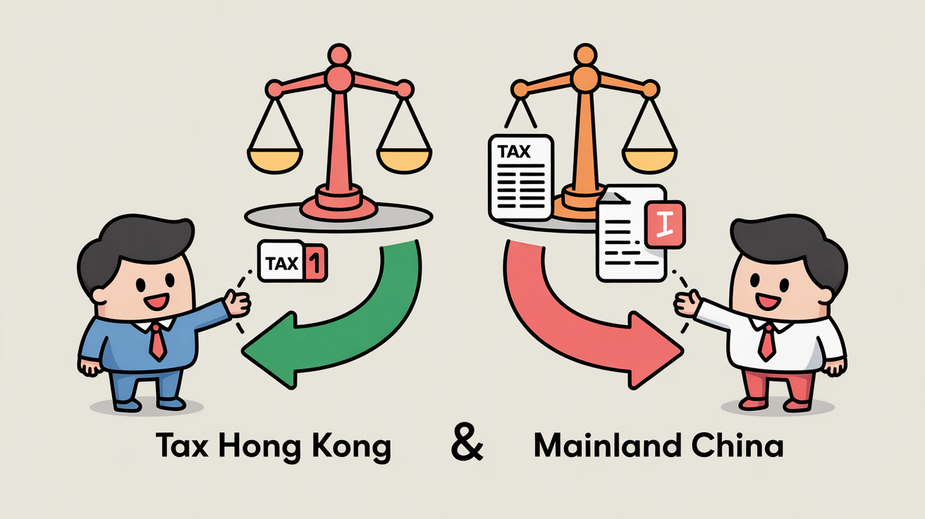
Hong Kong vs. Mainland China: Comparing Tax Dispute Resolution Mechanisms
📋 Key Facts at a Glance
- Hong Kong System: Independent Board of Review tribunal under common law adversarial principles
- Mainland China System: Two-track administrative reconsideration followed by court litigation under civil law inquisitorial approach
- Filing Deadlines: Hong Kong – 1 month from assessment; China – 60 days after tax payment (for assessment disputes)
- Payment Requirements: Hong Kong allows tax holdover; China requires upfront payment (though abolition proposed)
- Cross-Border Resolution: China-Hong Kong DTA provides Mutual Agreement Procedure (MAP) with 3-year filing window
- Case Volume Surge: China’s tax reconsideration cases jumped to 5,243 in 2024, reflecting increased enforcement
What happens when a Hong Kong company faces a multi-million dollar tax assessment from Mainland China authorities? Or when a Mainland investor receives an unexpected profits tax bill from Hong Kong’s Inland Revenue Department? As cross-border business between Hong Kong and Mainland China continues to expand at unprecedented rates, understanding the fundamentally different tax dispute resolution mechanisms in these two jurisdictions has become essential for every business operating across the border. While they share geographical proximity, their legal systems and tax dispute procedures couldn’t be more different.
Hong Kong’s Tax Dispute Resolution: The Common Law Approach
Hong Kong’s tax dispute resolution system operates under the Inland Revenue Ordinance (Cap 112) and follows a structured, multi-tier approach rooted in common law principles. The system is characterized by its adversarial nature, where taxpayers bear the burden of proving that assessments are excessive or incorrect. This contrasts sharply with Mainland China’s civil law approach, creating significant strategic implications for cross-border businesses.
Step 1: Initial Objection – The Critical First Move
The dispute resolution process begins with a compulsory administrative objection stage that requires precise timing and documentation:
- Filing Deadline: Taxpayers must lodge a written notice of objection within one month from the date of the assessment notice
- Filing Methods: Submit Form IR831 via post, fax, or through the eTax account system
- Content Requirements: The objection must state precisely the grounds for dispute with supporting evidence
- Special Case – Estimated Assessments: For assessments raised under section 59(3), taxpayers must submit a completed tax return with the objection to validate it
- Late Objections: The Commissioner may accept late objections if satisfied that absence from Hong Kong, sickness, or other reasonable causes prevented timely filing
Step 2: Commissioner’s Determination – The Internal Review
Following receipt of an objection, the Inland Revenue Department processes it through a two-stage internal review:
- First Review: The original assessor reconsiders the case based on your objection
- Second Review: If no changes are recommended, the file transfers to the IRD’s Appeal Section for a de novo review
- Determination: The Commissioner may confirm, reduce, increase, or annul the assessment, transmitting the determination with written reasons to the taxpayer
- Timeline: The Commissioner must act “within a reasonable time,” though no specific statutory deadline exists (typically 1-2 years)
Step 3: Board of Review Appeal – The Independent Tribunal
The Board of Review serves as an independent statutory tribunal that functions as a trial court, providing genuine separation from the IRD:
- Appeal Deadline: Within one month of the date of the Commissioner’s written determination
- Filing Requirements: Submit written appeal including copy of Commissioner’s determination, statement of grounds, and simultaneous service on Commissioner
- Burden of Proof: The taxpayer bears responsibility to prove the assessment is excessive or incorrect
- Board Powers: After hearing, the Board may confirm, reduce, increase, or annul the assessment, or remit the case to the Commissioner
- Costs Risk: Unsuccessful appeals may result in costs orders up to HKD 25,000
- Hearing Process: All appeals are heard in camera (private sessions), though anonymized decisions may be published
Step 4: Court Appeals – Judicial Review
Judicial review is available for questions of law through Hong Kong’s court hierarchy:
- Court of First Instance: Either party may apply for leave to appeal the Board’s decision on a question of law within one month
- Court of Appeal: With leave, parties may appeal directly to the Court of Appeal
- Court of Final Appeal: Final appellate jurisdiction rests with Hong Kong’s highest court
Mainland China’s Tax Dispute Resolution: The Civil Law Framework
China’s tax dispute resolution system operates as an internal error-correction mechanism within the tax administration hierarchy, characterized by civil law inquisitorial principles. The system distinguishes between tax assessment disputes and non-assessment disputes, with different procedural requirements for each category.
Types of Tax Disputes in China
Chinese law categorizes tax disputes into two distinct types with different procedural pathways:
| Dispute Type | Examples | Procedural Requirements |
|---|---|---|
| Tax Assessment Disputes | Imposition of taxes, late payment penalties, tax withholding decisions | Must pay tax first, then file reconsideration within 60 days |
| Non-Assessment Disputes | Other administrative decisions not directly related to tax calculations | No payment requirement; may choose reconsideration or direct judicial review |
Step 1: Administrative Reconsideration – The Mandatory First Step
Administrative reconsideration serves as the primary legal remedy mechanism in China’s tax dispute system:
- Prerequisites for Tax Assessment Disputes: Taxpayers must pay the disputed tax amount first, obtain a receipt, then file reconsideration within 60 days
- Reconsideration Authority: Generally the immediate superior tax authority of the original decision-maker
- Review Scope: The higher-level authority reviews factual determinations, evidence sufficiency, application of law, and statutory procedures
- Decision Timeline: Must make a decision within 60 days from accepting application, extendable to 90 days maximum
- Failure to Decide: If no decision within time limit, applicant may file suit in court within 15 days from expiry date
Step 2: Administrative Litigation – The Court System
Tax administrative litigation provides judicial review following reconsideration:
- Prerequisites: For tax assessment disputes, administrative reconsideration must be completed first; for non-assessment disputes, direct filing is possible
- Court Structure: Courts form collegial panels of three or more judges or judges and jurors
- Specialized Courts: China’s court system currently lacks specialized tax tribunals, with tax cases handled by administrative courts
Recent Legislative Developments in China
China’s tax dispute resolution landscape is undergoing significant transformation:
Tax Collection and Administration Law Revision (Draft 2025):
- Released by Ministry of Finance and State Taxation Administration in March 2025 for public comment
- Explicitly abolishes the tax clearance rules (pay-first requirement)
- Expected submission to Standing Committee of National People’s Congress in 2026
- Potential approval within approximately two to three years
- Abolition of tax clearance expected to significantly activate dispute resolution procedures
Comparative Analysis: Hong Kong vs. Mainland China
Understanding the fundamental differences between these two systems is crucial for cross-border tax planning and dispute management:
| Aspect | Hong Kong | Mainland China |
|---|---|---|
| Legal System | Common law adversarial system | Civil law inquisitorial approach |
| Initial Appeal Deadline | 1 month from assessment notice | 60 days from tax payment receipt |
| Payment Requirement | Tax may be held over during dispute | Must pay tax first (for assessment disputes) |
| Administrative Review | Compulsory Commissioner determination | Compulsory for tax treatment decisions |
| Review Timeline | “Reasonable time” (no statutory limit) | 60 days (extendable to 90 days) |
| Independent Tribunal | Board of Review (independent statutory body) | No independent tax tribunal |
| Burden of Proof | On taxpayer to prove assessment excessive/incorrect | Mixed – authorities must prove facts; taxpayer challenges legality |
| Hearing Process | In camera (private) with published anonymized decisions | Open court hearings (administrative litigation) |
| Costs Risk | Up to HKD 25,000 if appeal unsuccessful at Board | Litigation costs as determined by court |
| Average Total Timeline | 1-2 years (administrative) + 2 years (Board) + 2 years (courts) | 60-90 days (reconsideration) + court timeline varies |
Cross-Border Tax Dispute Resolution: China-Hong Kong DTA
The Arrangement between the Mainland of China and the Hong Kong Special Administrative Region for the Avoidance of Double Taxation and the Prevention of Fiscal Evasion provides a critical framework for resolving cross-border tax disputes. The Fifth Protocol, signed in 2019 and effective from December 2019, incorporates key elements of the OECD’s BEPS initiative.
Mutual Agreement Procedure (MAP) – The Diplomatic Solution
The MAP provides a diplomatic mechanism for resolving treaty-related disputes between jurisdictions:
- Eligibility: Taxpayers who consider that taxation imposed is not in accordance with the DTA
- Filing Timeline: Must present case within 3 years from the first notification of the action resulting in double taxation
- Parallel Proceedings: MAP and court processes run parallel to each other in China
- Competent Authorities: Hong Kong – Commissioner of Inland Revenue; Mainland China – State Taxation Administration
- Resolution: If mutual agreement is reached, Chinese tax authorities will revise the tax decision or make a new decision based on the agreement
Advance Pricing Arrangements (APA) – Preventing Disputes
APAs offer a non-adversarial approach to prevent transfer pricing disputes before they arise:
- Allows businesses to establish agreed-upon transfer pricing methodologies in advance
- Involves transparent engagement with tax authorities in both Hong Kong and China
- Prevents disputes regarding whether prices used in cross-border transactions are fair
- Provides certainty and optimal tax outcomes for multinational companies
Procedural Timelines Comparison
Understanding the different timelines is crucial for effective dispute management and cash flow planning:
| Stage | Hong Kong | Mainland China |
|---|---|---|
| Objection/Application Filing | 1 month from assessment | 60 days from tax payment |
| Administrative Review Decision | Reasonable time (typically 1-2 years) | 60 days (max 90 with extension) |
| Tribunal/Board Appeal Filing | 1 month from Commissioner’s determination | N/A (no independent tribunal) |
| Tribunal/Board Hearing | Approximately 2 years | N/A |
| Court Appeal Filing | 1 month from Board decision | 15 days if reconsideration deadline missed |
| Court Proceedings | Approximately 2 years per level | Varies by court and case complexity |
| MAP Filing Window | 3 years from first notification | 3 years from first notification |
Strategic Considerations for Cross-Border Taxpayers
For Hong Kong Taxpayers Facing China Assessments
- Payment Planning: Prepare for upfront tax payment requirement in China (though abolition proposed)
- MAP Early Invocation: Consider MAP at earliest stage of treaty-related dispute within 3-year window
- Documentation: Maintain comprehensive contemporaneous documentation to support positions
- Professional Coordination: Engage advisors familiar with both jurisdictions’ procedures
For Mainland Taxpayers Facing Hong Kong Assessments
- Cash Flow Advantage: Utilize Hong Kong’s tax holdover provision during disputes
- Burden of Proof: Prepare comprehensive evidence to prove assessment is excessive or incorrect
- Independent Review: Leverage Board of Review’s genuinely independent tribunal review
- Extended Timelines: Plan for potentially longer resolution timelines (5-6 years through all levels)
Pre-Dispute Prevention Strategies
- Robust Documentation: Maintain comprehensive records supporting tax positions in both jurisdictions
- Transfer Pricing Planning: Consider APAs for significant cross-border related-party transactions
- Professional Advice: Engage tax advisors familiar with both Hong Kong and Mainland China systems
- Compliance Reviews: Conduct internal audits to identify and rectify potential issues proactively
- Risk Assessment: Regularly evaluate exposure to enforcement priorities in both jurisdictions
✅ Key Takeaways
- Fundamental Structural Differences: Hong Kong’s independent Board of Review system contrasts sharply with China’s administrative reconsideration hierarchy, reflecting their common law versus civil law foundations
- Payment Requirements: Hong Kong allows tax to be held over during disputes, while China currently requires upfront payment for assessment disputes (though abolition is proposed in 2025 draft legislation)
- Timeline Advantages: China’s statutory 60-90 day reconsideration timeline provides certainty, while Hong Kong’s “reasonable time” standard can extend to 1-2 years administratively
- Cross-Border Mechanisms: The China-Hong Kong DTA provides MAP and APA mechanisms for preventing and resolving cross-border tax disputes, with a critical 3-year filing window
- Legislative Developments: China’s proposed abolition of tax clearance requirements and Hong Kong’s BEPS 2.0 implementation signal significant changes ahead for both jurisdictions
- Increasing Enforcement: Both jurisdictions show heightened tax scrutiny, with China’s tax reconsideration cases surging to 5,243 in 2024
- Strategic Importance: Understanding procedural differences is critical for cross-border taxpayers to effectively manage disputes, preserve rights, and minimize costs and delays
Navigating tax disputes between Hong Kong and Mainland China requires more than just understanding different tax rates – it demands mastery of fundamentally different legal systems and procedural frameworks. The choice between Hong Kong’s independent tribunal system and China’s administrative reconsideration hierarchy can significantly impact dispute outcomes, timelines, and financial implications. As cross-border business continues to grow, developing a coordinated strategy that leverages the strengths of both systems while mitigating their weaknesses will be essential for successful tax dispute management across the Greater Bay Area and beyond.
📚 Sources & References
This article has been fact-checked against official Hong Kong government sources and authoritative references:
- Inland Revenue Department (IRD) – Official tax rates, allowances, and regulations
- GovHK: Objections and Appeals – Hong Kong tax dispute procedures
- IRD: Board of Review Decisions – Published tax appeal decisions
- IRD: Mutual Agreement Procedure – Cross-border dispute resolution
- China Government Statistics – Administrative reconsideration case data 2024
- Leg