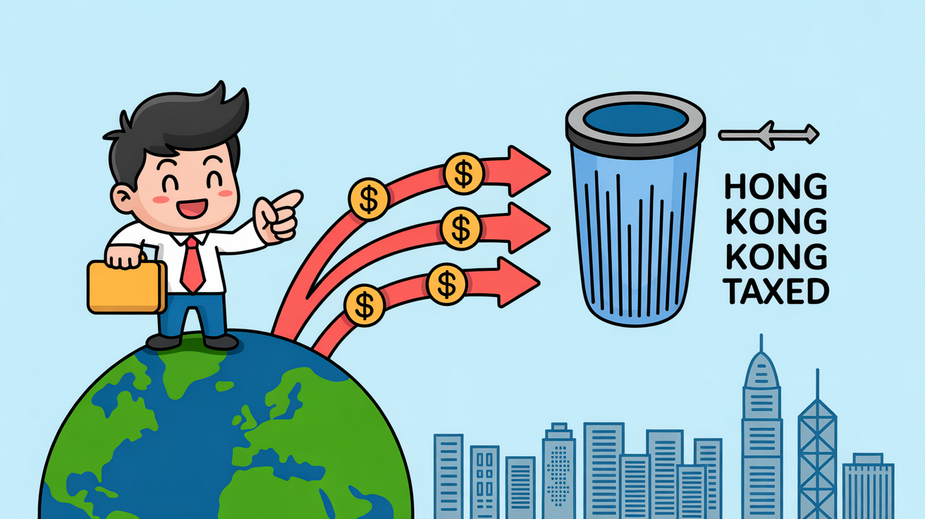
Hong Kong’s Territorial Tax System: Key Advantages for Global Entrepreneurs
📋 Key Facts at a Glance
- Territorial Tax System: Hong Kong only taxes income sourced within its borders, not worldwide income
- Profits Tax Rates: Two-tier system: 8.25% on first HK$2 million, 16.5% on remainder for corporations
- Offshore Income Exemption: Foreign-sourced profits generally not taxable if genuinely sourced outside Hong Kong
- No Capital Gains Tax: Hong Kong does not tax capital gains from investments
- Double Taxation Agreements: Comprehensive network with 45+ jurisdictions for tax certainty
Imagine running a global business where you only pay tax on income earned within one jurisdiction, while profits from your international operations remain completely tax-free. This isn’t a theoretical tax haven fantasy—it’s the reality for businesses operating from Hong Kong. As global entrepreneurs navigate increasingly complex international tax landscapes, Hong Kong’s territorial tax system offers a compelling solution that combines simplicity, efficiency, and significant cost savings.
The Core Principle: Territorial vs. Worldwide Taxation
At the heart of Hong Kong’s tax advantage lies a fundamental distinction between two approaches to taxation. Most Western economies, including the United States and European Union countries, follow a worldwide taxation model. This means residents and corporations are taxed on their entire global income, regardless of where it’s earned. While foreign tax credits and double taxation treaties provide some relief, the administrative burden remains substantial.
Hong Kong operates on a pure territorial tax system. The Inland Revenue Department (IRD) imposes Profits Tax exclusively on profits that arise in or are derived from Hong Kong from a trade, profession, or business carried on within Hong Kong. The key principle is simple: if the genuine source of your profits is located outside Hong Kong, those foreign-sourced profits are generally not subject to tax.
| Feature | Territorial Taxation (Hong Kong) | Worldwide Taxation (OECD-style) |
|---|---|---|
| Basis of Tax | Source of Income (within jurisdiction) | Residence/Nationality (globally) |
| Foreign Income | Generally exempt if genuinely sourced offshore | Taxable with foreign tax credits |
| Compliance Complexity | Lower (focus on source determination) | Higher (global reporting, credit calculations) |
| Double Taxation Risk | Minimal for offshore income | Significant without treaty protection |
Hong Kong’s Competitive Tax Rate Structure
Hong Kong’s tax advantages extend beyond its territorial principle to include remarkably competitive tax rates. The system is straightforward, transparent, and designed to support businesses of all sizes.
Two-Tier Profits Tax System (2024-2025)
Hong Kong employs a progressive two-tier profits tax system that provides significant benefits to smaller businesses and startups:
- Corporations: 8.25% on first HK$2 million of assessable profits, 16.5% on remainder
- Unincorporated businesses: 7.5% on first HK$2 million, 15% on remainder
- Important restriction: Only ONE entity per connected group can claim the lower tier
| Jurisdiction | Standard Corporate Tax Rate | Key Features |
|---|---|---|
| Hong Kong | 16.5% (standard) 8.25% (first HK$2M) |
Territorial system, no capital gains tax |
| European Union Average | ~21% | Worldwide taxation, complex compliance |
| United States Federal | 21% | Worldwide taxation, state taxes additional |
| Singapore | 17% | Territorial with some worldwide elements |
Strategic Advantages for International Operations
Hong Kong’s territorial system provides specific strategic benefits for businesses with international operations, making it an ideal base for global entrepreneurs.
Offshore Income Management
The ability to manage offshore income efficiently is perhaps the most significant advantage:
- Foreign-sourced dividends: Generally exempt from Hong Kong Profits Tax if genuinely sourced offshore
- Capital gains: Not taxed in Hong Kong (provided they’re not considered trading income)
- International supply chains: Income from offshore manufacturing or sales can remain outside Hong Kong tax scope
- Holding company efficiency: Ideal for managing global investments with minimal tax leakage
Simplified Compliance and Administration
The territorial approach dramatically reduces administrative burdens:
- Reduced transfer pricing documentation: For genuinely offshore transactions, extensive transfer pricing studies are often unnecessary
- Simplified global reporting: No need to consolidate worldwide income for Hong Kong tax purposes
- Clear source determination: Focus on establishing whether income has a Hong Kong source based on specific tests
- Minimized treaty shopping: The territorial exemption often removes the need for complex treaty-based structures
Double Taxation Agreements and International Protection
Hong Kong has built an extensive network of Comprehensive Double Taxation Agreements (CDTAs) with over 45 jurisdictions, providing additional protection and certainty for international businesses.
| Key Treaty Partners | Benefits | Strategic Importance |
|---|---|---|
| Mainland China | Reduced withholding taxes, clear sourcing rules | Critical for Greater Bay Area integration |
| Singapore | Competitive rates, regional coordination | ASEAN market access |
| United Kingdom | Historical ties, financial services alignment | European market gateway |
| Japan | Technology and investment flows | Asian innovation hub connection |
These agreements provide:
- Reduced withholding taxes on dividends, interest, and royalties
- Clear taxing rights allocation between jurisdictions
- Mutual agreement procedures for dispute resolution
- Tax certainty for cross-border investments and operations
Wealth Management and Family Office Advantages
Hong Kong’s territorial system extends significant benefits to wealth management and family office structures, particularly with the introduction of the Family Investment Holding Vehicle (FIHV) regime.
| Wealth Management Aspect | Hong Kong Territorial Tax Benefit |
|---|---|
| Family Investment Holding Vehicles | 0% tax on qualifying income with HK$240M+ AUM and substantial activities |
| International Inheritance Planning | Simplified due to no capital gains or inheritance taxes |
| Holding Company Efficiency | Foreign-sourced dividends and capital gains often exempt |
| Private Banking Integration | Tax-efficient base complements world-class financial services |
Positioning for Asia-Pacific Expansion
Hong Kong serves as the perfect gateway to Asia-Pacific markets, combining geographical advantage with tax efficiency:
- Greater Bay Area access: Direct connectivity to mainland China’s massive consumer markets
- Currency advantages: Hong Kong Dollar’s free convertibility simplifies international transactions
- Legal system: Common law framework provides familiarity for international businesses
- Tax neutrality: Engage with China while keeping global operations tax-efficient
✅ Key Takeaways
- Hong Kong’s territorial system taxes only Hong Kong-sourced income, not worldwide profits
- The two-tier profits tax system (8.25%/16.5%) provides significant savings for businesses of all sizes
- Foreign-sourced dividends, interest, and capital gains are generally exempt from Hong Kong tax
- Simplified compliance reduces administrative burdens compared to worldwide tax systems
- 45+ double taxation agreements provide international tax certainty and protection
- Family office and wealth management structures benefit from specialized regimes like FIHV
For global entrepreneurs seeking an efficient, predictable, and competitive tax environment, Hong Kong’s territorial system offers unparalleled advantages. By focusing taxation only on locally-sourced income while providing exemptions for genuine offshore profits, Hong Kong enables businesses to operate internationally with minimal tax complexity and maximum retention of earnings. Whether you’re expanding into Asia-Pacific markets, managing global investments, or establishing a family office, Hong Kong provides the tax efficiency and international connectivity needed for sustainable global growth.
📚 Sources & References
This article has been fact-checked against official Hong Kong government sources and authoritative references:
- Inland Revenue Department (IRD) – Official tax rates, allowances, and regulations
- Rating and Valuation Department (RVD) – Property rates and valuations
- GovHK – Official Hong Kong Government portal
- Legislative Council – Tax legislation and amendments
- IRD Profits Tax Guide – Detailed profits tax regulations and rates
- IRD FSIE Regime – Foreign-sourced income exemption requirements
- IRD FIHV Regime – Family Investment Holding Vehicle regulations
- OECD BEPS – International tax standards and guidelines
Last verified: December 2024 | Information is for general guidance only. Consult a qualified tax professional for specific advice.