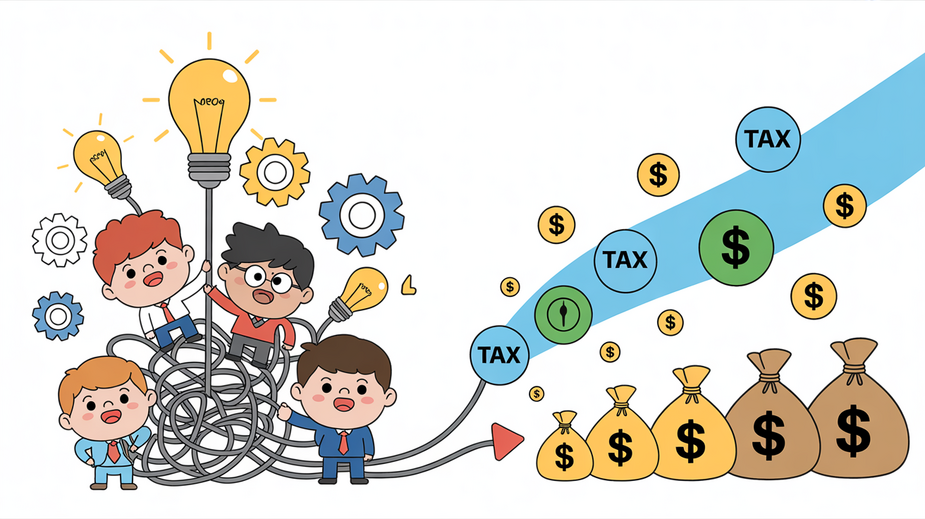
How Hong Kong’s Tax Treatment of Intellectual Property Can Benefit Tech Startups
📋 Key Facts at a Glance
- Territorial Tax System: Hong Kong only taxes profits sourced in Hong Kong, potentially offering 0% tax on offshore IP income
- Two-Tier Profits Tax: Corporations pay 8.25% on first HK$2 million, 16.5% on remainder; unincorporated businesses pay 7.5% and 15% respectively
- Patent Box Regime: New 5% tax rate on qualifying IP income from patents and copyrighted software (effective July 5, 2024)
- FSIE Regime: Foreign-sourced IP income exempt from tax if economic substance requirements are met (Phase 2 effective January 2024)
- No Capital Gains Tax: Hong Kong does not tax capital gains from IP asset sales
Imagine building a groundbreaking AI algorithm or developing revolutionary biotech research, only to see 25-30% of your hard-earned revenue disappear to taxes. For tech startups worldwide, this is a harsh reality. But what if there was a jurisdiction where offshore intellectual property income could be taxed at 0%, where R&D expenses are fully deductible, and where selling your IP assets doesn’t trigger capital gains tax? Welcome to Hong Kong – Asia’s premier hub for tech startups seeking to maximize their intellectual property value while minimizing their tax burden.
Why Intellectual Property is Your Startup’s Most Valuable Asset
In today’s hyper-competitive tech landscape, intellectual property isn’t just legal protection – it’s your company’s core value proposition. Whether you’re developing proprietary software, patented algorithms, or unique digital platforms, your IP represents the innovation that sets you apart. For investors and acquirers, a strong IP portfolio signals defensibility, scalability, and future revenue potential. But here’s the crucial insight: where you manage and commercialize your IP can dramatically impact your tax efficiency and overall valuation.
The Three Pillars of Startup IP Value
- Patents & Proprietary Technology: Protect your core inventions and maintain competitive barriers
- Software & Algorithms: Secure your digital assets through copyrights and trade secrets
- Brand & Design Rights: Build recognizable identity and prevent imitation in crowded markets
Hong Kong’s Tax Advantages for IP-Driven Startups
Hong Kong offers a uniquely favorable tax environment for tech startups, built on several key principles that directly benefit IP-intensive businesses. Understanding these advantages is the first step toward optimizing your tax strategy.
The Territorial Tax Principle: Your Offshore Advantage
Hong Kong operates on a territorial basis of taxation – only profits sourced in Hong Kong are subject to profits tax. This means if your startup develops IP in Hong Kong but licenses it to customers overseas, that offshore income may be completely tax-free. For a SaaS company with global subscribers or a biotech firm licensing patents internationally, this can translate to significant tax savings.
The New Patent Box Regime: 5% Tax Rate on IP Income
Effective July 5, 2024, Hong Kong introduced a groundbreaking “patent box” tax concession. Qualifying IP income from patents and copyrighted software can now enjoy a preferential tax rate of just 5% – significantly lower than the standard profits tax rates. This applies to income from:
- Licensing of qualifying IP rights
- Sale of qualifying IP rights
- Embedded IP income from products or services
Generous R&D Tax Deductions
Hong Kong allows full deduction of qualifying R&D expenditures incurred for producing taxable profits. For tech startups, this means:
- Salaries for engineers and researchers
- Software development costs
- Laboratory and testing expenses
- Costs of registering patents and other IP rights
Navigating the FSIE Regime for International IP Income
The Foreign-Sourced Income Exemption (FSIE) regime, expanded in January 2024, is particularly relevant for startups with international IP operations. Under this regime, foreign-sourced IP income (dividends, interest, disposal gains, and IP income) can be exempt from Hong Kong tax if specific conditions are met.
| FSIE Requirement | What It Means for Startups |
|---|---|
| Economic Substance | You must have adequate employees, premises, and operating expenditure in Hong Kong related to the IP income |
| Nexus Approach | Tax benefits are linked to proportion of R&D activities conducted in Hong Kong |
| Participation Exemption | Foreign-sourced dividends and disposal gains may qualify if holding period and other conditions are met |
Comparative Analysis: Hong Kong vs. Regional Tech Hubs
How does Hong Kong stack up against other popular tech hubs in Asia? The comparison reveals why Hong Kong is particularly attractive for IP-focused startups.
| Jurisdiction | Standard Corporate Tax | IP-Specific Benefits | Capital Gains Tax |
|---|---|---|---|
| Hong Kong | 8.25% on first HK$2M, 16.5% thereafter | 5% patent box rate, territorial system, R&D deductions | None |
| Singapore | 17% | IP development incentives, but more complex | None generally |
| Shenzhen (China) | 25% (with High-Tech Enterprise rate of 15%) | Substantial R&D incentives, but worldwide taxation | Yes, typically 10-20% |
Strategic IP Structuring for Hong Kong Startups
To maximize Hong Kong’s tax benefits, consider these strategic approaches to IP structuring:
- Establish a Dedicated IP Holding Company: Create a separate Hong Kong entity to hold your intellectual property assets. This ringfences valuable IP and optimizes tax treatment.
- Leverage Double Taxation Agreements: Hong Kong has over 45 comprehensive DTAs that can reduce or eliminate withholding taxes on cross-border royalty payments.
- Document Your Substance: Maintain proper records of R&D activities, decision-making processes, and commercial operations in Hong Kong to support your tax position.
- Time Your Commercialization: Strategically plan when to license or sell IP assets, considering both business objectives and optimal tax timing.
Real-World Case Studies: Hong Kong IP Success Stories
| Startup Type | IP Strategy | Tax Benefit Achieved |
|---|---|---|
| AI/ML Platform | Developed proprietary algorithms in Hong Kong, licensed globally | 0% tax on offshore licensing income under territorial principle |
| Biotech Research Firm | Patented drug discovery processes, conducted R&D locally | Full R&D expense deductions + 5% patent box rate on licensing income |
| Fintech SaaS Company | Copyrighted software platform, cross-border subscriptions | Reduced withholding taxes via DTA network + territorial benefits |
| Gaming Studio | Sold IP assets to international acquirer | 0% capital gains tax on IP asset sale proceeds |
Future-Proofing Your IP Strategy: Global Tax Developments
While Hong Kong offers exceptional IP tax benefits today, savvy startups must also prepare for global tax developments:
Pillar Two Global Minimum Tax (Effective January 2025)
Hong Kong has enacted the Global Minimum Tax framework, which applies to multinational enterprise groups with consolidated revenue of €750 million or more. While most startups won’t meet this threshold initially, scaling companies should:
- Monitor when they approach the revenue threshold
- Understand the 15% minimum effective tax rate requirements
- Consider the Hong Kong Minimum Top-up Tax (HKMTT) implications
Substance Over Form: The New Reality
Global tax authorities increasingly scrutinize IP structures lacking economic substance. To maintain Hong Kong’s tax advantages:
- Ensure genuine R&D activities occur in Hong Kong
- Maintain key IP management personnel locally
- Document strategic decision-making processes in Hong Kong
- Invest in adequate premises and operational infrastructure
✅ Key Takeaways
- Hong Kong’s territorial tax system can result in 0% tax on properly structured offshore IP income
- The new patent box regime offers a 5% tax rate on qualifying IP income from patents and copyrighted software
- Full R&D expense deductions and no capital gains tax make Hong Kong ideal for IP-intensive startups
- The FSIE regime requires economic substance – build genuine operations in Hong Kong from the start
- Hong Kong’s extensive DTA network reduces withholding taxes on international royalty payments
- Plan for global tax developments like Pillar Two as your startup scales beyond €750 million revenue
For tech startups, intellectual property isn’t just about legal protection – it’s about strategic advantage. Hong Kong offers one of the world’s most favorable tax environments for IP commercialization, combining low rates, territorial taxation, and progressive incentives like the patent box regime. By structuring your IP strategy around Hong Kong’s unique advantages and building genuine substance from day one, you can maximize your startup’s valuation, preserve capital for growth, and create a defensible competitive position in global markets. The time to optimize your IP tax strategy is now – before your innovation becomes your biggest tax liability.
📚 Sources & References
This article has been fact-checked against official Hong Kong government sources and authoritative references:
- Inland Revenue Department (IRD) – Official tax rates, allowances, and regulations
- Rating and Valuation Department (RVD) – Property rates and valuations
- GovHK – Official Hong Kong Government portal
- Legislative Council – Tax legislation and amendments
- IRD Patent Box Regime – Tax concessions for intellectual property income
- IRD FSIE Regime – Foreign-sourced income exemption rules
- Government Information Service – Patent box tax concession enactment announcement
Last verified: December 2024 | Information is for general guidance only. Consult a qualified tax professional for specific advice.