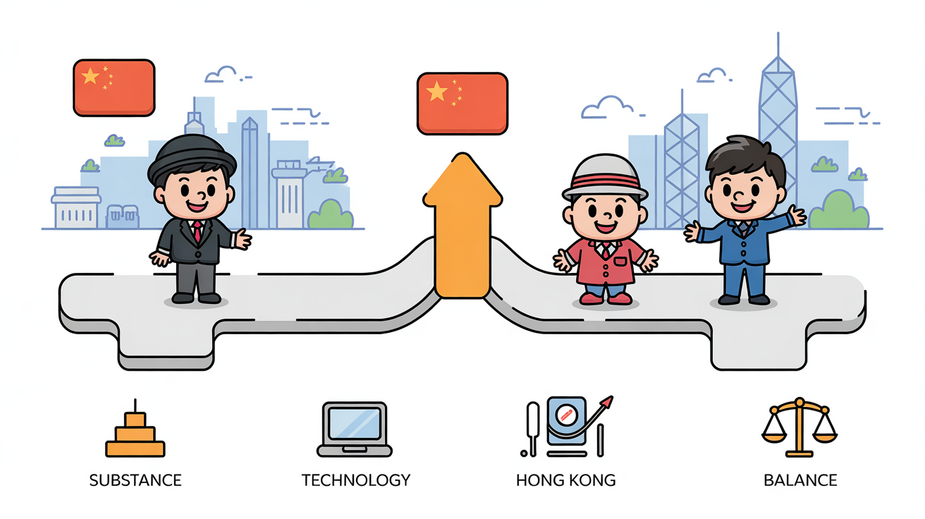
How Mainland China’s Tax Policies Impact Hong Kong Offshore Structures
📋 Key Facts at a Glance
- Fact 1: Hong Kong has a comprehensive double taxation arrangement with Mainland China that significantly reduces withholding tax rates on cross-border payments
- Fact 2: Both Hong Kong and China have implemented strict transfer pricing documentation requirements, including Master File, Local File, and Country-by-Country Reporting
- Fact 3: Hong Kong’s FSIE regime (effective January 2024) requires economic substance for foreign-sourced income to qualify for tax exemption
Are you using Hong Kong structures for your China business operations? With both jurisdictions tightening their tax rules and aligning with international standards, understanding the evolving landscape is crucial for maintaining tax efficiency while ensuring full compliance. China’s tax reforms and Hong Kong’s updated regulations are reshaping how cross-border structures operate, demanding greater substance, transparency, and proper documentation.
The Mainland-Hong Kong Double Taxation Arrangement: Your Strategic Advantage
Hong Kong’s comprehensive double taxation arrangement with Mainland China remains one of the most valuable tools for businesses operating across the border. This agreement significantly reduces withholding tax rates on various types of cross-border payments, making Hong Kong an attractive holding and operational location for China investments.
| Type of Income | Standard China Rate | DTA Reduced Rate |
|---|---|---|
| Dividends | 10% | 5% (if beneficial owner holds ≥25% equity) |
| Interest | 10% | 7% |
| Royalties | 10% | 7% |
Anti-Abuse Provisions and Substance Requirements
Both China and Hong Kong have strengthened anti-abuse provisions in their tax treaties and domestic legislation. The days of “letterbox companies” enjoying treaty benefits are over. Your Hong Kong structure must demonstrate:
- Genuine business activities conducted in Hong Kong
- Adequate staffing with qualified personnel
- Sufficient operating expenses and physical presence
- Real decision-making and risk management functions
Transfer Pricing: The New Compliance Frontier
Transfer pricing has become a critical compliance area for cross-border operations between Hong Kong and Mainland China. Both jurisdictions require comprehensive documentation to support that intercompany transactions are conducted at arm’s length prices.
Three-Tier Documentation Requirements
- Master File: Provides a high-level overview of the multinational group’s global business operations, transfer pricing policies, and intangibles
- Local File: Detailed documentation specific to Hong Kong-China transactions, including comparability analysis and pricing methodology
- Country-by-Country Report: Required for groups with consolidated revenue exceeding EUR 750 million (approximately HK$6.3 billion)
Hong Kong’s FSIE Regime: Economic Substance is Non-Negotiable
Hong Kong’s Foreign-Sourced Income Exemption (FSIE) regime, fully effective from January 2024, represents a fundamental shift in how Hong Kong structures handle foreign income. This directly impacts holding companies with China investments.
What the FSIE Regime Covers
- Dividends: Must meet economic substance requirements or participation exemption conditions
- Interest: Requires economic substance or nexus approach for IP income
- Disposal gains: From equity interests in foreign entities
- IP income: Subject to nexus approach requiring substantial R&D activities
For Hong Kong holding companies receiving dividends from China subsidiaries, the FSIE regime requires either:
- Economic substance test: Adequate employees, operating expenses, and physical premises in Hong Kong to manage and hold the equity interests
- Participation exemption: Holding at least 5% of shares for continuous 12 months, with the investee subject to comparable tax rate (minimum 15%)
China’s General Anti-Avoidance Rules (GAAR): The Ultimate Compliance Test
China’s GAAR represents the most powerful tool in the tax authority’s arsenal. It allows Chinese tax authorities to disregard or recharacterize arrangements that lack commercial substance or have tax avoidance as their main purpose.
Red Flags That Trigger GAAR Scrutiny
- Hong Kong entities with minimal substance routing large China profits
- Excessive interest payments to Hong Kong affiliates
- Royalty payments for IP developed and used primarily in China
- Circular transactions with no economic purpose
Practical Steps for Compliance and Optimization
- Conduct a substance audit: Evaluate whether your Hong Kong entity has sufficient economic substance for its functions
- Review transfer pricing policies: Ensure all China-Hong Kong transactions are properly documented and priced at arm’s length
- Assess DTA eligibility: Verify your Hong Kong entity qualifies as beneficial owner under the China-Hong Kong DTA
- Implement proper documentation: Maintain contemporaneous records for all tax positions and transactions
- Consider restructuring: If current structures lack substance, explore legitimate alternatives like regional headquarters or operational centers
✅ Key Takeaways
- Economic substance is now mandatory, not optional, for Hong Kong structures claiming tax benefits
- Proper transfer pricing documentation is essential for all cross-border transactions between Hong Kong and China
- The China-Hong Kong DTA remains valuable but requires genuine qualification as beneficial owner
- China’s GAAR can challenge even technically compliant structures lacking commercial substance
- Proactive compliance and documentation are cheaper than defending against tax authority challenges
The era of purely tax-driven Hong Kong offshore structures is ending. Successful cross-border operations now require genuine substance, proper documentation, and alignment with both Hong Kong and China’s evolving tax frameworks. By focusing on real business activities and robust compliance, companies can continue to benefit from Hong Kong’s favorable tax regime while meeting the heightened standards of both jurisdictions.
📚 Sources & References
This article has been fact-checked against official Hong Kong government sources and authoritative references:
- Inland Revenue Department (IRD) – Official tax rates, allowances, and regulations
- Rating and Valuation Department (RVD) – Property rates and valuations
- GovHK – Official Hong Kong Government portal
- Legislative Council – Tax legislation and amendments
- IRD Comprehensive Double Taxation Agreements – Hong Kong-China DTA details
- IRD Transfer Pricing Documentation – Hong Kong transfer pricing requirements
- IRD Foreign-sourced Income Exemption – FSIE regime guidance
Last verified: December 2024 | Information is for general guidance only. Consult a qualified tax professional for specific advice.