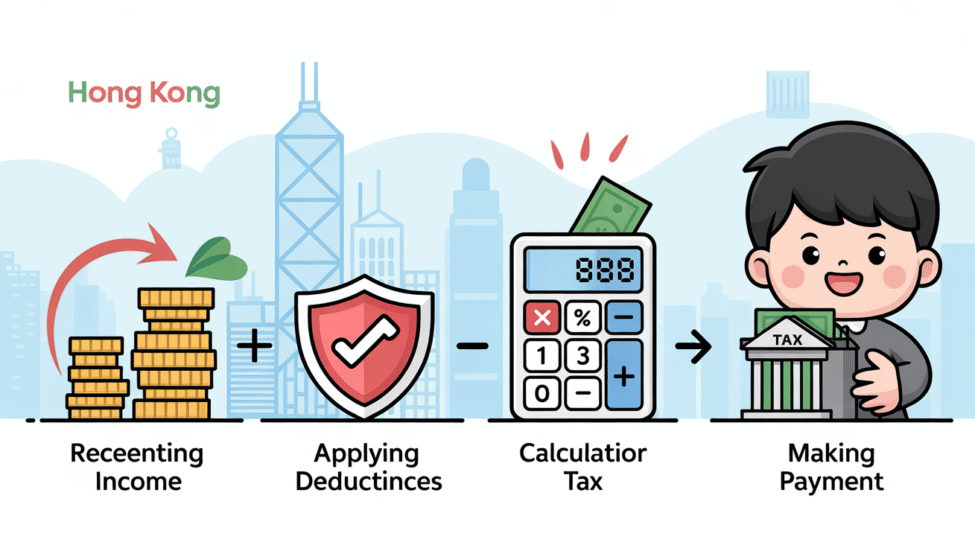
How to Calculate Your Salaries Tax Liability in Hong Kong: A Practical Example
📋 Key Facts at a Glance
- Two Calculation Methods: Hong Kong uses both progressive rates (2%-17%) and standard rates (15%-16%), with taxpayers paying the lower amount
- Generous Allowances: Basic personal allowance is HK$132,000 (2024/25), with additional allowances for dependents, children, and married couples
- Territorial System: Only Hong Kong-sourced employment income is taxable, making it ideal for international professionals
- Tax Year: April 1 to March 31, with returns typically issued in early May and due within one month
Ever wondered why some Hong Kong professionals pay significantly less tax than their counterparts in other global financial hubs? The answer lies in Hong Kong’s unique and taxpayer-friendly salaries tax system. Whether you’re a new resident, an expatriate, or a long-time Hong Kong employee, understanding how to calculate your salaries tax can save you thousands of dollars each year. This practical guide walks you through the entire process with real-world examples and actionable strategies to optimize your tax position legally.
Hong Kong’s Salaries Tax Fundamentals: What You Need to Know
Hong Kong operates on a territorial tax system, meaning only income with a Hong Kong source is subject to salaries tax. This principle is the foundation of the entire calculation process. If you perform your employment duties in Hong Kong, your income is typically considered Hong Kong-sourced and taxable, regardless of your nationality, residential status, or where payment is received.
What Counts as Taxable Income?
Your assessable income includes all Hong Kong-sourced employment income such as:
- Salaries and wages
- Bonuses, commissions, and tips
- Leave pay and termination payments
- Director’s fees
- Certain employment benefits (like housing benefits valued at specific statutory rates)
- Income from services rendered on ships or aircraft during Hong Kong voyages
The Three-Step Calculation Process
Calculating your Hong Kong salaries tax follows a logical three-step process that systematically reduces your gross income to your final tax liability. Understanding each step is key to accurate calculation and potential tax savings.
- Step 1: Determine Total Assessable Income – Sum all Hong Kong-sourced employment income for the tax year (April 1 to March 31)
- Step 2: Subtract Allowable Deductions – Reduce your income by eligible expenses and contributions
- Step 3: Apply Personal Allowances – Deduct allowances based on your personal circumstances
Key Deductions You Can Claim (2024/25)
Hong Kong offers several valuable deductions that can significantly reduce your tax burden:
| Deduction Type | Maximum Amount (HK$) | Key Requirements |
|---|---|---|
| Mandatory MPF Contributions | 18,000 per year | Mandatory contributions only |
| Qualifying Annuity/Voluntary MPF | 60,000 per year | Combined limit for both |
| Charitable Donations | 35% of assessable income | To approved institutions only |
| Self-Education Expenses | 100,000 per year | Relevant to current employment |
| Home Loan Interest | 100,000 per year | Maximum 20 years total |
| Domestic Rent | 100,000 per year | No property ownership in HK |
Personal Allowances That Reduce Your Tax (2024/25)
After deductions, personal allowances provide further tax relief based on your circumstances:
| Allowance Type | Amount (HK$) | Eligibility Criteria |
|---|---|---|
| Basic Personal Allowance | 132,000 | Every taxpayer |
| Married Person’s Allowance | 264,000 | Joint assessment with spouse |
| Child Allowance (each) | 130,000 | Each dependent child |
| Child Allowance (year of birth) | 130,000 additional | Additional for year child is born |
| Dependent Parent/Grandparent (60+) | 50,000 | Each dependent aged 60+ |
| Single Parent Allowance | 132,000 | Eligible single parents |
Progressive vs Standard Rate: Which Saves You More?
Hong Kong’s unique system calculates your tax using two methods, and you pay the lower amount. The Inland Revenue Department automatically performs both calculations, ensuring you get the most favorable outcome.
Progressive Tax Rates (2024/25)
Applied to your net chargeable income (after all deductions and allowances):
| Net Chargeable Income Bracket (HK$) | Tax Rate | Tax on Bracket |
|---|---|---|
| First 50,000 | 2% | 1,000 |
| Next 50,000 | 6% | 3,000 |
| Next 50,000 | 10% | 5,000 |
| Next 50,000 | 14% | 7,000 |
| Remainder | 17% | Varies |
Standard Tax Rates (2024/25)
Applied to your net assessable income (after deductions but BEFORE personal allowances):
| Income Level (HK$) | Standard Rate | Notes |
|---|---|---|
| First 5,000,000 | 15% | On net assessable income |
| Above 5,000,000 | 16% | On amount exceeding HK$5M |
Practical Calculation Example: Mr. Chan’s Case Study
Let’s walk through a real-world example to see how the calculation works in practice. Meet Mr. Chan, a single professional living and working in Hong Kong.
| Calculation Step | Amount (HK$) | Explanation |
|---|---|---|
| Annual Salary | 800,000 | Hong Kong-sourced employment |
| Performance Bonus | 50,000 | Taxable employment income |
| Total Assessable Income | 850,000 | Step 1 complete |
| Less: MPF Contributions | 18,000 | Maximum deductible amount |
| Net Assessable Income | 832,000 | For standard rate calculation |
| Less: Basic Personal Allowance | 132,000 | 2024/25 basic allowance |
| Net Chargeable Income | 700,000 | For progressive rate calculation |
Calculating Mr. Chan’s Tax Liability
Now let’s calculate using both methods:
Method 1: Progressive Rate Calculation
On HK$700,000 net chargeable income:
- First HK$50,000 × 2% = HK$1,000
- Next HK$50,000 × 6% = HK$3,000
- Next HK$50,000 × 10% = HK$5,000
- Next HK$50,000 × 14% = HK$7,000
- Remaining HK$500,000 × 17% = HK$85,000
- Total Progressive Tax = HK$101,000
Method 2: Standard Rate Calculation
On HK$832,000 net assessable income (since this is below HK$5,000,000):
- HK$832,000 × 15% = HK$124,800
Result: Mr. Chan pays HK$101,000 (the lower amount from progressive calculation).
Common Calculation Mistakes to Avoid
Even experienced taxpayers can make errors that cost them money or trigger IRD inquiries. Here are the most common pitfalls:
- Misunderstanding Territorial Source: Failing to properly document work performed outside Hong Kong that should be exempt from tax
- Overlooking Eligible Deductions: Missing out on legitimate deductions like self-education expenses or charitable donations
- Claiming Ineligible Expenses: Attempting to deduct personal expenses not allowed under salaries tax rules
- Missing Personal Allowances: Forgetting to claim allowances for dependents, especially when circumstances change during the year
- Incorrect MPF Calculations: Miscalculating mandatory or voluntary MPF contribution limits
Deadlines and Compliance Essentials
Staying compliant means understanding key dates and procedures:
| Action | Typical Timing | Key Details |
|---|---|---|
| Tax Returns Issued | Early May | IRD sends returns for previous tax year |
| Standard Filing Deadline | Early June | 1 month from issue date |
| E-filing Extension | Often early July | Automatic extension for online filing |
| First Provisional Tax Installment | January | Based on previous year’s income |
| Second Provisional Tax Installment | April | Following tax year |
Smart Tax Optimization Strategies
Beyond basic compliance, these strategies can legally reduce your tax burden:
- Maximize Voluntary MPF Contributions: Contribute up to HK$60,000 annually to qualifying annuities or voluntary MPF for immediate tax relief while building retirement savings
- Strategic Charitable Giving: Plan donations to approved charities (up to 35% of assessable income) to maximize tax benefits while supporting causes you care about
- Timing of Income and Expenses: Consider the timing of bonuses, deductions, and allowances across tax years where possible
- Review Allowances Annually: Update your allowances whenever personal circumstances change (marriage, children, dependent parents)
- Consider Personal Assessment: If you have business or rental income, personal assessment might offer additional tax savings
✅ Key Takeaways
- Hong Kong’s salaries tax system is territorial – only Hong Kong-sourced employment income is taxable
- You always pay the lower of two calculations: progressive rates (2%-17%) or standard rates (15%-16%)
- Personal allowances (HK$132,000 basic) and deductions (MPF, donations, etc.) significantly reduce your tax liability
- Proper documentation of work location is crucial for claiming exemptions for overseas work
- Strategic planning with voluntary MPF contributions and charitable donations can optimize your tax position
- File your tax return by early June (or extended deadline for e-filing) to avoid penalties
Mastering Hong Kong’s salaries tax calculation isn’t just about compliance – it’s about financial empowerment. By understanding the system’s nuances, you can make informed decisions that optimize your tax position while staying fully compliant. Remember that while this guide provides comprehensive information, individual circumstances vary. For complex situations or significant financial decisions, consulting a qualified tax professional ensures you maximize your benefits while minimizing risks. Start planning now for the next tax year – your future self will thank you.
📚 Sources & References
This article has been fact-checked against official Hong Kong government sources and authoritative references:
- Inland Revenue Department (IRD) – Official tax rates, allowances, and regulations
- Rating and Valuation Department (RVD) – Property rates and valuations
- GovHK – Official Hong Kong Government portal
- Legislative Council – Tax legislation and amendments
- IRD Salaries Tax Guide – Official salaries tax information and rates
- GovHK Allowances – Detailed information on personal allowances
- GovHK MPF Deductions – MPF contribution limits and tax treatment
Last verified: December 2024 | Information is for general guidance only. Consult a qualified tax professional for specific advice.