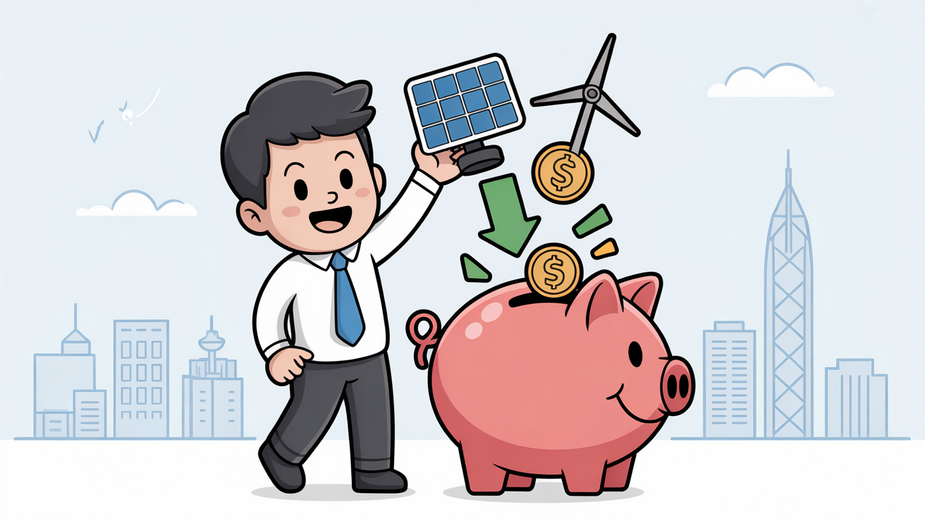
How to Leverage Hong Kong’s Tax Deductions for Renewable Energy Investments
📋 Key Facts at a Glance
- Tax Savings: Renewable energy investments qualify for capital allowances that reduce taxable profits by up to 60% in the first year
- Business Rates: Companies pay 8.25% on first HK$2 million profits, 16.5% on remainder under Hong Kong’s two-tiered system
- Revenue Stream: Feed-in Tariff schemes pay HK$2.5-5 per kWh for solar energy exported to the grid
- Documentation: Maintain records for 7 years as required by Hong Kong tax law
Did you know that investing in solar panels or wind turbines for your Hong Kong business could slash your tax bill while generating long-term revenue? As Hong Kong accelerates toward its carbon neutrality goals, smart investors are discovering that renewable energy isn’t just good for the planet—it’s excellent for your bottom line. Through strategic use of capital allowances and government incentives, you can transform green energy investments into powerful tax-saving opportunities.
Hong Kong’s Renewable Energy Tax Landscape: More Than Just Green Credentials
Hong Kong’s commitment to sustainable development has created a compelling financial case for renewable energy investments. While the environmental benefits are clear, the tax advantages make these projects financially attractive for businesses of all sizes. The government’s approach leverages Hong Kong’s territorial tax system and capital allowance framework to directly reduce your taxable profits when you invest in qualifying renewable energy assets.
Unlike some jurisdictions with complex green energy tax credits, Hong Kong uses its existing profits tax system to incentivize renewable investments. This means you don’t need to navigate entirely new tax regimes—you simply apply standard capital allowance rules to your green energy assets. The result is a straightforward path to significant tax savings while contributing to Hong Kong’s environmental goals.
How Capital Allowances Work for Renewable Energy
Capital allowances are Hong Kong’s version of depreciation for tax purposes. When you invest in plant and machinery for your business—including renewable energy systems—you can claim these allowances to reduce your taxable profits. The system operates on a reducing balance basis, meaning you claim a percentage of the remaining value each year.
| Asset Type | Initial Allowance | Annual Allowance |
|---|---|---|
| Solar PV Systems | 60% | 10%, 20%, or 30% |
| Wind Turbines | 60% | 10%, 20%, or 30% |
| Biomass Systems | 60% | 10%, 20%, or 30% |
| Associated Equipment | 60% | 10%, 20%, or 30% |
What Qualifies for Renewable Energy Tax Deductions?
Not every “green” investment qualifies for tax deductions. To maximize your benefits, you need to understand exactly what the Inland Revenue Department (IRD) considers eligible renewable energy assets. The key is that the equipment must be used for the purpose of producing profits in your trade or business.
Eligible Renewable Energy Systems
- Solar Photovoltaic (PV) Systems: Rooftop solar panels, solar carports, and building-integrated photovoltaics
- Wind Energy Systems: Small-scale wind turbines suitable for urban or industrial settings
- Biomass Energy Systems: Equipment that converts organic materials into energy
- Geothermal Heat Pumps: Systems that use ground-source heat for heating and cooling
- Supporting Infrastructure: Inverters, mounting systems, monitoring equipment, and installation costs
Calculating Your Tax Savings: A Practical Example
Let’s walk through a real-world example to show how renewable energy investments translate into tax savings. Imagine a Hong Kong manufacturing company invests HK$500,000 in a rooftop solar system for its factory.
| Year | Allowance Calculation | Tax Saving (16.5% rate) |
|---|---|---|
| Year 1 | HK$500,000 × 60% = HK$300,000 | HK$49,500 |
| Year 2 | HK$200,000 × 20% = HK$40,000 | HK$6,600 |
| Year 3 | HK$160,000 × 20% = HK$32,000 | HK$5,280 |
| Year 4 | HK$128,000 × 20% = HK$25,600 | HK$4,224 |
| Total (4 years) | HK$397,600 claimed | HK$65,604 saved |
This example shows how a HK$500,000 investment generates over HK$65,000 in direct tax savings within just four years. But the financial benefits don’t stop there—you also save on electricity bills and may earn additional revenue through Hong Kong’s Feed-in Tariff scheme.
Combining Tax Savings with Feed-in Tariff Revenue
Hong Kong’s Feed-in Tariff (FiT) scheme pays businesses for renewable energy exported to the grid. Current rates (2024) are:
- Solar PV Systems: HK$2.5-5 per kWh depending on system size
- Contract Term: Typically 15 years guaranteed pricing
- Additional Benefit: FiT payments are generally taxable as business income, but you can deduct operating expenses
Documentation and Compliance: Protecting Your Investment
Proper documentation is non-negotiable when claiming renewable energy tax deductions. The IRD requires you to maintain records for seven years, and any audit will focus on proving that your investment qualifies for capital allowances.
- Purchase Documentation: Keep all invoices, receipts, and contracts showing equipment costs, installation fees, and payment records
- Certification Proof: Maintain copies of all safety certifications, equipment specifications, and installer qualifications
- Operational Records: Track energy production data, maintenance logs, and any performance monitoring reports
- Tax Filing: Include capital allowance claims in your annual profits tax return using the correct IRD forms
Strategic Timing for Maximum Benefits
When you make your renewable energy investment can significantly impact your tax savings. Here are key timing considerations:
Fiscal Year Alignment
Capital allowances are claimed in the year the asset is first used for business purposes. If you complete installation and commissioning near the end of your fiscal year, you can claim the 60% initial allowance sooner, accelerating your tax savings.
Phased Implementation Strategy
For larger projects, consider phasing your investment:
- Year 1: Install core system, claim initial allowance
- Year 2: Add monitoring/optimization equipment
- Year 3: Expand capacity or add storage
This approach spreads your tax benefits across multiple years while allowing you to incorporate technological improvements.
Common Pitfalls and How to Avoid Them
Even well-intentioned investors can make mistakes that jeopardize their tax deductions. Here are the most common pitfalls and how to avoid them:
| Pitfall | Consequence | Prevention Strategy |
|---|---|---|
| Uncertified Equipment | Claim rejection, potential penalties | Verify certifications before purchase, use approved suppliers |
| Incomplete Documentation | Delayed processing, audit issues | Create checklist, organize files digitally, keep for 7+ years |
| Incorrect Allowance Rates | Under/over-claiming, adjustments | Consult IRD guidelines, work with tax professional |
| Missing Deadlines | Lost benefits for the year | Mark tax calendar, set reminders for April/May filings |
Future-Proofing Your Renewable Energy Investment
The renewable energy landscape is evolving rapidly. To ensure your investment remains valuable for years to come, consider these forward-thinking strategies:
Smart Technology Integration
Invest in systems with smart capabilities:
- Grid-Interactive Inverters: Allow participation in future grid services
- Energy Monitoring Systems: Provide data for optimization and reporting
- Battery-Ready Design: Plan for future energy storage integration
Policy Monitoring
Stay informed about Hong Kong’s evolving energy policies:
- Monitor Feed-in Tariff rate adjustments
- Watch for new renewable energy incentives
- Track carbon neutrality roadmap updates
✅ Key Takeaways
- Renewable energy investments qualify for 60% initial capital allowances plus annual allowances, significantly reducing taxable profits
- Combine tax savings with Feed-in Tariff revenue (HK$2.5-5 per kWh) for enhanced returns
- Maintain meticulous documentation for 7+ years including invoices, certifications, and operational records
- Time installations strategically around fiscal year-ends to accelerate tax benefits
- Invest in certified equipment and work with qualified installers to ensure compliance
- Future-proof investments with smart technology and monitor evolving energy policies
Hong Kong’s renewable energy tax incentives create a compelling financial case for businesses to go green. By leveraging capital allowances, Feed-in Tariff revenue, and strategic timing, you can achieve attractive returns while contributing to Hong Kong’s sustainable future. The combination of immediate tax savings, long-term revenue streams, and environmental benefits makes renewable energy one of the smartest investments available to Hong Kong businesses today. Start planning your project now to maximize benefits in the coming tax year.
📚 Sources & References
This article has been fact-checked against official Hong Kong government sources and authoritative references:
- Inland Revenue Department (IRD) – Official tax rates, allowances, and regulations
- Rating and Valuation Department (RVD) – Property rates and valuations
- GovHK – Official Hong Kong Government portal
- Legislative Council – Tax legislation and amendments
- IRD Profits Tax Guide – Capital allowances and business deductions
- GovHK Feed-in Tariff Scheme – Renewable energy incentive program
- CLP Feed-in Tariff – Utility provider renewable energy program
Last verified: December 2024 | Information is for general guidance only. Consult a qualified tax professional for specific advice.