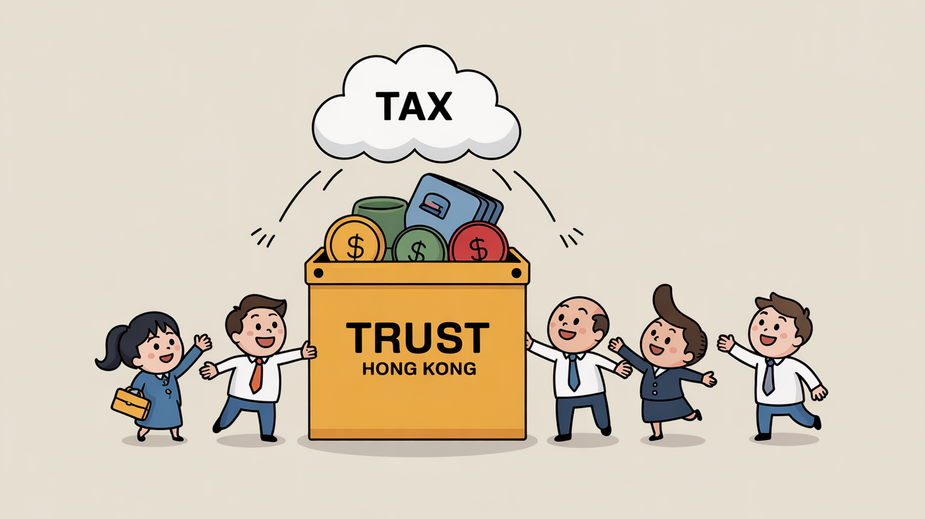
How to Use Hong Kong Trusts for Tax-Efficient Wealth Preservation
📋 Key Facts at a Glance
- Zero Capital Gains Tax: Hong Kong imposes no tax on asset appreciation within trusts
- No Estate Duty: Inheritance tax was abolished in 2006, eliminating transfer taxes
- Territorial Tax System: Offshore income is not taxable in Hong Kong
- Tax-Free Distributions: Dividends to beneficiaries face no withholding tax
- FIHV 0% Tax Rate: Family trusts can qualify for 0% profits tax on qualifying transactions
- Perpetual Trusts: Can last indefinitely under Hong Kong’s 2013 Trust Law Amendment
- Market Size: HK$5.188 trillion (US$667 billion) in trust assets as of 2023
- No Withholding Tax: On distributions to Hong Kong or overseas beneficiaries
With over HK$5.188 trillion in trust assets and growing at 10% annually, Hong Kong has cemented its position as Asia’s premier jurisdiction for tax-efficient wealth preservation. But what makes Hong Kong trusts so uniquely attractive for high-net-worth families? The answer lies in a powerful combination: zero capital gains tax, no estate duty, a territorial tax system that exempts offshore income, and the groundbreaking Family-Owned Investment Holding Vehicle (FIHV) regime offering 0% tax rates. This comprehensive guide reveals how to leverage Hong Kong’s trust framework to protect and transfer wealth across generations while maximizing tax efficiency.
Hong Kong’s Trust Tax Framework: The Foundation of Wealth Preservation
The Territorial Tax Principle: Your Global Advantage
Hong Kong’s territorial tax system forms the cornerstone of its attractiveness for trust structures. Under the Inland Revenue Ordinance, Hong Kong adopts a source-based taxation principle rather than residence or domicile-based taxation. This fundamental distinction creates exceptional planning opportunities for trusts.
A Hong Kong trust is only subject to profits tax if it carries on a trade, profession, or business in Hong Kong and derives Hong Kong-source profits from that activity. Crucially, chargeability to Hong Kong tax is not dependent on the settlor’s domicile, the trustee’s residence, or the beneficiaries’ nationality. This means income derived by a trust from assets located outside Hong Kong is not taxable to the trustee, the trust entity, or the beneficiaries—regardless of whether those beneficiaries are Hong Kong residents or overseas.
Zero Capital Gains and Estate Taxes: The Perfect Combination
Hong Kong does not impose capital gains tax on any transactions, including those conducted by or within a trust structure. When trust assets appreciate in value and are subsequently sold, the gains are entirely tax-free. This benefit extends to all asset classes—equities, bonds, real estate (outside Hong Kong), private equity investments, and increasingly, virtual assets.
Additionally, Hong Kong abolished estate duty in February 2006. Before abolition, trusts served primarily as estate tax planning vehicles. While the elimination of estate duty removed this specific incentive, trusts have evolved to serve broader wealth preservation and succession planning purposes. The combination of zero capital gains tax and no estate duty creates an extraordinarily favorable environment for long-term wealth accumulation and transfer.
Dividend Taxation and Distribution Rules: Complete Transparency
Hong Kong’s tax regime does not tax dividend income, whether sourced from Hong Kong companies or overseas entities. When a Hong Kong trust receives dividends, those distributions are not subject to tax at the trust level. More importantly, there is no withholding tax on distributions made by the trust to beneficiaries, regardless of whether the beneficiaries are located in Hong Kong or abroad.
This tax transparency creates efficient wealth transfer mechanisms. Distributions to beneficiaries from a Hong Kong trust—whether funded from Hong Kong-source income or offshore income—are not taxable in the hands of the beneficiaries. This applies equally to resident and non-resident beneficiaries, making Hong Kong trusts particularly attractive for families with members scattered across multiple jurisdictions.
Trust Structures for Optimal Wealth Preservation
Discretionary Family Trusts: Maximum Flexibility
Discretionary trusts remain the most popular structure for Hong Kong families engaged in succession planning. Under a discretionary trust, the trustee has full discretion to determine which beneficiaries receive distributions, when distributions are made, and in what amounts. This flexibility serves multiple purposes beyond tax efficiency.
- Asset Protection: Protects assets from creditor claims against individual beneficiaries
- Divorce Protection: Shields wealth from divorce proceedings and family disputes
- Strategic Distribution: Allows trustees to manage distributions according to beneficiaries’ changing circumstances
- Forced Heirship Avoidance: Provides protection against forced heirship rules in civil law jurisdictions
Perpetual Trusts for Multigenerational Wealth Transfer
The Trust Law (Amendment) Ordinance 2013 introduced a groundbreaking change to Hong Kong trust law: the ability to establish perpetual trusts without any rule against perpetuities limitation. Traditionally, common law jurisdictions restricted trust duration to a life or lives in being plus 21 years, or a fixed period (often 80-125 years).
Hong Kong’s removal of this restriction allows settlors to create trusts that can last indefinitely, preserving family wealth across unlimited generations. This perpetual feature is particularly valuable for ultra-high-net-worth families concerned with dynasty planning and long-term wealth preservation.
Purpose Trusts and Private Trust Companies
Hong Kong law permits purpose trusts—trusts established for specific purposes rather than for the benefit of defined beneficiaries. These structures are increasingly used to hold family business interests, ensure continuity of philanthropic missions, or preserve specific assets like art collections or intellectual property portfolios.
Many sophisticated families establish Private Trust Companies (PTCs) to serve as trustees of their family trusts. A PTC is a company whose sole purpose is to act as trustee for one family’s trust structures. This arrangement provides families with greater control and involvement in trust governance while maintaining the legal separation between personal assets and trust assets.
The Family-Owned Investment Holding Vehicle (FIHV) Regime: 0% Tax Rate
Structure and Eligibility Requirements
Introduced in 2022 and enhanced significantly in 2024, the FIHV regime provides a 0% profits tax rate for qualifying family investment vehicles, including trusts. This concessionary regime was designed to attract family offices and investment holding structures to Hong Kong, competing with Singapore and other regional wealth management hubs.
| Requirement | Details |
|---|---|
| Beneficial Ownership | At least 95% held by members of a single family |
| Management | Must engage an Eligible Single Family Office (ESFO) |
| Asset Threshold | Minimum HK$240 million in total net asset value |
| Central Management | Must maintain central management and control in Hong Kong |
| Legal Structure | Can be corporation, partnership, or trust |
2024 Enhancements: Expanded Qualifying Assets
Under the FIHV regime, assessable profits from “qualifying transactions” and “incidental transactions” are taxed at 0%. The November 2024 consultation paper proposed significant expansions to the scope of qualifying assets, reflecting Hong Kong’s ambition to remain competitive in the evolving wealth management landscape.
- Virtual Assets: Cryptocurrencies, digital tokens, and other blockchain-based assets
- Private Credit Investments: Direct lending and private debt instruments
- Loans: Various forms of lending arrangements
- Non-Corporate Entities: Partnerships, limited liability partnerships, and similar structures
- Traditional Assets: Securities, futures contracts, foreign exchange contracts, and deposits
Integration with Trust Structures
A trust can qualify as an FIHV if it meets the statutory requirements, or alternatively, a trust can hold the beneficial interest in an FIHV structured as a corporation or partnership. This flexibility allows families to design multi-layered structures that optimize both governance and tax efficiency.
For example, a discretionary trust might be established with a Hong Kong trustee, and that trust could wholly own an FIHV corporation that conducts the investment activities. Alternatively, the trust itself could be designated as the FIHV, with the trustee engaging an ESFO to manage the trust’s investment portfolio.
Asset Protection Benefits Beyond Tax Efficiency
Creditor Protection and Ring-Fencing
Beyond tax efficiency, Hong Kong trusts provide robust asset protection mechanisms. When assets are properly transferred to a trust, they are legally owned by the trustee for the benefit of the beneficiaries. This separation means the assets are generally protected from claims against the settlor’s personal estate and from claims against individual beneficiaries.
For business owners and professionals exposed to commercial risks, trusts offer a method to ring-fence family wealth from business liabilities. If a family business faces bankruptcy or litigation, properly structured trust assets typically remain beyond the reach of business creditors.
Protection from Divorce and Family Disputes
Discretionary trusts provide significant protection from divorce claims against beneficiaries. Because beneficiaries of a discretionary trust have no fixed entitlement to trust assets—only a hope or expectation of future distributions at the trustee’s discretion—those assets generally are not considered part of the beneficiary’s matrimonial property.
This protection is particularly valuable for families concerned about preserving wealth across generations where beneficiaries may enter into marriages or relationships that later dissolve. By maintaining assets in trust rather than distributing them outright, families can ensure wealth remains within the bloodline and is not diluted through divorce settlements.
Compliance and Reporting Requirements
Trustee Tax Obligations
Hong Kong trustees must comply with the Inland Revenue Ordinance, which treats trustees as “persons” subject to tax obligations. If a trust carries on business in Hong Kong or derives Hong Kong-source income, the trustee must file annual profits tax returns and pay any applicable tax on Hong Kong-source profits.
Trustees must maintain comprehensive records of all trust transactions, income sources, distributions to beneficiaries, and expense allocations. These records must be retained for at least seven years and be available for review by the Inland Revenue Department upon request.
Common Reporting Standard (CRS) Compliance
Hong Kong implemented the Common Reporting Standard (CRS) for automatic exchange of financial account information in 2017. Under CRS, Hong Kong financial institutions—including trust companies acting as trustees—must identify account holders who are tax residents of reportable jurisdictions and report their account information to the Inland Revenue Department, which exchanges this information with the relevant foreign tax authorities.
For trust structures, this means information about settlors, trustees, protectors, and beneficiaries who are tax residents of CRS participating jurisdictions may be reported to their home tax authorities. Families must ensure they are compliant with tax obligations in all relevant jurisdictions, as Hong Kong’s participation in CRS eliminates the possibility of using Hong Kong trusts for tax evasion.
Practical Steps for Establishing a Hong Kong Trust
- Select the Right Trustee: Choose between licensed trust companies, Private Trust Companies (PTCs), or individual trustees based on your family’s needs and the trust’s complexity
- Structure the Trust Deed: Work with legal professionals to draft comprehensive terms covering beneficiary definitions, distribution provisions, trustee powers, and duration
- Consider FIHV Eligibility: Evaluate whether your trust structure can qualify for the 0% tax rate under the FIHV regime
- Fund the Trust: Properly document asset transfers through appropriate legal instruments and account openings
- Establish Ongoing Management: Implement investment management, accounting, tax compliance, and distribution decision processes
- Ensure Regulatory Compliance: Maintain CRS reporting, beneficial ownership disclosure, and other regulatory requirements
Key Trustee Selection Considerations
| Trustee Type | Advantages | Considerations |
|---|---|---|
| Licensed Trust Companies | Professional expertise, regulatory compliance, institutional continuity | Less family control, potentially higher fees |
| Private Trust Companies | Family control, customized governance, continuity | Higher setup costs, ongoing compliance requirements |
| Individual Trustees | Personal relationships, potentially lower costs | Lacks institutional continuity, potential succession issues |
✅ Key Takeaways
- Hong Kong’s territorial tax system exempts offshore income, making it ideal for international wealth structures
- The combination of zero capital gains tax and no estate duty creates unparalleled wealth preservation opportunities
- The FIHV regime offers 0% profits tax rate for qualifying family trusts with minimum HK$240 million in assets
- Perpetual trusts allow indefinite wealth transfer across generations without time limitations
- Discretionary trusts provide robust asset protection from creditors, divorce claims, and forced heirship rules
- Proper trustee selection and professional advice are essential for maximizing benefits while ensuring compliance
- Hong Kong’s trust market has grown to HK$5.188 trillion, reflecting strong regional demand and competitive advantages
- Ongoing regulatory enhancements position Hong Kong favorably for evolving wealth management needs
Hong Kong trusts offer sophisticated wealth preservation and tax planning opportunities for high-net-worth families, combining favorable tax treatment, robust asset protection, and perpetual duration within a well-established legal framework. As the Asia-Pacific region’s wealth continues to grow and international tax transparency increases, Hong Kong’s position as the premier trust domicile for Asian families is strengthened by ongoing regulatory enhancements and adaptation to emerging asset classes. Proper professional advice from experienced Hong Kong trust practitioners and tax advisors is essential to maximize these benefits while ensuring full compliance with evolving regulatory requirements.
📚 Sources & References
This article has been fact-checked against official Hong Kong government sources and authoritative references:
- Inland Revenue Department (IRD) – Official tax rates, allowances, and regulations
- IRD FIHV Regime – Family-Owned Investment Holding Vehicle tax concessions
- IRD Territorial Source Principle – Guide to Hong Kong’s territorial tax system
- GovHK – Official Hong Kong Government portal
- Legislative Council – Trust Law amendments and tax legislation
- IRD Profits Tax Guide – Corporate and trust taxation framework
Last verified: December 2024 | Information is for general guidance only. Consult a qualified tax professional for specific advice.