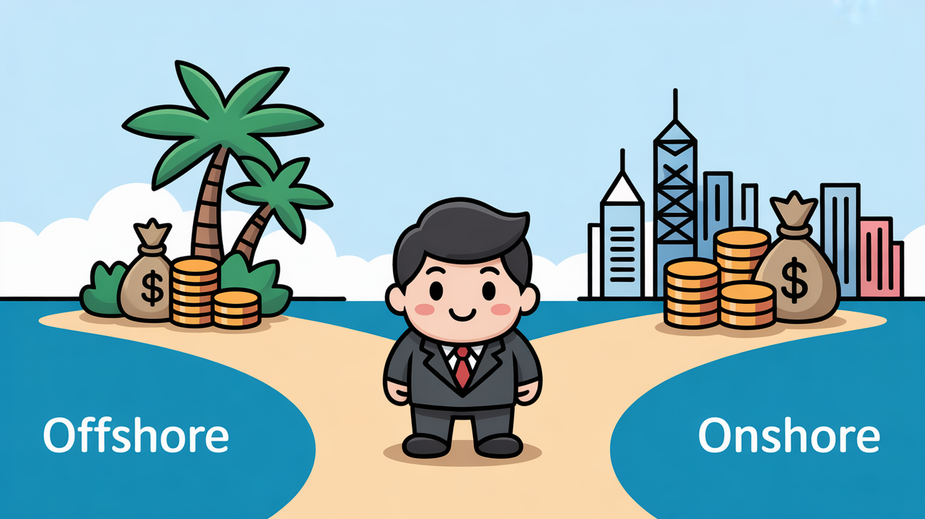
Offshore vs. Onshore: Structuring Investments for Optimal Tax Efficiency in Hong Kong
📋 Key Facts at a Glance
- Territorial Taxation: Only Hong Kong-sourced profits are subject to profits tax
- Corporate Tax Rates: 8.25% on first HK$2 million, 16.5% on remaining profits
- FSIE Regime Phase 2: Expanded coverage from January 1, 2024 to all disposal gains
- Economic Substance: MNEs must demonstrate adequate operations in Hong Kong
- No Capital Gains Tax: Generally no tax on capital gains (subject to FSIE rules for MNEs)
- Offshore Claim Validity: Approved offshore status typically valid for 3-5 years
- EU Compliance: Hong Kong removed from EU watchlist in February 2024
Are you structuring investments through Hong Kong but confused about the evolving tax landscape? With the introduction of the Foreign-Sourced Income Exemption (FSIE) regime and enhanced economic substance requirements, the distinction between offshore and onshore taxation has become more sophisticated than ever. This comprehensive guide breaks down Hong Kong’s territorial tax system, the latest FSIE developments through 2024, and strategic considerations for achieving optimal tax efficiency while maintaining full compliance.
Understanding Hong Kong’s Territorial Taxation Principle
Hong Kong operates under a territorial source principle of taxation, meaning only profits that have a source in Hong Kong are subject to profits tax. This fundamental principle distinguishes Hong Kong from many jurisdictions that tax on a worldwide basis. The practical application, however, requires careful analysis of where and how profits are generated.
The Operations Test: How the IRD Determines Source
The Inland Revenue Department (IRD) applies the “operations test” to determine the source of profits. This test examines what the taxpayer has done to earn the profits and where those profit-generating activities occurred. If the operations that essentially give rise to the profits take place in Hong Kong, the profits are taxable in Hong Kong. Conversely, if the essential profit-generating activities occur outside Hong Kong, the profits are not subject to Hong Kong profits tax.
The operations test is not a mechanical application of fixed criteria. Instead, the IRD considers all relevant facts and circumstances of each transaction. Key considerations include:
- Location of contract negotiation and execution: Where purchase and sale contracts are concluded
- Location of decision-making: Where strategic and operational decisions are made (though this alone is not determinative)
- Location of profit-generating activities: Where the substantive work is performed
- Place where goods are sourced or services delivered: The geographic location of business operations
Trading Profits: Clear Guidelines for Determination
For trading businesses, the IRD has established clear guidelines for determining source:
| Scenario | Tax Treatment |
|---|---|
| Both purchase and sale contracts effected in Hong Kong | Profits taxable in Hong Kong |
| Both purchase and sale contracts effected outside Hong Kong | Profits not taxable in Hong Kong |
| Either purchase or sale contract effected in Hong Kong | Initial presumption of taxability; requires examination of all relevant facts |
The Foreign-Sourced Income Exemption (FSIE) Regime: A Game Changer
The FSIE regime represents a significant evolution in Hong Kong’s tax framework, introduced to address EU concerns about double non-taxation while maintaining Hong Kong’s territorial tax system. The regime has undergone two phases of implementation that every MNE operating in Hong Kong must understand.
Phase 1: Implementation from January 1, 2023
The initial FSIE regime took effect on January 1, 2023, targeting four types of specified foreign-sourced income received in Hong Kong by MNE entities:
- Interest income
- Dividend income
- Disposal gains from equity interests
- Intellectual property (IP) income
Under this regime, if an MNE entity carrying on a trade, profession, or business in Hong Kong receives these types of foreign-sourced income in Hong Kong, the income is deemed to be sourced from Hong Kong and becomes chargeable to profits tax unless the entity satisfies specific exemption requirements.
Phase 2: Major Expansion from January 1, 2024
Following further refinements enacted on December 8, 2023, the FSIE regime expanded significantly from January 1, 2024. The key changes include:
- Expanded scope of disposal gains: Coverage now extends to disposal gains on all types of property (movable and immovable), not just equity interests
- Both capital and revenue gains: The regime applies regardless of whether gains are capital or revenue in nature
- Financial and non-financial assets: All asset types are covered under the expanded regime
- Intra-group transfer relief: New relief mechanism to defer tax on disposal gains for transfers between associated entities, subject to anti-abuse rules
Who is Subject to the FSIE Regime?
The FSIE regime specifically targets MNE entities. An entity is considered part of an MNE group if:
- The entity is part of a group that prepares consolidated financial statements
- The group includes entities located in more than one jurisdiction
- The group has annual consolidated revenue of HK$750 million or more
Importantly, individuals and purely domestic companies not part of an MNE group are not subject to the FSIE regime and continue to benefit from traditional offshore profits exemption.
Exemption Requirements Under the FSIE Regime
MNE entities can exempt specified foreign-sourced income from Hong Kong profits tax by satisfying one of three requirements, depending on the type of income:
1. Economic Substance Requirement
The economic substance requirement applies to interest income, dividend income, and non-IP disposal gains. To satisfy this requirement, an entity must demonstrate that it conducts adequate economic activities in Hong Kong in relation to the foreign-sourced income.
The IRD applies an “adequacy test” rather than a fixed checklist. The assessment considers:
- Adequate employees: Sufficient qualified personnel in Hong Kong to conduct the relevant activities
- Adequate operating expenditure: Expenditure in Hong Kong proportionate to the income-generating activities
- Adequate physical presence: Office space and facilities appropriate for the operations
2. Participation Requirement
The participation requirement applies to foreign-sourced dividends and equity disposal gains. To qualify for exemption, the Hong Kong entity must:
- Hold at least 5% of the equity interests in the entity generating the income
- Maintain this holding for a continuous period of at least 12 months
- Satisfy anti-abuse conditions (the investee cannot derive more than 50% of its asset value from Hong Kong immovable property)
3. Nexus Requirement for IP Income
The nexus requirement applies specifically to IP income and is based on the OECD’s modified nexus approach. To satisfy this requirement, the entity must demonstrate a direct connection between the IP income and research and development (R&D) activities conducted in Hong Kong.
The nexus calculation compares qualifying R&D expenditure incurred in Hong Kong to total R&D expenditure. Only IP income proportionate to Hong Kong R&D activities qualifies for exemption. This prevents MNEs from routing IP income through Hong Kong without substantive R&D activities in the jurisdiction.
Offshore Tax Claims: Process and Documentation
For entities not subject to the FSIE regime (non-MNE entities) or for income streams that fall outside the FSIE scope, the traditional offshore claim process remains relevant.
Filing an Offshore Tax Claim: Step-by-Step
- Initial filing: Submit detailed documentation supporting the offshore nature of profits with the profits tax return
- IRD review: The IRD examines the claim, which can take 6 months or longer
- Approval: If approved, offshore status is typically granted for 3-5 years
- Ongoing compliance: Annual confirmation that business operations remain offshore
Documentation Requirements: What You Need
| Document Type | Purpose |
|---|---|
| Contracts and agreements | Evidence of where contracts were negotiated and executed |
| Correspondence and communications | Demonstrate the location of business negotiations and operations |
| Banking and payment records | Show payment flows and banking arrangements |
| Organizational structure | Detail the roles and locations of personnel |
| Travel records | Evidence of where business activities were conducted |
| Supplier and customer details | Demonstrate the geographic location of business relationships |
Structuring Considerations for Investment Vehicles
The interplay between Hong Kong’s territorial taxation principle, the FSIE regime, and economic substance requirements creates a complex landscape for structuring investment vehicles. Optimal structuring requires careful consideration of multiple factors.
MNE vs. Non-MNE Structures: A Critical Decision
One of the most fundamental structuring decisions is whether the investment structure will be part of an MNE group. Non-MNE structures remain largely unaffected by the FSIE regime and can continue to benefit from traditional offshore exemptions, provided they satisfy source of profits requirements.
Economic Substance Planning: Getting It Right
For MNE entities receiving specified foreign-sourced income, establishing adequate economic substance in Hong Kong is often the most practical exemption route. This requires genuine operational presence:
- Qualified personnel: Hiring employees with appropriate skills and authority for investment decision-making
- Operational expenditure: Maintaining Hong Kong office space and incurring operating costs proportionate to activities
- Board and management meetings: Holding substantive meetings in Hong Kong where investment decisions are made
- Documentation: Maintaining records evidencing that Hong Kong personnel are conducting the relevant activities
Holding Company Structures: Maximizing Benefits
Hong Kong remains attractive for regional holding company structures, particularly after the introduction of the participation requirement and tax certainty scheme. Effective structuring involves:
- Maintaining qualifying participation: Ensuring equity holdings meet the 5% threshold for FSIE participation exemption or 15% for tax certainty
- Holding period planning: Structuring acquisitions to satisfy the 12-month (FSIE) or 24-month (tax certainty) holding periods before anticipated disposals
- Anti-abuse compliance: Ensuring investee companies do not derive excessive value from Hong Kong property
- Dividend repatriation: Planning for tax-efficient dividend flows from operating subsidiaries
Future Developments: Pillar Two Implementation
Hong Kong has enacted legislation to implement the OECD’s Pillar Two Global Anti-Base Erosion (GloBE) rules, including:
- Income Inclusion Rule (IIR): Effective for fiscal years beginning on or after January 1, 2025
- Hong Kong Minimum Top-up Tax (HKMTT): Also effective from January 1, 2025
- Undertaxed Profits Rule (UTPR): Effective date to be announced
These rules will apply to MNE groups with consolidated revenue of EUR 750 million or more (approximately HK$6.5 billion), ensuring a minimum effective tax rate of 15% on profits in each jurisdiction. Investment structures should consider the interaction between the FSIE regime and Pillar Two, particularly regarding substance requirements and effective tax rate calculations.
Practical Compliance Considerations
Successfully navigating Hong Kong’s offshore-onshore tax framework requires robust compliance processes. Based on IRD enquiries and tax disputes, common areas of risk include insufficient economic substance, confusion about contract execution location, and inadequate FSIE exemption documentation.
Record-Keeping Best Practices
- Contemporaneous documentation: Maintain real-time records of where activities occur, not retrospective reconstructions
- Substance evidence: Document employee activities, meeting locations, and decision-making processes
- Transaction documentation: Retain contracts, correspondence, and communications showing transaction flow
- Source allocation: For mixed source businesses, maintain systems to allocate profits between Hong Kong and offshore sources
✅ Key Takeaways
- Hong Kong maintains its territorial tax system but has introduced the FSIE regime to prevent double non-taxation for MNE entities receiving specified foreign-sourced income.
- Source of profits determination remains critical and is based on the operations test examining where profit-generating activities occur, not just where decisions are made.
- The FSIE regime expanded significantly from January 1, 2024 to cover disposal gains on all types of property, not just equity interests.
- Economic substance is increasingly important both for offshore claims and FSIE exemptions, with the IRD applying an adequacy test proportionate to the business scale.
- Non-MNE entities remain largely unaffected by FSIE requirements and can continue to benefit from traditional offshore exemptions if activities genuinely occur outside Hong Kong.
- Holding company structures benefit from participation requirements allowing 5% holdings for FSIE exemption and 15% holdings for tax certainty on disposals.
- IP structures face stringent nexus requirements requiring genuine R&D activities in Hong Kong proportionate to IP income claimed for exemption.
- Robust documentation and contemporaneous record-keeping are essential to support offshore claims and FSIE exemptions during IRD review.
- Pillar Two implementation from 2025 will add an additional layer of complexity for large MNE groups, requiring consideration of minimum effective tax rates.
- Advance planning and professional advice are crucial for structuring investments to achieve tax efficiency while maintaining full compliance with evolving requirements.
Hong Kong’s tax landscape continues to evolve, balancing its traditional territorial system with international compliance requirements. While the FSIE regime and economic substance requirements add complexity, they also provide clarity and certainty for MNEs operating in Hong Kong. The key to successful tax structuring lies in understanding these rules, maintaining proper documentation, and seeking professional advice tailored to your specific circumstances.
📚 Sources & References
This article has been fact-checked against official Hong Kong government sources and authoritative references:
- Inland Revenue Department (IRD) – Official tax rates, allowances, and regulations
- Rating and Valuation Department (RVD) – Property rates and valuations
- GovHK – Official Hong Kong Government portal
- Legislative Council – Tax legislation and amendments
- IRD FSIE Regime Guide – Foreign-Sourced Income Exemption regulations and requirements
- IRD Profits Tax Guide – Corporate tax rates and offshore claims process
- IRD BEPS & Pillar Two – Global minimum tax implementation in Hong Kong
Last verified: December 2024 | Information is for general guidance only. Consult a qualified tax professional for specific advice.