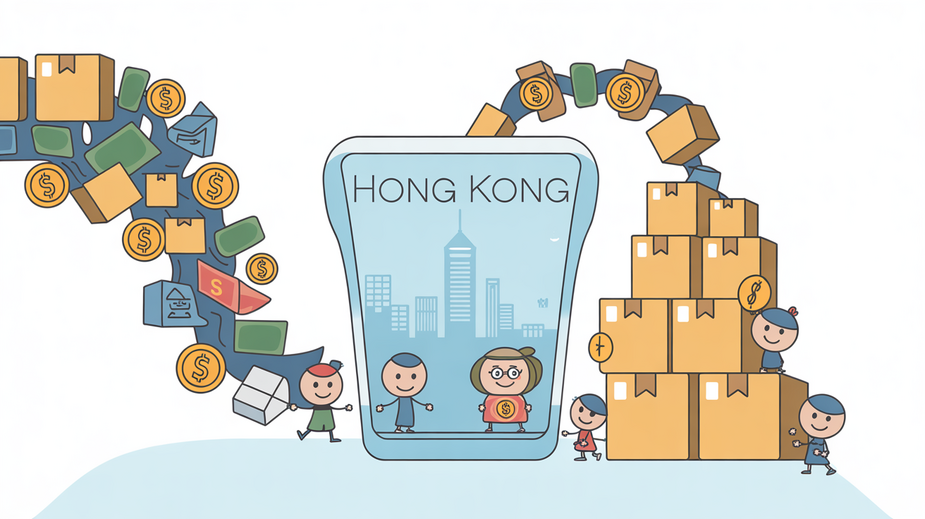
Tax-Efficient Supply Chain Structuring Through Hong Kong: A Practical Framework
📋 Key Facts at a Glance
- Territorial Tax System: Hong Kong only taxes profits sourced within its borders, making it ideal for international supply chain operations.
- Competitive Tax Rates: Two-tier profits tax system: 8.25% on first HK$2 million, 16.5% on remainder for corporations (2024-25).
- No VAT/GST: Hong Kong has no value-added tax or goods and services tax, simplifying cross-border trade operations.
- FSIE Regime: Foreign-sourced income exemption requires economic substance in Hong Kong for qualifying entities.
- Global Minimum Tax: Pillar Two implementation effective January 1, 2025, affecting MNE groups with revenue ≥ EUR 750 million.
Imagine managing a global supply chain where profits from international operations flow tax-efficiently, where cross-border transactions face minimal withholding taxes, and where your regional hub operates under one of the world’s most business-friendly tax regimes. This isn’t a theoretical scenario—it’s the reality for thousands of multinational corporations leveraging Hong Kong’s strategic tax advantages. In today’s complex global trade environment, structuring your supply chain through Hong Kong can deliver significant competitive advantages, from reduced tax liabilities to streamlined compliance. Let’s explore how to build a tax-efficient framework that maximizes these benefits while navigating evolving international tax standards.
Hong Kong’s Core Tax Advantages for Global Supply Chains
Hong Kong’s tax framework offers unique advantages that make it exceptionally well-suited for international supply chain operations. At its core is the territorial basis of taxation—Hong Kong only imposes profits tax on income sourced from or earned within its geographical boundaries. This means profits derived from business activities conducted entirely outside Hong Kong are generally exempt from Hong Kong profits tax, providing significant strategic flexibility for companies managing complex global flows of goods and services.
Key Tax Benefits for Supply Chain Operations
- No VAT/GST: Hong Kong does not impose Value Added Tax or Goods and Services Tax, eliminating the administrative burden and potential tax costs associated with these consumption taxes in other jurisdictions.
- No Capital Gains Tax: Profits from the sale of assets, shares, or investments held by a Hong Kong entity are generally not subject to capital gains tax, facilitating restructurings and divestments.
- Competitive Corporate Tax Rates: Hong Kong’s two-tiered profits tax system offers rates of 8.25% on the first HK$2 million and 16.5% on the remainder for corporations (2024-25).
- Extensive Treaty Network: Hong Kong has comprehensive Double Taxation Agreements with 45+ jurisdictions, providing clarity on taxing rights and reducing withholding tax rates on cross-border payments.
Common Supply Chain Tax Challenges and Solutions
Global supply chains face several tax-related challenges that can significantly impact operational efficiency and profitability. Understanding these pain points is essential for building a resilient and tax-efficient structure.
Permanent Establishment Risks
Activities such as maintaining significant warehousing, consignment stock, or deploying employees to perform specific tasks in a jurisdiction can potentially create a permanent establishment (PE), exposing the company to local corporate income tax obligations. Proper structuring through Hong Kong entities with clear functional separation can help mitigate these risks.
Transfer Pricing Compliance
As goods, services, and intangible assets are exchanged between related entities across borders, pricing must comply with the arm’s length principle. Non-compliance can lead to transfer pricing adjustments, penalties, and double taxation. Hong Kong’s clear tax framework and extensive DTA network provide a solid foundation for compliant transfer pricing arrangements.
Strategic Entity Structuring for Asian Hub Operations
Selecting the appropriate legal entity structure in Hong Kong directly impacts operational flexibility, tax liabilities, and compliance requirements. The strategic choice should align with your intended activities and regional footprint.
| Structure Type | Primary Role | Typical Activities | Key Tax Considerations |
|---|---|---|---|
| Regional Headquarters (RHQ) | Strategic oversight, Management, Coordination | Regional management services, IP management, group financing coordination | Taxation of Hong Kong-sourced profits from management fees, IP royalties, or financing activities (requires adequate substance) |
| Operational Subsidiary | Execution, Trading, Logistics | Regional trading, manufacturing oversight, logistics execution, sales | Taxation of Hong Kong-sourced profits from trading, manufacturing, or service provision |
| Procurement Entity | Centralized Purchasing | Consolidated purchasing, supplier negotiation, logistics management | Transfer pricing on goods/services acquired, requires proper substance and documentation |
Family Investment Holding Vehicles (FIHV)
For family offices and investment structures, Hong Kong offers the FIHV regime with a 0% tax rate on qualifying income, provided there is substantial activity in Hong Kong and minimum assets under management of HK$240 million. This can be particularly useful for supply chain-related investment structures.
Optimizing Intra-Group Financial Flows
Efficient management of financial transactions between related entities is fundamental to tax-efficient supply chain structures. Hong Kong’s transparent tax framework supports these flows when structured properly.
| Financing Strategy | Tax Implications | Considerations |
|---|---|---|
| Debt Financing (Loans) | Interest payments often tax-deductible; may be subject to withholding tax | Thin capitalization rules may limit deductibility; DTA benefits can reduce withholding |
| Equity Financing | Dividends not tax-deductible; may be subject to withholding tax | DTA benefits can reduce/eliminate withholding; simpler capital repatriation |
| Service Fees | Must comply with arm’s length principle; may attract withholding tax | Comprehensive documentation essential; DTA benefits may apply |
Leveraging Customs and Trade Agreements
Hong Kong’s customs framework and trade agreements offer significant opportunities for optimizing the physical movement of goods within supply chains.
Bonded Warehousing and Duty Suspension
Storing goods in bonded areas allows suspension of import duties and taxes until goods are withdrawn for local consumption or re-exported. This provides cash flow benefits and can potentially avoid duty payments entirely on inventory destined for international markets.
Free Trade Agreement Benefits
The ASEAN-Hong Kong Free Trade Agreement (AHKFTA) provides preferential tariff treatments for qualifying goods. Origin cumulation rules allow materials from ASEAN Member States or Hong Kong to be considered as originating in the territory where final processing occurs, benefiting complex regional supply chains.
| Trade Mode | Duty Treatment | Primary Focus | Key Benefit |
|---|---|---|---|
| Processing Trade | Suspended/exempt for re-export materials | Manufacturing/assembly for re-export | Reduces upfront costs on inputs |
| Ordinary Trade | Paid upon importation | Standard import/export activities | Standard procedures for general trading |
Digital Tools for Tax Risk Management
Modern supply chains require sophisticated digital tools to manage tax compliance and risk effectively. These technologies transform tax management from a reactive function into a strategic advantage.
- Automated Transfer Pricing Systems: Streamline documentation generation, ensure consistency across entities, and provide support for arm’s length pricing principles.
- Customs Compliance Platforms: Assist with accurate HS code classification, customs valuation, and real-time regulatory updates to minimize errors and optimize duty costs.
- BEPS 2.0 Impact Modeling: Forecast effects of global minimum tax rules on worldwide tax liability and evaluate potential restructuring needs.
Maintaining Agility in Evolving Tax Landscapes
The global tax environment continues to evolve rapidly, requiring supply chain structures to remain agile and adaptable. Regular reviews and proactive planning are essential for long-term compliance and efficiency.
| Focus Area | Key Consideration | Proactive Strategy |
|---|---|---|
| Substance Requirements | Increased global scrutiny on economic substance | Regular substance health checks; align physical presence with reported functions |
| Global Minimum Tax | Pillar Two implementation from January 2025 | Scenario planning and impact analysis for top-up tax exposure |
| Sustainable Tax Incentives | Emerging ESG-linked tax benefits | Assess eligibility for green logistics, ethical sourcing incentives |
| FSIE Compliance | Economic substance requirements for exemptions | Ensure adequate staffing, decision-making, and operational activities |
✅ Key Takeaways
- Hong Kong’s territorial tax system and absence of VAT/GST make it ideal for international supply chain operations.
- Proper entity structuring (RHQ, operational subsidiary, or procurement entity) is crucial for tax efficiency and compliance.
- The FSIE regime requires economic substance in Hong Kong for foreign-sourced income exemptions.
- Global Minimum Tax (Pillar Two) implementation from January 2025 will affect large MNE groups and requires proactive planning.
- Regular substance checks, transfer pricing documentation, and digital tools are essential for ongoing compliance.
- Leveraging Hong Kong’s customs framework and trade agreements can significantly reduce duty costs and improve cash flow.
Building a tax-efficient supply chain through Hong Kong requires careful planning that balances immediate tax benefits with long-term compliance in an evolving global tax landscape. By leveraging Hong Kong’s territorial tax system, extensive treaty network, and business-friendly environment, companies can create resilient structures that withstand international scrutiny while optimizing their global operations. As tax regulations continue to evolve—particularly with the implementation of global minimum tax rules—maintaining agility through regular reviews and strategic adjustments will be key to sustaining competitive advantages in international trade and logistics.
📚 Sources & References
This article has been fact-checked against official Hong Kong government sources and authoritative references:
- Inland Revenue Department (IRD) – Official tax rates, allowances, and regulations
- Rating and Valuation Department (RVD) – Property rates and valuations
- GovHK – Official Hong Kong Government portal
- Legislative Council – Tax legislation and amendments
- IRD Profits Tax Guide – Two-tier profits tax system details
- IRD FSIE Regime – Foreign-sourced income exemption requirements
- IRD Global Minimum Tax – Pillar Two implementation details
- OECD BEPS – International tax standards and guidelines
Last verified: December 2024 | Information is for general guidance only. Consult a qualified tax professional for specific advice.