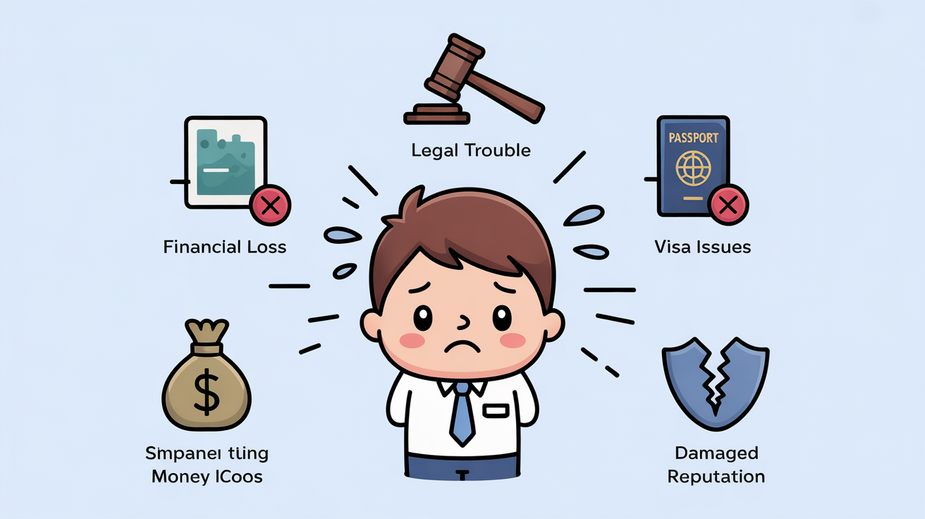
The Real Cost of Tax Non-Compliance for Expats in Hong Kong
📋 Key Facts at a Glance
- Financial Penalties: Late payment interest charges at 8.25% (from July 2025) plus potential fines up to 300% of tax evaded
- Legal Risks: Criminal prosecution for tax evasion with fines up to HK$50,000 and 3 years imprisonment per offense
- Immigration Impact: Tax non-compliance can lead to visa renewal denials and jeopardize permanent residency applications
- Record Keeping: Mandatory 7-year retention period for all tax-related documents and records
- Back Assessment: IRD can assess taxes for up to 6 years (10 years for fraud cases)
What happens when an expat in Hong Kong fails to meet their tax obligations? Beyond the immediate financial penalties lies a complex web of consequences that can unravel careers, jeopardize residency status, and create lasting financial damage. In Asia’s financial hub, where professional reputation is currency, tax non-compliance carries hidden costs that extend far beyond the tax bill itself. This comprehensive guide reveals the real price expats pay when they neglect their Hong Kong tax responsibilities.
The Financial Avalanche: Beyond Basic Fines
Many expats mistakenly believe tax non-compliance simply means paying the original tax owed plus a small penalty. The reality is far more severe. The Inland Revenue Department (IRD) has a comprehensive penalty framework that can transform a manageable tax bill into a financial crisis.
Compounding Interest Charges
When tax payments are delayed or missed, the IRD imposes interest on the outstanding balance. Starting from July 2025, this interest rate is set at 8.25% annually. This interest compounds continuously, meaning what begins as a modest tax debt can balloon into a significant financial burden over time. For example, a HK$100,000 tax debt left unpaid for two years could accumulate over HK$17,000 in interest charges alone.
Asset Seizure and Recovery Actions
For persistent or high-value tax debts, the IRD possesses powerful recovery tools. These include:
- Bank Account Freezes: The IRD can freeze bank accounts in Hong Kong to secure outstanding tax liabilities
- Asset Seizure: Authorities may seize and sell assets including property, vehicles, and investments
- Legal Cost Recovery: If the IRD must initiate legal proceedings, the taxpayer becomes liable for all associated legal fees
- Wage Garnishment: Employers can be directed to deduct tax debts directly from salary payments
| Type of Penalty | Financial Impact | Typical Trigger |
|---|---|---|
| Late Payment Interest | 8.25% annually (from July 2025) | Missed payment deadline |
| Additional Tax Assessment | Up to 300% of tax evaded | Deliberate under-reporting |
| Legal Proceedings | Court costs + legal fees | Persistent non-compliance |
| Asset Recovery | Forced sale of assets | High-value unpaid debts |
Criminal Prosecution: When Tax Issues Become Legal Nightmares
Tax non-compliance crosses into criminal territory when there’s evidence of deliberate evasion or fraud. The distinction between an honest mistake and willful tax evasion is critical—and the consequences are dramatically different.
Mandatory Audits and Loss of Trust
Once flagged for non-compliance, expats face mandatory audits on all future tax filings. This isn’t a temporary inconvenience—it represents a permanent loss of trust with the IRD. Every subsequent tax declaration undergoes intense scrutiny, requiring:
- Detailed documentation for every claim and deduction
- Regular meetings with tax authorities
- Professional tax representation (at your expense)
- Extended processing times for all tax matters
Criminal Penalties for Tax Evasion
Under Hong Kong’s Inland Revenue Ordinance, deliberate tax evasion carries severe criminal penalties:
| Offense | Maximum Fine | Maximum Imprisonment |
|---|---|---|
| Making false tax returns | HK$50,000 | 3 years |
| Willful tax evasion | HK$50,000 + 300% of tax evaded | 3 years |
| Failure to keep proper records | HK$100,000 | – |
Travel Restrictions and Immigration Bans
For expats with significant unresolved tax debts, the IRD can request immigration authorities to implement travel bans. This severe measure prevents individuals from leaving or re-entering Hong Kong until tax matters are resolved. The consequences are devastating:
- Inability to attend international business meetings
- Separation from family overseas
- Missed career opportunities requiring travel
- Effective confinement within Hong Kong territory
Visa and Residency: The Immigration Connection
For expatriates, tax compliance is intrinsically linked to immigration status. Hong Kong’s immigration authorities coordinate with tax authorities, meaning tax problems directly impact your right to remain in the territory.
Visa Renewal Denials
When applying for visa extensions or changes in status, immigration officers review for outstanding legal or financial issues. Tax arrears or unresolved disputes can result in:
- Immediate visa renewal refusal
- Conditional extensions requiring tax clearance
- Mandatory reporting to immigration during resolution
- Potential requirement to leave Hong Kong
Permanent Residency Complications
Achieving permanent resident status requires demonstrating respect for Hong Kong’s laws. A clean tax record is fundamental to this evaluation. Tax non-compliance can:
- Delay permanent residency applications by years
- Require extensive documentation of tax resolution
- Result in outright rejection of applications
- Undermine years of effort to establish long-term residency
Professional Reputation: The Hidden Career Cost
In Hong Kong’s competitive financial hub, professional reputation is everything. Tax issues can erode trust and credibility in ways that are difficult to repair.
Employer Trust Erosion
Employers view tax-compliant employees as reliable and trustworthy. Tax problems signal potential issues with:
- Judgment: Ability to make sound financial decisions
- Integrity: Honesty in professional dealings
- Reliability: Consistency in meeting obligations
- Discretion: Ability to handle sensitive matters appropriately
Business License Risks
For expat business owners, tax non-compliance carries existential risks:
| Risk Factor | Potential Consequence | Industry Impact |
|---|---|---|
| Business Registration Revocation | Immediate cessation of operations | All industries |
| Professional License Suspension | Inability to practice regulated profession | Finance, law, accounting |
| Client Contract Termination | Loss of revenue streams | Consulting, professional services |
| Industry Blacklisting | Exclusion from professional networks | Finance, banking, investment |
Long-Term Financial Planning Disruptions
Tax non-compliance doesn’t just impact your present finances—it can derail your entire financial future. The ripple effects extend to critical areas of long-term wealth building.
Creditworthiness Damage
Unpaid tax debts and legal judgments severely impact your credit profile. This affects:
- Mortgage Applications: Difficulty securing home loans in Hong Kong or internationally
- Business Financing: Challenges obtaining business loans or credit facilities
- Insurance Premiums: Higher rates for life and property insurance
- Rental Applications: Rejection by landlords conducting financial checks
Investment Account Freezes
During tax investigations or debt recovery, authorities can freeze investment accounts, preventing:
- Trading or portfolio rebalancing
- Access to funds for emergencies
- Benefiting from market opportunities
- Regular dividend or interest payments
Forced Asset Liquidation
To satisfy tax debts, the IRD can force the sale of assets earmarked for long-term goals:
| Asset Type | Long-Term Impact | Recovery Time |
|---|---|---|
| Retirement Investments | Delayed retirement by 5-10 years | 10+ years to rebuild |
| Education Funds | Children’s education compromised | Immediate family impact |
| Property Holdings | Lost equity and housing security | 5-7 years to re-enter market |
| Business Assets | Entrepreneurial dreams ended | Potentially permanent |
The Hidden Costs of Tax Investigations
Beyond direct penalties, tax investigations introduce hidden costs that impact every aspect of an expat’s life. These often-overlooked expenses can be substantial.
Professional Service Fees
Tax investigations require ongoing professional support. Typical costs include:
- Tax Specialists: HK$800-2,500 per hour
- Legal Counsel: HK$1,500-5,000 per hour
- Forensic Accountants: HK$1,000-3,000 per hour
- Document Preparation: HK$5,000-20,000 per submission
Opportunity Costs and Income Loss
The time and mental energy required for investigations directly impact earning capacity:
| Time Commitment | Typical Duration | Financial Impact |
|---|---|---|
| Document Gathering | 40-120 hours | HK$20,000-60,000 in lost productivity |
| Meetings & Consultations | 20-50 hours | HK$10,000-25,000 in time away from work |
| Case Management | Ongoing for 6-24 months | Persistent distraction from core responsibilities |
| Court Appearances | Variable | Complete work disruption during proceedings |
Health and Well-being Costs
The stress of tax investigations takes a physical and mental toll, leading to:
- Stress-related medical conditions requiring treatment
- Psychological counseling or therapy sessions
- Medication for anxiety, depression, or sleep disorders
- Reduced work performance affecting career progression
Real-World Consequences: Hong Kong Case Studies
These actual cases from Hong Kong’s expat community demonstrate how theoretical risks become painful realities.
Case 1: The Financial Professional
A senior finance executive failed to report substantial overseas income over three years. The IRD investigation revealed deliberate concealment. The consequences:
- Penalty: 300% of tax evaded (HK$1.2 million on HK$400,000 tax)
- Criminal conviction for tax evasion
- Termination from financial sector position
- Industry blacklisting preventing future finance roles
Case 2: The Business Owner
An expat consultancy owner neglected proper record-keeping and under-reported profits. After repeated warnings:
- Business registration revoked by authorities
- Forced closure of 5-year-old consultancy
- Personal liability for business tax debts
- Inability to obtain new business license for 3 years
Case 3: The Family Visa Crisis
A spouse’s tax non-compliance (misunderstanding filing requirements) created immigration issues:
- Entire family’s dependent visas cancelled
- Forced relocation from Hong Kong within 30 days
- Children removed from international school mid-term
- Spouse’s employment contract terminated due to visa loss
Proactive Compliance: Your Protection Strategy
Preventing tax problems is significantly easier and cheaper than resolving them. Implement these proactive measures to safeguard your financial and professional future in Hong Kong.
- Engage Cross-Border Tax Specialists Early: Don’t wait for problems. Consult professionals experienced in both Hong Kong taxation and your home country’s tax system. They can navigate double taxation agreements and ensure proper reporting from day one.
- Implement Digital Record-Keeping Systems: Use accounting software or organized digital systems to track all income and expenses throughout the year. Maintain records for the mandatory 7-year retention period.
- Understand Your Specific Obligations: Hong Kong’s territorial tax system has unique rules for expats. Know what constitutes Hong Kong-sourced income versus foreign income, and understand the Foreign-Sourced Income Exemption (FSIE) regime requirements.
- File Timely and Accurately: Individual tax returns are typically due in early June (about one month after issuance). Corporate returns have different deadlines. Never miss filing deadlines, even if you need to file a “zero” return.
- Stay Informed on Regulatory Changes: Hong Kong’s tax laws evolve. Monitor changes to salaries tax rates, allowances, stamp duty regulations, and international tax compliance requirements like the Global Minimum Tax (effective January 2025).
✅ Key Takeaways
- Tax non-compliance costs extend far beyond financial penalties to include legal risks, immigration problems, and career damage
- The IRD can assess back taxes for 6 years (10 years for fraud) with 8.25% interest on late payments from July 2025
- Criminal tax evasion carries fines up to HK$50,000 plus 300% of tax evaded and up to 3 years imprisonment per offense
- Visa renewals and permanent residency applications can be denied due to tax issues, potentially forcing relocation
- Professional reputation damage in Hong Kong’s financial hub can be career-ending and difficult to repair
- Proactive compliance through professional advice and proper record-keeping is significantly cheaper than resolving problems
In Hong Kong’s competitive environment, tax compliance isn’t just a legal requirement—it’s a fundamental component of professional integrity and financial security. The true cost of non-compliance extends far beyond the tax bill, potentially unraveling careers, jeopardizing residency, and creating lasting financial damage. By understanding these risks and implementing proactive compliance strategies, expats can protect their Hong Kong future while focusing on building successful careers in Asia’s world city.