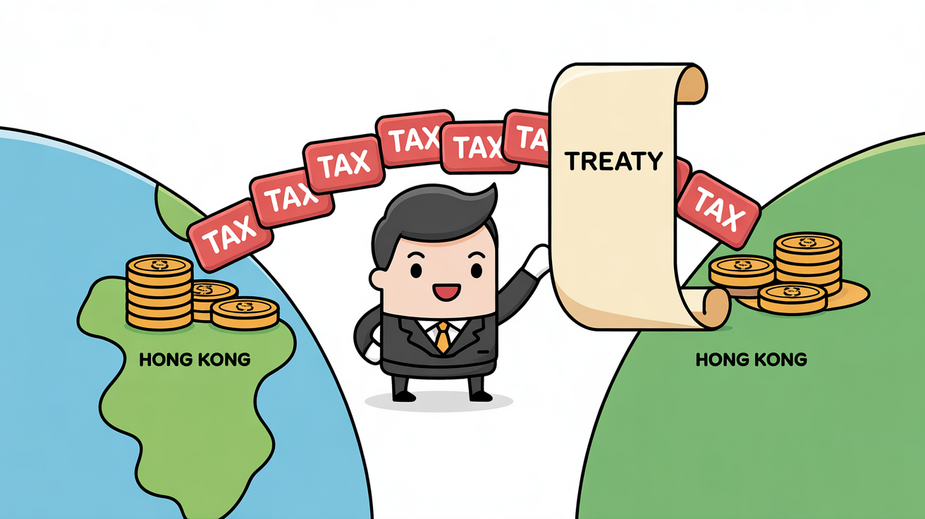
The Role of Double Taxation Treaties in Structuring Your Hong Kong Business
📋 Key Facts at a Glance
- Hong Kong’s DTA Network: Comprehensive agreements with 45+ jurisdictions including Mainland China, Singapore, UK, and Japan
- Profits Tax Advantage: Two-tiered system with 8.25% on first HK$2 million and 16.5% on remainder for corporations
- FSIE Regime: Foreign-sourced income exemption requires economic substance in Hong Kong (Phase 2 effective January 2024)
- Global Minimum Tax: Pillar Two implemented June 6, 2025, effective January 1, 2025, with 15% minimum effective tax rate
Imagine your Hong Kong-based technology company earns substantial royalties from software licenses in Japan. Without protection, Japan could withhold 20% tax, then Hong Kong could tax the same income again. This double taxation nightmare could erode 30-40% of your profits. Fortunately, Hong Kong’s extensive network of Double Taxation Agreements (DTAs) provides a powerful solution, transforming potential tax liabilities into strategic advantages for businesses operating internationally.
The Double Taxation Challenge: More Than Just Extra Tax
Double taxation occurs when the same income gets taxed by two or more countries, typically when a business operates across borders. This isn’t just about paying more tax—it creates a cascade of problems that can cripple international expansion. The financial impact goes beyond the direct tax payment, affecting cash flow, operational efficiency, and strategic planning.
The Hidden Costs of Cross-Border Operations
Beyond the obvious tax payments, businesses face substantial hidden costs:
- Expert Advisory Fees: Navigating multiple tax systems requires specialized international tax advice, often costing tens of thousands annually
- Compliance Burden: Understanding and filing returns in multiple jurisdictions consumes significant administrative resources
- Audit Risks: Cross-border operations face higher audit scrutiny, potentially leading to lengthy disputes and penalties
- Cash Flow Constraints: Capital gets tied up in potential tax liabilities rather than being reinvested for growth
| Income Type | Potential Tax in Source Country | Potential Tax in Residence Country (Without Treaty) |
|---|---|---|
| Business Profit | Yes (if operations create taxable presence) | Yes (on worldwide income basis) |
| Interest | Yes (via withholding tax) | Yes (on worldwide income basis) |
| Royalties | Yes (via withholding tax) | Yes (on worldwide income basis) |
Hong Kong’s DTA Network: Your Strategic Advantage
Hong Kong’s extensive network of Comprehensive Double Taxation Agreements (CDTAs) with over 45 jurisdictions provides a powerful framework for international business. These agreements aren’t just legal documents—they’re strategic tools that deliver tangible benefits for companies operating from Hong Kong.
Three Core Benefits of Hong Kong’s DTAs
- Tax Liability Minimization: DTAs clearly define which country has primary taxing rights, preventing the same income from being taxed twice. This directly reduces overall tax expenses and increases retained earnings.
- Investor Confidence Boost: Predictable tax frameworks reduce uncertainty, making Hong Kong more attractive for foreign direct investment and business expansion.
- Global Competitiveness Enhancement: Reduced withholding tax rates on cross-border payments (often 5% or 0% instead of 10-20%) lower transaction costs and improve profitability.
Essential Treaty Provisions for Business Success
To maximize DTA benefits, you need to understand and strategically apply these key provisions:
1. Reduced Withholding Tax Rates
Most Hong Kong DTAs significantly reduce withholding taxes on cross-border payments:
- Dividends: Often reduced to 5-10% (vs. 15-30% domestic rates)
- Interest: Typically 0-10% (vs. 10-20% domestic rates)
- Royalties: Commonly 5-10% (vs. 10-20% domestic rates)
2. Permanent Establishment (PE) Protection
The PE clause defines what constitutes a taxable presence in a foreign country. This is crucial for:
- Service Providers: Avoid triggering corporate tax through temporary activities
- Digital Businesses: Clarify when online operations create taxable presence
- Manufacturers: Define when facilities or inventory storage creates PE
3. Mutual Agreement Procedures (MAPs)
MAPs provide a formal dispute resolution mechanism when:
- Tax authorities disagree on treaty interpretation
- Double taxation occurs despite treaty provisions
- Transfer pricing adjustments create conflicts
Strategic Business Structuring with DTA Advantages
Effective DTA utilization requires integrating treaty benefits into your business structure from the ground up:
| Strategic Element | DTA Advantage to Leverage |
|---|---|
| Entity Type Selection | Qualify for specific reduced withholding tax rates; Access beneficial PE definitions for service activities |
| Supply Chain Location | Minimize withholding tax on intercompany payments; Favorable PE treatment for operational entities |
| Holding Company Setup | Reduced withholding tax on inbound investment income; Coordination with foreign tax credits |
| IP Holding Structure | Beneficial royalty withholding rates; Alignment with FSIE economic substance requirements |
Real-World Structuring Examples
- Technology Licensing: Hong Kong entity licenses software to Japan. Without DTA: 20% Japanese withholding tax. With DTA: 5% withholding tax, saving 15% on royalty income.
- Regional Headquarters: Hong Kong holding company receives dividends from Singapore subsidiary. DTA reduces withholding from 15% to 5%, improving cash flow by 10%.
- Service Company: Hong Kong consulting firm sends staff to Mainland China for projects. DTA PE provisions prevent triggering Chinese corporate tax on temporary activities.
Compliance Essentials for Treaty Benefits
Claiming DTA benefits requires meticulous compliance. Tax authorities increasingly scrutinize treaty claims, and failure to meet requirements can lead to denied benefits plus penalties.
| Compliance Area | Key Requirements |
|---|---|
| Documentation Management | Tax residency certificates, income source documentation, transaction records, beneficial ownership proof |
| Substance Requirements | Genuine physical presence, qualified employees, substantive activities, local decision-making |
| Tax Audit Preparedness | Organized documentation, clear treaty application rationale, business purpose documentation |
| FSIE Compliance | Economic substance requirements for foreign-sourced income exemption claims |
Future-Proofing Your DTA Strategy
The international tax landscape is evolving rapidly. To maintain your competitive advantage, consider these emerging trends:
1. OECD BEPS 2.0 Impact
The OECD’s Base Erosion and Profit Shifting project is reshaping international taxation:
- Pillar One: Reallocates taxing rights for large multinationals, potentially overriding traditional PE concepts
- Pillar Two: Global minimum tax of 15% affects how DTA benefits interact with overall tax planning
- Digital Economy Taxes: New unilateral measures may conflict with existing treaty principles
2. Expanding Treaty Networks
Hong Kong continues to expand its DTA network, particularly with emerging markets. Monitor new agreements for:
- Fresh opportunities in growing markets
- Updated provisions reflecting modern business practices
- Enhanced dispute resolution mechanisms
3. Digital Business Considerations
Digital businesses face unique challenges with traditional PE concepts. Future treaty updates may address:
- Virtual permanent establishments
- Data localization and digital service taxes
- Cross-border e-commerce taxation
✅ Key Takeaways
- Hong Kong’s 45+ DTAs provide substantial tax savings through reduced withholding rates and clear taxing rights allocation
- Strategic business structuring must integrate DTA benefits with Hong Kong’s FSIE regime and economic substance requirements
- Compliance is non-negotiable—maintain thorough documentation and genuine substance to support treaty claims
- Future-proof your strategy by monitoring OECD BEPS developments, digital economy taxes, and Hong Kong’s expanding treaty network
- The new Global Minimum Tax (Pillar Two) requires reevaluation of how DTA benefits interact with 15% minimum effective tax requirements
Hong Kong’s Double Taxation Agreements transform potential tax liabilities into strategic advantages for international businesses. By understanding and strategically applying these agreements, companies can significantly reduce cross-border tax burdens, enhance cash flow, and improve global competitiveness. However, success requires more than just claiming benefits—it demands careful structuring, meticulous compliance, and ongoing adaptation to evolving international tax standards. As the global tax landscape continues to shift with initiatives like BEPS 2.0 and digital economy taxes, proactive DTA management becomes increasingly essential for maintaining Hong Kong’s position as a premier international business hub.
📚 Sources & References
This article has been fact-checked against official Hong Kong government sources and authoritative references:
- Inland Revenue Department (IRD) – Official tax rates, allowances, and regulations
- Rating and Valuation Department (RVD) – Property rates and valuations
- GovHK – Official Hong Kong Government portal
- Legislative Council – Tax legislation and amendments
- IRD Comprehensive Double Taxation Agreements – Official DTA network information
- IRD Foreign-Sourced Income Exemption (FSIE) Regime – Economic substance requirements
- IRD Global Minimum Tax and Hong Kong Minimum Top-up Tax – Pillar Two implementation details
- OECD BEPS – International tax standards and guidelines
Last verified: December 2024 | Information is for general guidance only. Consult a qualified tax professional for specific advice.