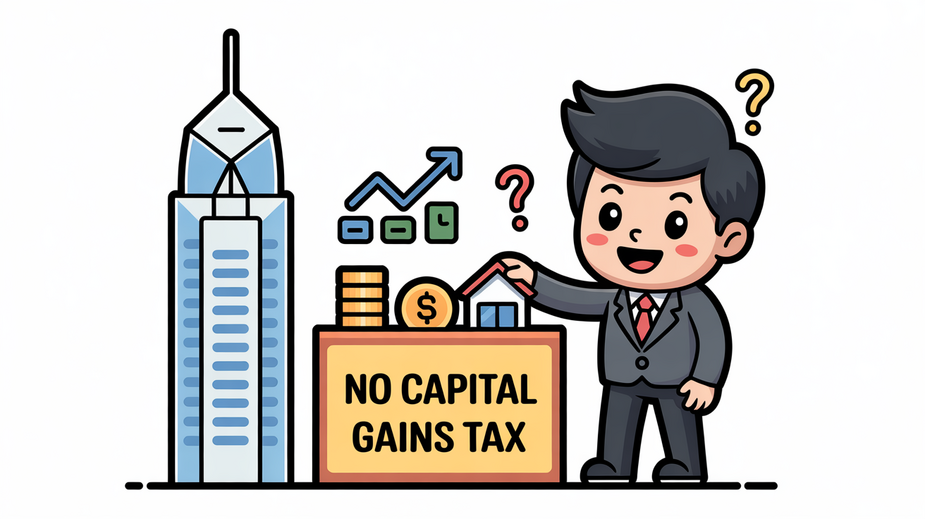
The Truth About Hong Kong’s ‘No Capital Gains Tax’ Policy for Expats
📋 Key Facts at a Glance
- Fact 1: Hong Kong has NO general capital gains tax for individuals on investment assets like stocks, property, or cryptocurrencies
- Fact 2: Property stamp duties were simplified in February 2024 – BSD, SSD, and NRSD were abolished, leaving only Ad Valorem Stamp Duty
- Fact 3: The territorial principle means only Hong Kong-sourced income is taxed, not worldwide income like in many expat home countries
Imagine selling your investment portfolio and keeping 100% of the profits, or cashing out on cryptocurrency gains without a tax bill. For expats in Hong Kong, this isn’t a fantasy—it’s the reality of living in one of the world’s few major financial centers without a general capital gains tax. But is it really that simple? Let’s explore what Hong Kong’s unique tax framework truly means for your wealth and what critical exceptions you need to understand.
Hong Kong’s Tax Philosophy: Why No Capital Gains Tax?
Hong Kong operates on a territorial taxation principle, which fundamentally shapes its approach to capital gains. Unlike countries like the UK, US, Australia, or Canada that tax residents on their worldwide income, Hong Kong only taxes income and profits that arise in or are derived from Hong Kong. This distinction is crucial for expats to understand.
| Tax Aspect | Hong Kong (2024-25) | Common Expat Home Countries |
|---|---|---|
| Capital Gains Tax on Investment Assets | Generally None* | Often Taxed (Varying rates and rules) |
| Basis of Taxation | Territorial (Source-based) | Worldwide (Residence-based) |
| Dividends Tax | None | Often Taxed |
| Inheritance/Estate Tax | None | Often Applies |
The “Adventure in the Nature of Trade” Test
The Inland Revenue Department (IRD) uses several factors to determine if your investment activities constitute a trade:
- Frequency of transactions: Regular buying and selling suggests trading
- Nature of the asset: Assets typically held for investment vs. quick resale
- Financing method: Using borrowed money for purchases
- Your expertise: Professional background in the asset class
- Intention at purchase: Documentation showing investment vs. trading intent
Property Investments: Stamp Duty Reality Check
While capital gains on property sales aren’t taxed, expats must understand the significant stamp duty landscape. The good news? Hong Kong simplified property stamp duties dramatically in February 2024.
Here’s what property buyers face in 2024-25:
| Property Value (HK$) | Ad Valorem Stamp Duty Rate |
|---|---|
| Up to 3,000,000 | HK$100 |
| 3,000,001 – 3,528,240 | HK$100 + 10% of excess |
| 3,528,241 – 4,500,000 | 1.5% |
| 4,500,001 – 4,935,480 | 1.5% to 2.25% |
| 4,935,481 – 6,000,000 | 2.25% |
| Above 21,739,120 | 4.25% |
Property as Investment vs. Trading Business
Even with simplified stamp duties, expats must be careful about property flipping. If you buy and sell multiple properties within short periods, the IRD may classify this as a property trading business. In that case:
- Profits become taxable business income
- Subject to Profits Tax rates (8.25%/16.5% for corporations)
- You’ll need to file Profits Tax returns
- Keep business records for 7 years
Investment Portfolio Strategy in a No-CGT Environment
Hong Kong’s tax framework creates unique opportunities for expat investors. Without capital gains tax eating into returns, you can:
- Reallocate freely: Adjust your portfolio without tax consequences on gains
- Take profits strategically: Sell winning positions when market conditions suggest, not based on tax year timing
- Compound returns: Reinvest 100% of gains without tax drag
- Hold assets optimally: Keep investments as long as makes financial sense, not for tax advantages
Cryptocurrency and Digital Assets
Hong Kong’s approach to cryptocurrency is particularly advantageous:
- No capital gains tax on crypto trading for individuals
- No specific crypto tax legislation (as of December 2024)
- Same “trading vs. investment” test applies – frequent trading may be taxable
- Keep detailed records of all transactions for 7 years
The Double Taxation Dilemma for Expats
Here’s where it gets complex: While Hong Kong doesn’t tax your capital gains, your home country might. This creates a critical planning consideration.
Double Taxation Agreements (DTAs) and Tie-Breaker Rules
Hong Kong has DTAs with 45+ jurisdictions. These agreements include “tie-breaker” rules to determine which country has primary taxing rights when you could be resident in both. Factors considered:
- Where you have a permanent home
- Your center of vital interests (family, economic ties)
- Where you habitually live
- Your nationality
Strategic timing is everything: Selling major assets after establishing Hong Kong tax residency (and breaking home country residency) can save significant tax.
Corporate Structures: When Business Income Becomes Taxable
Expats operating businesses through Hong Kong companies must understand a critical distinction:
| Activity Type | Tax Treatment | Tax Rate (2024-25) |
|---|---|---|
| Company investment portfolio (long-term) | Capital gains – Not taxable | 0% |
| Company trading business (frequent buying/selling) | Business income – Taxable | 8.25% on first HK$2M, 16.5% on remainder |
| Individual investment activities | Capital gains – Not taxable | 0% |
| Individual trading business | Business income – Taxable | 7.5% on first HK$2M, 15% on remainder |
Essential Documentation and Compliance
To protect yourself and prove your activities are investment (not trading), maintain these records for 7 years:
- Investment policy statement: Document your long-term investment strategy
- Transaction records: Dates, amounts, prices for all buys and sells
- Holding periods: Evidence of long-term holding intent
- Financing documentation: Show if using own funds vs. leverage
- Professional advice records: Correspondence with financial advisors
Future Regulatory Considerations
While Hong Kong’s capital gains tax exemption remains stable, expats should monitor these developments:
- Global Minimum Tax (Pillar Two): Effective January 1, 2025 for large multinational groups (revenue ≥ €750M)
- Foreign-Sourced Income Exemption (FSIE): Expanded in January 2024, requiring economic substance in HK
- Digital asset regulations: Evolving framework for cryptocurrencies
- International pressure: OECD initiatives on tax transparency
✅ Key Takeaways
- Hong Kong genuinely has no capital gains tax for individual investors, making it a unique wealth-building environment
- Property stamp duties were simplified in February 2024 – BSD, SSD, and NRSD are abolished
- The critical distinction is between investment (tax-free) and trading (taxable) activities
- Your home country may still tax your gains if you maintain tax residency there
- Maintain meticulous records for 7 years to prove investment intent if questioned
- Corporate structures require careful planning to avoid unintended business income classification
Hong Kong’s no-capital-gains-tax policy represents a genuine competitive advantage for expat investors, but it’s not a free pass. Understanding the boundaries between tax-free investing and taxable trading, navigating property stamp duties, and managing cross-border tax obligations requires careful planning. With proper documentation, strategic timing, and professional guidance, you can maximize Hong Kong’s unique tax benefits while staying fully compliant across all jurisdictions that claim your allegiance.
📚 Sources & References
This article has been fact-checked against official Hong Kong government sources and authoritative references:
- Inland Revenue Department (IRD) – Official tax rates, allowances, and regulations
- Rating and Valuation Department (RVD) – Property rates and valuations
- GovHK – Official Hong Kong Government portal
- Legislative Council – Tax legislation and amendments
- IRD Profits Tax Guide – Business income and trading vs. investment distinctions
- IRD Stamp Duty Guide – Property transaction stamp duties
- IRD Territorial Source Principle – Explanation of Hong Kong’s taxation basis
Last verified: December 2024 | Information is for general guidance only. Consult a qualified tax professional for specific advice.