When Does Hong Kong Consider Business Profits ‘Offshore’? A Detailed Analysis
📋 Key Facts at a Glance
- Territorial System: Hong Kong only taxes profits sourced within its territory, not worldwide income
- Tax Rates: Corporations pay 8.25% on first HK$2M, 16.5% on remainder; unincorporated businesses pay 7.5%/15%
- Burden of Proof: Taxpayer must prove profits are offshore with comprehensive documentation
Did you know that a Hong Kong company could potentially earn millions in profits completely tax-free? This isn’t a loophole—it’s the fundamental principle of Hong Kong’s territorial tax system. Unlike most countries that tax residents on their worldwide income, Hong Kong only taxes profits that arise within its borders. But here’s the million-dollar question: when exactly does Hong Kong consider business profits “offshore” and therefore tax-exempt? Let’s dive into the detailed analysis that could save your business significant tax liabilities.
Hong Kong’s Unique Territorial Tax System Explained
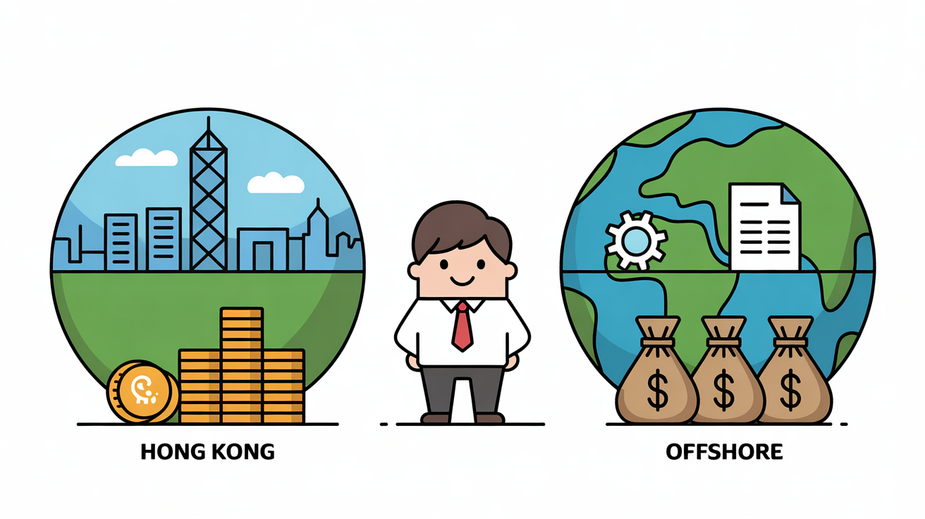
Hong Kong operates on a distinctive territorial basis of taxation that sets it apart from most global jurisdictions. While countries like the United States, China, and the UK tax residents on their worldwide income, Hong Kong’s Profits Tax applies exclusively to profits that arise in or are derived from Hong Kong. This means a company incorporated in Hong Kong can earn substantial profits completely tax-free if those profits genuinely originate outside Hong Kong’s territory.
| Aspect | Onshore Profit | Offshore Profit |
|---|---|---|
| Tax Status in HK | Taxable | Generally Non-Taxable |
| Determining Factor | Source of Profits (not residence or incorporation) | |
| Source Location | Profit-generating activities occur in Hong Kong | Profit-generating activities occur outside Hong Kong |
| Tax Rate (Corporations) | 8.25% on first HK$2M, 16.5% on remainder | 0% (if proven offshore) |
The “Operations Test”: How Hong Kong Determines Profit Source
The Inland Revenue Department (IRD) applies what’s commonly called the “operations test” to determine whether profits are onshore or offshore. This isn’t about superficial indicators like where contracts are signed or payments are received. Instead, it requires a thorough examination of where the actual profit-producing activities took place.
Three Core Principles for Determining Offshore Status
| Principle | What It Examines | Relevance to Offshore Status |
|---|---|---|
| Operations Location | Where substantive business activities occur | Critical – Activities wholly or substantially outside HK strongly support offshore status |
| Contract Negotiations | Where key deals are negotiated and concluded | Supporting – Can bolster claim when tied to overseas operations |
| Risk Management | Where significant business risks are borne and managed | Important – Key indicator of where profit source truly resides |
The IRD evaluates these factors holistically, recognizing that no single element is typically decisive in isolation. The combined weight of these principles paints a comprehensive picture of where the economic substance of the profit-generating activity truly resides.
Essential Documentation for Proving Offshore Status
Successfully claiming offshore profits requires presenting clear, verifiable evidence to the IRD. The burden of proof rests entirely on the taxpayer, making comprehensive documentation absolutely essential. Without a well-organized collection of these documents, substantiating an offshore claim becomes significantly challenging.
| Document Category | Purpose/What It Demonstrates |
|---|---|
| Contracts & Agreements | Evidence of negotiation/signing locations, parties involved, and where contractual obligations are performed |
| Financial Records | Traces fund flow, links revenue/expenses to overseas clients/suppliers, indicates location of economic activity |
| Decision-Making Documentation | Proof that key operational/strategic decisions were made by personnel located outside Hong Kong |
| Transaction Audit Trails | Verifies physical movement of goods or location where services were rendered outside Hong Kong |
Critical Evidence: Decision-Making Location
Demonstrating that crucial decision-making processes occurred outside Hong Kong is particularly vital. This goes beyond simply employing personnel abroad; it requires showing that substantive decisions regarding the business’s core profit-generating activities were genuinely made by individuals located physically outside the jurisdiction.
- Minutes of board or management meetings held overseas
- Detailed correspondence executing transactions by offshore staff
- Documented delegation of authority structures showing offshore decision-making
- Travel records showing key personnel were physically outside Hong Kong during critical periods
Common Pitfalls That Jeopardize Offshore Claims
Businesses frequently encounter pitfalls that can jeopardize their offshore claims, leading to unexpected tax liabilities and potentially costly disputes with the IRD. Recognizing these common mistakes is crucial for effective tax planning.
- Underestimating Hong Kong-based ancillary services: Even if primary income-generating activities occur overseas, performing essential support functions (accounting, IT, logistics coordination) within Hong Kong can lead the IRD to conclude that a portion of profit is sourced locally.
- Misinterpreting “central management and control”: If critical strategic decisions and ultimate control are exercised by individuals predominantly located in Hong Kong, the IRD may argue profits are taxable locally regardless of where other operations occur.
- Inadequate separation of revenue streams: Businesses earning income from both offshore and local operations must maintain meticulous, separate accounting records. Commingled funds or undifferentiated accounting systems raise red flags during audits.
Strategic Planning for Maintaining Offshore Eligibility
Maintaining recognition for offshore profits requires proactive strategic planning that extends far beyond initial structuring. Businesses must continuously assess and manage their activities to ensure they consistently meet the IRD’s criteria.
Three Essential Strategies
- Meticulous Contract Structuring: Draft sales agreements, service contracts, and supplier agreements to explicitly reflect where key activities occur. Detail where negotiations take place, where goods transfer ownership/risk, or where services are rendered.
- Robust Transfer Pricing Policies: For companies with intercompany transactions, implement clear transfer pricing rules aligned with international arm’s length principles. Maintain comprehensive documentation supporting profit allocations between entities.
- Regular Operational Nexus Reviews: Periodically assess where key personnel operate, where significant management decisions are made, where assets are held, and where core revenue-generating activities occur. Adjust structures as business evolves.
Real-World Business Scenarios
Understanding how the principles apply in practice helps clarify the often-complex criteria for determining tax liability. Here are common scenarios:
| Business Type | Successful Offshore Claim Requirements | Common IRD Challenges |
|---|---|---|
| Trading Company | Entire supply chain managed outside HK; sourcing, negotiations, logistics, risk-bearing all offshore | If any key activities (pricing decisions, quality control) occur in HK |
| Service Company | Personnel performing services located outside HK; strategic decisions made offshore | Services substantially rendered from HK; key negotiations in HK |
| Manufacturing Entity | Production process, quality control, manufacturing management all outside HK | Difficulty segregating profits from HK-based management/sales functions |
✅ Key Takeaways
- Hong Kong’s territorial system only taxes profits sourced within its borders, offering potential 0% tax on offshore profits
- The “operations test” focuses on where substantive profit-generating activities occur, not just contract signing locations
- Comprehensive documentation is non-negotiable—the burden of proof rests entirely on the taxpayer
- Recent legal developments emphasize “real substance” requirements, making shell company structures increasingly risky
- Regular operational reviews and strategic planning are essential for maintaining offshore eligibility as your business evolves
Hong Kong’s territorial tax system offers significant advantages for internationally-focused businesses, but navigating the offshore profit determination requires careful planning and meticulous documentation. The difference between paying 16.5% profits tax and 0% tax could be millions of dollars annually. By understanding the IRD’s “operations test,” maintaining comprehensive evidence of offshore activities, and avoiding common pitfalls, businesses can legitimately minimize their Hong Kong tax liabilities while remaining fully compliant. Remember: when it comes to offshore claims, substance always trumps form, and documentation is your strongest defense.
📚 Sources & References
This article has been fact-checked against official Hong Kong government sources and authoritative references:
- Inland Revenue Department (IRD) – Official tax rates, allowances, and regulations
- Rating and Valuation Department (RVD) – Property rates and valuations
- GovHK – Official Hong Kong Government portal
- Legislative Council – Tax legislation and amendments
- IRD Profits Tax Guide – Official guidance on profits tax and territorial principle
- IRD Territorial Source Principle – Detailed explanation of operations test
- IRD Two-tiered Profits Tax FAQ – Current tax rates and thresholds
Last verified: December 2024 | Information is for general guidance only. Consult a qualified tax professional for specific advice.