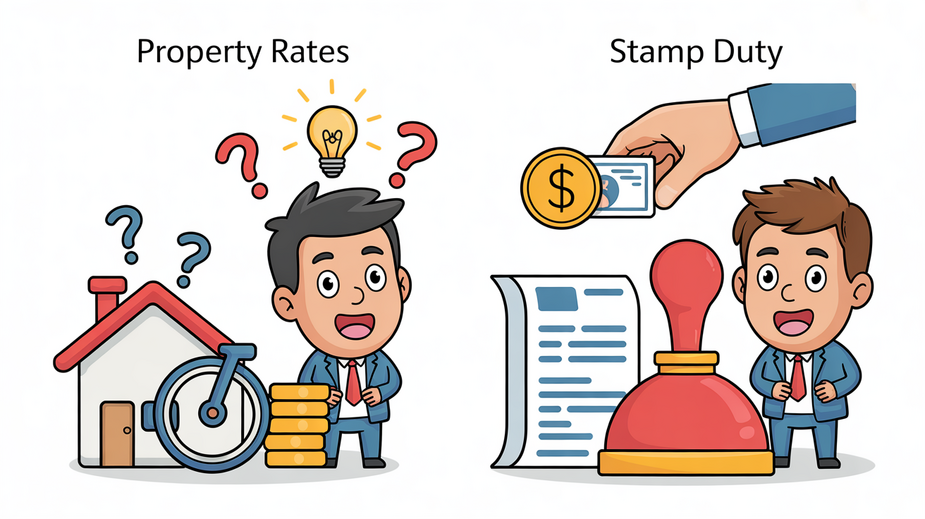
Property Rates vs. Stamp Duty in Hong Kong: Clarifying the Confusion
📋 Key Facts at a Glance
- Property Rates: Recurring quarterly tax based on rateable value (5-12% annually for domestic properties)
- Stamp Duty: One-time tax on property transactions (HK$100 to 4.25% of purchase price)
- Major 2024 Reform: BSD, SSD, and NRSD abolished from February 28, 2024
- Government Rent: Additional 3% of rateable value for certain properties
- Progressive Rating: Affects only domestic properties with rateable values above HK$550,000
Are you confused about the difference between property rates and stamp duty in Hong Kong? You’re not alone. Many property owners and buyers mix up these two essential charges, leading to budgeting surprises and compliance headaches. In this comprehensive guide, we’ll demystify both taxes, explain their distinct purposes, and show you exactly what to expect when buying or owning property in Hong Kong. Whether you’re a first-time buyer or a seasoned investor, understanding these charges is crucial for smart financial planning.
Understanding Property Rates: Your Recurring Ownership Cost
Property rates are a recurring tax that property owners or occupiers pay throughout their ownership. Unlike stamp duty (which is a one-time charge), property rates are billed quarterly and continue for as long as you own the property. The Rating and Valuation Department (RVD) administers these charges, which fund essential local government services like street cleaning, public lighting, and community facilities.
What Exactly is Rateable Value?
The rateable value is the cornerstone of property rates calculation. It represents the estimated annual rental value of your property in the open market, assuming it’s vacant and available for rent. The RVD determines this value by analyzing comparable rental transactions in your area, considering factors like:
- Location: Proximity to transportation, schools, and amenities
- Property Characteristics: Size, age, condition, and quality of finishes
- Market Conditions: Current rental trends in your neighborhood
- Management Standards: Quality of building maintenance and facilities
Progressive Rating System for Domestic Properties
Hong Kong introduced a progressive rating system for domestic properties starting from the 2024-25 assessment year. This system affects only properties with higher rateable values, while the majority of homeowners continue to pay the standard rate.
| Property Type | Rateable Value Range | Rate Percentage |
|---|---|---|
| Non-Domestic (Commercial) | All values | 5% |
| Domestic (Residential) | First HK$550,000 | 5% |
| Next HK$250,000 (HK$550,001 – HK$800,000) | 8% | |
| Above HK$800,000 | 12% |
Key Insight: Approximately 98% of private domestic properties in Hong Kong have rateable values below HK$550,000, meaning they continue to pay the flat 5% rate. Only about 42,000 properties (1.9% of the total) are subject to the progressive rates.
Government Rent: The Additional Charge
In addition to property rates, certain properties are subject to government rent at 3% of the rateable value. This charge applies to:
- Properties in most areas north of Boundary Street in Kowloon
- Properties in the New Territories and Outlying Islands
- Land leases granted after May 27, 1985
The RVD collects government rent quarterly alongside property rates, making it a combined payment for affected properties.
Understanding Stamp Duty: Your One-Time Purchase Tax
Stamp duty is fundamentally different from property rates. It’s a one-time tax payable only when you acquire property in Hong Kong. The Inland Revenue Department (IRD) administers stamp duty, and it’s calculated based on the purchase price or market value of the property (whichever is higher).
The 2024 Stamp Duty Revolution
On February 28, 2024, Hong Kong implemented one of the most significant property tax reforms in over a decade. The government abolished three major demand-side management measures:
- Buyer’s Stamp Duty (BSD): Previously 15% for non-Hong Kong permanent residents
- Special Stamp Duty (SSD): Previously 10-20% for sales within 36 months
- New Residential Stamp Duty (NRSD): Previously 15% for Hong Kong permanent residents buying additional properties
Current Stamp Duty Rates (Effective from February 26, 2025)
The Hong Kong government further enhanced property market accessibility by raising the threshold for the HK$100 stamp duty. Here are the current AVD Scale 2 rates:
| Property Value | Stamp Duty Payable | Effective Rate |
|---|---|---|
| Up to HK$4,000,000 | HK$100 | ~0% |
| HK$4,000,001 – HK$4,428,570 | HK$90,000 + 10% of excess over HK$4,000,000 | Graduated |
| HK$4,428,571 – HK$6,000,000 | 3.00% of property value | 3.00% |
| HK$6,000,001 – HK$6,720,000 | HK$180,000 + 10% of excess over HK$6,000,000 | Graduated |
| HK$6,720,001 – HK$20,000,000 | 3.75% of property value | 3.75% |
| HK$20,000,001 – HK$21,739,120 | HK$750,000 + 10% of excess over HK$20,000,000 | Graduated |
| Above HK$21,739,120 | 4.25% of property value | 4.25% |
Side-by-Side Comparison: Property Rates vs. Stamp Duty
| Aspect | Property Rates | Stamp Duty (AVD) |
|---|---|---|
| Frequency | Recurring (quarterly payments) | One-time payment upon purchase/transfer |
| Calculation Basis | Rateable value (estimated annual rental value) | Purchase price or market value (whichever is higher) |
| Rate Range | 5-12% of rateable value (annual) | HK$100 to 4.25% of purchase price |
| When Payable | Throughout property ownership | At time of property acquisition |
| Who Pays | Property owner or occupier | Property buyer |
| Administering Authority | Rating and Valuation Department (RVD) | Inland Revenue Department (IRD) |
| Purpose | Fund local government services | Generate revenue and regulate property market |
| Applies To | All properties (residential and commercial) | Property transactions (purchase/transfer) |
Real-World Examples: Putting It All Together
Example 1: First-Time Buyer Purchasing a Mid-Range Property
Scenario: Hong Kong permanent resident buying a HK$6,000,000 residential property with a rateable value of HK$300,000 (subject to government rent)
| Cost Type | Calculation | Amount |
|---|---|---|
| Stamp Duty (One-time) | HK$6,000,000 × 3.00% | HK$180,000 |
| Property Rates (Annual) | HK$300,000 × 5% | HK$15,000 |
| Government Rent (Annual) | HK$300,000 × 3% | HK$9,000 |
| Total Annual Recurring Cost | HK$15,000 + HK$9,000 | HK$24,000 |
| Quarterly Payment | HK$24,000 ÷ 4 | HK$6,000 |
Summary: This buyer pays HK$180,000 once at purchase, then HK$24,000 annually (or HK$6,000 quarterly) for as long as they own the property.
Example 2: Non-Resident Buying Luxury Property (Post-2024 Reform)
Scenario: Non-Hong Kong permanent resident buying a HK$25,000,000 luxury property with a rateable value of HK$1,200,000 (subject to government rent)
| Cost Type | Calculation | Amount |
|---|---|---|
| Stamp Duty (One-time) | HK$25,000,000 × 4.25% | HK$1,062,500 |
| Property Rates (Annual) | First HK$550,000 × 5% = HK$27,500 Next HK$250,000 × 8% = HK$20,000 Remaining HK$400,000 × 12% = HK$48,000 |
HK$95,500 |
| Government Rent (Annual) | HK$1,200,000 × 3% | HK$36,000 |
| Total Annual Recurring Cost | HK$95,500 + HK$36,000 | HK$131,500 |
| Quarterly Payment | HK$131,500 ÷ 4 | HK$32,875 |
Common Questions Answered
Q1: Do I pay property rates if my property is vacant?
Yes. Property rates are chargeable whether or not the property is occupied. Both the owner and occupier are liable, though in practice, the liability depends on the tenancy agreement. In the absence of any agreement to the contrary, the occupier is responsible for rates.
Q2: Can I get a refund on stamp duty if I sell my property quickly?
No. Stamp duty is a one-time tax paid upon acquisition. Unlike the old SSD regime (which penalized quick sales), there is now no additional duty for selling within a specific period. However, the original stamp duty paid at purchase is non-refundable.
Q3: As a non-Hong Kong permanent resident, do I still pay higher stamp duty?
No. Since February 28, 2024, all buyers (regardless of residency status) pay the same AVD rates under Scale 2. There is no longer a BSD surcharge for non-permanent residents.
Q4: What happens if I don’t pay property rates?
Failure to pay property rates can result in serious consequences. The RVD may:
- Impose a 5% surcharge on overdue amounts
- Take legal recovery action through the court
- Register a charging order against the property
✅ Key Takeaways
- Property rates are recurring quarterly charges (5-12% of rateable value), while stamp duty is a one-time tax on property transactions (HK$100 to 4.25% of purchase price)
- The progressive rating system only affects domestic properties with rateable values exceeding HK$550,000 – impacting just 1.9% of properties
- Major 2024 reform: BSD, SSD, and NRSD were abolished on February 28, 2024, creating a level playing field for all buyers regardless of residency status
- As of February 26, 2025, properties up to HK$4 million incur only HK$100 in stamp duty, significantly reducing costs for first-time buyers
- Government rent (3% of rateable value) is an additional recurring charge applicable to certain properties, collected alongside property rates
- The RVD administers property rates and government rent, while the IRD handles stamp duty – consult the appropriate department for specific queries
- Always budget for both upfront and ongoing costs when purchasing property in Hong Kong
Understanding the distinction between property rates and stamp duty is essential for anyone involved in Hong Kong’s property market. While stamp duty represents a significant upfront cost when purchasing property, property rates are the ongoing financial commitment of ownership. With the 2024 reforms simplifying the stamp duty structure and making property more accessible to all buyers, now is an excellent time to review your property investment strategy. Remember to consult with qualified professionals and use official government resources to ensure accurate calculations and compliance with all tax obligations.
📚 Sources & References
This article has been fact-checked against official Hong Kong government sources and authoritative references:
- Inland Revenue Department (IRD) – Official tax rates, allowances, and regulations
- Rating and Valuation Department (RVD) – Property rates and valuations
- GovHK – Official Hong Kong Government portal
- Legislative Council – Tax legislation and amendments
- IRD Stamp Duty Guide – Official stamp duty rates and calculations
- RVD Government Rent Information – Official government rent details