
The Role of Trusts in Tax-Efficient Wealth Transfer for Hong Kong Entrepreneurs
📋 Key Facts at a Glance
- Territorial Taxation: Only Hong Kong-sourced income is taxable; offshore income generally exempt
- No Estate Duty: Abolished for deaths occurring on or after 11 February 2006
- No Capital Gains Tax: Trust investment gains are not subject to taxation
- No Withholding Tax: Distributions to beneficiaries are tax-free in Hong Kong
- Perpetual Trusts: Hong Kong trusts established after 1 December 2013 can exist indefinitely
- FSIE Regime: Foreign-sourced income exemption rules expanded January 2024
- RA13 Regulation: New regulatory framework for corporate trustees implemented October 2024
What if you could transfer your business wealth to future generations while paying minimal taxes, avoiding probate delays, and protecting assets from creditors? For Hong Kong entrepreneurs building substantial wealth, trusts represent one of the most powerful tools for tax-efficient wealth preservation and succession planning. Hong Kong’s unique combination of territorial taxation, absence of estate duties, and robust common law trust framework creates an exceptionally favorable environment for structuring wealth transfer strategies that can span multiple generations while minimizing tax exposure.
Understanding Hong Kong’s Trust Taxation Framework
The Territorial Source Principle: Your Tax Advantage
Hong Kong’s territorial source principle forms the cornerstone of its trust taxation regime. Unlike many jurisdictions that tax based on residence or domicile, Hong Kong taxes only income and profits that are sourced within Hong Kong. This fundamental principle has profound implications for trust structures.
Under section 14 of the Inland Revenue Ordinance (Cap. 112), a person is taxable in Hong Kong only if they carry on a trade, profession, or business in Hong Kong and derive Hong Kong-sourced profits from that activity. Critically, section 2 of the Ordinance defines “person” to include trustees, meaning that trustees are treated as separate taxable entities distinct from settlors and beneficiaries.
Trusts as Separate Taxable Entities
Although trusts do not possess separate legal personality under Hong Kong law, they are treated as separate taxable entities for profits tax purposes. This distinction is crucial for tax planning. If a trust derives profits from a Hong Kong source, those profits can be subject to profits tax as if the trust were a separate taxpayer, regardless of the tax status of the settlor or beneficiaries.
The two-tier profits tax system applies to trusts just as it does to corporations and unincorporated businesses. The first HK$2 million of assessable profits is taxed at 8.25%, while profits exceeding this threshold are taxed at 16.5%. However, given the territorial principle, this tax burden typically applies only when the trust actively conducts business operations within Hong Kong.
The Absence of Estate and Inheritance Taxes
Perhaps the most significant advantage for wealth transfer planning is Hong Kong’s abolition of estate duty effective 11 February 2006. This means no tax is levied on the transfer of assets from a deceased person’s estate to beneficiaries, regardless of the size of the estate or the relationship between the deceased and the beneficiaries.
Combined with the absence of gift duty, capital gains tax, and inheritance tax, Hong Kong provides an extraordinarily tax-efficient environment for generational wealth transfer. Assets can be transferred into trust structures, appreciate over time, and eventually pass to beneficiaries without triggering taxation at any stage of the process, provided the income-generating activities occur outside Hong Kong.
Settlor, Trustee, and Beneficiary Tax Treatment
Settlor’s Tax Position: Transfer Without Tax
When a Hong Kong entrepreneur establishes a trust and transfers assets into it, several important tax considerations arise. First, there is no gift duty in Hong Kong, so the act of settling assets into a trust does not trigger an immediate tax liability for the settlor. This applies whether the assets are cash, securities, real property, or business interests.
The Trustee Ordinance (Cap. 29) expressly provides that a settlor’s reservation of investment powers or asset management functions does not invalidate the trust. This allows Hong Kong entrepreneurs to retain a significant degree of control over their business interests held in trust without compromising the trust’s validity or creating adverse tax consequences.
Trustee’s Tax Obligations: Minimal for Offshore Assets
Trustees bear primary responsibility for complying with Hong Kong tax obligations relating to trust income. If the trust derives Hong Kong-sourced income, the trustee must file tax returns and pay tax on that income. However, trustee fees themselves constitute taxable income for the trustee receiving them, requiring careful recordkeeping and reporting.
For trusts holding offshore assets and deriving offshore income, trustees typically have minimal Hong Kong tax compliance obligations. The territorial principle means such income remains outside the Hong Kong tax net. Trustees must maintain accurate records demonstrating the offshore nature of income sources to support their tax position if questioned by the Inland Revenue Department (IRD).
Beneficiary’s Tax Treatment: Tax-Free Distributions
One of the most attractive features of Hong Kong trust taxation is the treatment of distributions to beneficiaries. Hong Kong imposes no withholding tax on trust distributions, and beneficiaries receiving distributions from trusts are not subject to Hong Kong tax on those amounts, regardless of whether the underlying trust income was Hong Kong-sourced or offshore-sourced.
This treatment applies equally to Hong Kong resident beneficiaries and beneficiaries located overseas. The tax status, residency, or domicile of beneficiaries has no bearing on their Hong Kong tax liability for trust distributions. As trusts are treated as separate legal entities for tax purposes, income generated by the trust is not considered beneficiaries’ personal income.
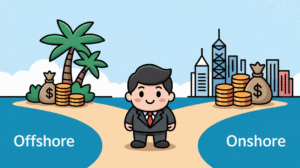
Offshore Trusts vs. Onshore Trusts: Strategic Considerations
Aspect
Onshore Trust
Offshore Trust
Primary Asset Location
Hong Kong
Outside Hong Kong
Income Source
Hong Kong-sourced
Non-Hong Kong-sourced
Profits Tax Liability
Yes, if carrying on business in HK
Generally no
Tax Rate (if applicable)
8.25% (first HK$2M), 16.5% (above)
N/A
Distribution Tax
None
None
Capital Gains Tax
None
None
Stamp Duty
May apply on HK property/stock transfers
Generally not applicable
Hybrid Structures for Hong Kong Entrepreneurs
| Aspect | Onshore Trust | Offshore Trust |
|---|---|---|
| Primary Asset Location | Hong Kong | Outside Hong Kong |
| Income Source | Hong Kong-sourced | Non-Hong Kong-sourced |
| Profits Tax Liability | Yes, if carrying on business in HK | Generally no |
| Tax Rate (if applicable) | 8.25% (first HK$2M), 16.5% (above) | N/A |
| Distribution Tax | None | None |
| Capital Gains Tax | None | None |
| Stamp Duty | May apply on HK property/stock transfers | Generally not applicable |
Many Hong Kong entrepreneurs find that a hybrid approach offers optimal tax efficiency. This might involve establishing a Hong Kong trust that holds both Hong Kong operating businesses (which may generate taxable Hong Kong-sourced income) and offshore investment portfolios (which generate tax-exempt offshore income).
The key is carefully structuring operations to ensure that international income remains genuinely offshore-sourced. The IRD applies substance-over-form principles and examines where value-creating activities occur, where key decisions are made, and where risks are borne. Entrepreneurs cannot simply route income through offshore entities if the underlying value-creation occurs in Hong Kong.
The Foreign-Sourced Income Exemption (FSIE) Regime: 2024 Updates
Overview and 2024 Refinements
In response to European Union concerns about base erosion and profit shifting, Hong Kong introduced the Foreign-Sourced Income Exemption (FSIE) regime effective 1 January 2023, with significant refinements taking effect 1 January 2024. These rules represent the most important development in Hong Kong trust taxation in recent years.
The FSIE regime addresses a specific concern: passive foreign-sourced income received by Hong Kong taxpayers that would otherwise escape taxation entirely under Hong Kong’s territorial system. The regime deems certain categories of foreign-sourced income to be Hong Kong-sourced (and thus taxable) unless specific economic substance requirements are met.
The January 2024 refinements significantly expanded the regime’s scope. Most notably, the definition of covered income was extended to include foreign-sourced disposal gains on all types of property—movable and immovable, financial and non-financial, capital and revenue—dramatically broadening the regime’s reach.
Application to Trusts: What’s Covered
The FSIE regime expressly applies to multinational enterprise (MNE) groups, defined to include not only corporations and partnerships but also trusts that prepare separate financial statements. An MNE group exists when entities are required under applicable accounting principles to be included in consolidated financial statements and at least one entity or permanent establishment is located outside the ultimate parent entity’s jurisdiction.
For trusts falling within the FSIE regime, the following categories of foreign-sourced income are subject to potential taxation:
- Interest income: Foreign-sourced interest received by the trust
- Dividend income: Dividends from foreign corporations
- Disposal gains: Gains from disposing of all types of property (post-January 2024)
- Intellectual property income: Royalties and similar income from IP assets
Economic Substance Requirements and Exemptions
To maintain tax exemption for foreign-sourced income under the FSIE regime, trusts must satisfy one of three tests: the economic substance requirement, the participation requirement, or the nexus requirement, depending on the type of income.
For interest and dividend income, the economic substance requirement generally requires that the trust (or relevant entity within the MNE group) conducts adequate economic activities in Hong Kong in relation to the income-generating assets. This typically means maintaining appropriate levels of operating expenditure and having employees or premises in Hong Kong.
Trusts in Comprehensive Estate Planning Strategies
Advantages Beyond Tax Efficiency
While tax efficiency is a primary driver for incorporating trusts into wealth transfer planning, Hong Kong trusts offer numerous additional advantages that make them attractive for entrepreneurs:
- Probate avoidance: Assets held in properly structured trusts pass to beneficiaries without requiring probate proceedings. This avoids delays, costs, and the public disclosure associated with probate, while ensuring business continuity for operating companies held in trust.
- Asset protection: Trusts established in compliance with Hong Kong law provide robust protection against creditors’ claims, particularly when combined with appropriate offshore trustee arrangements. For entrepreneurs in high-risk industries, this protection can be invaluable.
- Confidentiality: Unlike wills, which become public documents upon probate, trust deeds typically remain private. This confidentiality extends to the identity of beneficiaries, the nature and value of trust assets, and the terms governing distributions.
- Perpetual succession: Following amendments to Hong Kong’s perpetuities law in 2013, trusts established after 1 December 2013 can exist indefinitely. This allows entrepreneurs to create dynastic wealth structures that can benefit multiple generations without forced termination.
- Professional management: Appointing professional trustees ensures continuity of asset management even after the settlor’s death or incapacity, while protector provisions allow family members to retain oversight without direct control that might create tax issues.
Integration with Corporate Structures
Hong Kong entrepreneurs typically hold business interests through corporate entities, and trusts serve as ideal holding vehicles for shares in private operating companies. This structure offers several advantages:
- Business continuity is maintained upon the entrepreneur’s death, as shareholding passes automatically to beneficiaries without probate delays
- The corporate structure provides liability protection for business operations, while the trust structure provides succession planning and asset protection
- Dividend distributions from the operating company to the trust can often be received tax-free, particularly if the company operates offshore or qualifies for Hong Kong’s participation exemption
- The entrepreneur can continue managing the business as a director of the operating company while having transferred beneficial ownership to the trust
Recent Regulatory Developments and Compliance
Type 13 Regulated Activity (RA13): October 2024 Implementation
October 2024 marked a significant regulatory milestone with the implementation of Type 13 Regulated Activity under the Securities and Futures Ordinance. This new regulatory category specifically covers depositaries of SFC-authorized collective investment schemes and certain corporate trustee activities.
While RA13 primarily targets corporate trustees acting as depositaries for investment funds rather than private family trusts, it reflects Hong Kong’s commitment to strengthening its regulatory framework for trust services. The new regime aims to enhance investor protection, increase industry credibility, and align Hong Kong with international best practices.
Corporate trustees now face enhanced compliance obligations, including capital adequacy requirements, operational standards, and client asset protection rules. For entrepreneurs using corporate trustees for private wealth structures, this regulatory enhancement provides additional assurance of professional standards and client protection.
Trust and Company Service Provider (TCSP) Licensing
Hong Kong’s TCSP licensing regime, administered by the Companies Registry, requires persons providing trust or company services to be licensed. As of November 2024, Hong Kong had 6,783 TCSP licensees, comprising 331 trust service providers, 1,978 trust and company service providers, and 4,474 company service providers.
This extensive regulatory framework serves multiple purposes: anti-money laundering compliance, professional standards enforcement, and enhanced transparency. For entrepreneurs establishing trusts, engaging licensed TCSPs ensures professional competence and regulatory compliance while providing recourse mechanisms if issues arise.
Practical Implementation for Hong Kong Entrepreneurs
Selecting the Appropriate Trust Structure
Hong Kong entrepreneurs face several structural choices when establishing trusts for wealth transfer:
- Discretionary trusts vs. fixed trusts: Discretionary trusts give trustees flexibility in determining distribution amounts and timing, providing tax efficiency and protection against beneficiary creditors. Fixed trusts specify beneficiaries’ entitlements precisely, offering certainty but less flexibility.
- Purpose trusts: These trusts, designed to achieve specific purposes rather than benefit particular individuals, can be useful for philanthropic goals or business succession arrangements where maintaining family control is paramount.
- Private trust companies: For entrepreneurs with substantial wealth, establishing a private trust company (PTC) as trustee offers enhanced control while maintaining professional governance. PTCs combine family involvement in trust governance with institutional-quality administration.
Cost Considerations: What to Expect
While trusts offer substantial benefits, entrepreneurs must account for establishment and ongoing costs. Initial establishment costs typically include legal fees for drafting trust deeds (ranging from HK$30,000 to HK$150,000+ depending on complexity), TCSP licensing verification, and initial asset transfer costs.
Ongoing costs include annual trustee fees (typically 0.5% to 1.5% of trust assets, with minimum annual fees), accounting and tax compliance fees, investment management fees if applicable, and periodic legal review costs. These expenses must be weighed against the tax savings, asset protection, and succession planning benefits trusts provide.
Future Outlook: Hong Kong Trusts in a Changing Landscape
Market Growth and Trends
Hong Kong’s trust industry has demonstrated robust growth, with assets under trust increasing from HK$4,719 billion (US$606 billion) in 2021 to HK$5,188 billion (US$667 billion) in 2023—a 10% increase over two years. This growth reflects Hong Kong’s strengthening position as a premier wealth management hub for Asia-Pacific high-net-worth individuals.
Key growth drivers identified by industry surveys include Greater Bay Area connectivity, expansion of family office services, virtual asset integration, the Capital Investment Entrant Scheme attracting new wealth to Hong Kong, and growing interest in ESG-focused investment structures. These trends suggest continued expansion of Hong Kong’s trust sector.
Regulatory Evolution: Balancing Oversight and Competitiveness
Hong Kong’s regulatory framework for trusts continues evolving, balancing enhanced oversight with maintaining competitiveness. The successful implementation of RA13 and ongoing refinement of the FSIE regime demonstrate Hong Kong’s commitment to meeting international standards while preserving tax advantages that make the jurisdiction attractive.
Future regulatory developments will likely focus on virtual asset custody (particularly following the May 2025 Stablecoins Ordinance), cross-border pension arrangements, and further alignment with OECD transparency initiatives. Entrepreneurs should anticipate continued compliance cost increases but also enhanced credibility and international acceptance of Hong Kong trust structures.
✅ Key Takeaways
- Territorial taxation means Hong Kong trusts holding offshore assets can receive income tax-free, creating powerful planning opportunities for entrepreneurs with international portfolios
- No estate duty, capital gains tax, or withholding tax on trust distributions makes Hong Kong exceptionally favorable for multi-generational wealth transfer
- Trusts are separate taxable entities distinct from settlors and beneficiaries, with income taxed only if Hong Kong-sourced and the trust carries on business in Hong Kong
- The FSIE regime requires careful planning for foreign-sourced passive income, but exemptions exist for qualifying funds and family offices
- Perpetual trusts established after December 2013 allow dynasty planning spanning unlimited generations
- Beyond tax benefits, trusts offer probate avoidance, asset protection, confidentiality, and protection from foreign forced heirship rules
- Enhanced regulation through RA13 and TCSP licensing strengthens Hong Kong’s credibility while requiring greater compliance and due diligence
- Proper structuring requires professional advice considering Hong Kong tax law, international tax implications, and practical wealth management considerations
- Hybrid approaches combining Hong Kong and offshore trustees, discretionary and fixed provisions, and corporate structures offer optimal flexibility
- Ongoing administration and review are essential to maintain tax efficiency and adapt to changing regulations and family circumstances
For Hong Kong entrepreneurs seeking tax-efficient wealth transfer strategies, trusts remain indispensable planning tools. Hong Kong’s unique combination of territorial taxation, absence of estate and capital gains taxes, robust common law trust framework, and strategic geographic position creates exceptional opportunities for multi-generational wealth preservation. The evolving regulatory landscape—particularly the FSIE regime and enhanced corporate trustee oversight—requires more sophisticated planning than in past decades. However, with proper structuring and professional guidance, trusts continue offering unparalleled advantages for asset protection, succession planning, and tax optimization.
📚 Sources & References
This article has been fact-checked against official Hong Kong government sources and authoritative references:
- Inland Revenue Department (IRD) – Official tax rates, allowances, and regulations
- Rating and Valuation Department (RVD) – Property rates and valuations
- GovHK – Official Hong Kong Government portal
- Legislative Council – Tax legislation and amendments
- IRD FSIE Regime Guidance – Foreign-sourced income exemption rules
- IRD FIHV Regime – Family investment holding vehicle regulations
- Charltons Law: RA13 Implementation – Type 13 regulated activity details
Last verified: December 2024 | Information is for general guidance only. Consult a qualified tax professional for specific advice.