Salaries Tax vs. Profits Tax: Clarifying the Differences for Business Owners
📋 Key Facts at a Glance
- Tax Scope: Salaries Tax targets employment income; Profits Tax targets business income
- Tax Rates: Salaries Tax uses progressive rates (2%-17%) or standard rate (15%-16%); Profits Tax uses two-tier rates (8.25% on first HK$2M, 16.5% thereafter)
- Liability: Individuals pay Salaries Tax; business entities pay Profits Tax
- Territorial Basis: Both taxes only apply to Hong Kong-sourced income
Are you a Hong Kong business owner struggling to understand whether your income should be taxed as employment earnings or business profits? With different rates, deductions, and compliance requirements, choosing the wrong tax category could cost you thousands—or trigger an IRD investigation. This comprehensive guide breaks down the critical differences between Salaries Tax and Profits Tax, helping you navigate Hong Kong’s tax landscape with confidence and avoid costly misclassification errors.
Fundamental Distinctions: What Gets Taxed?
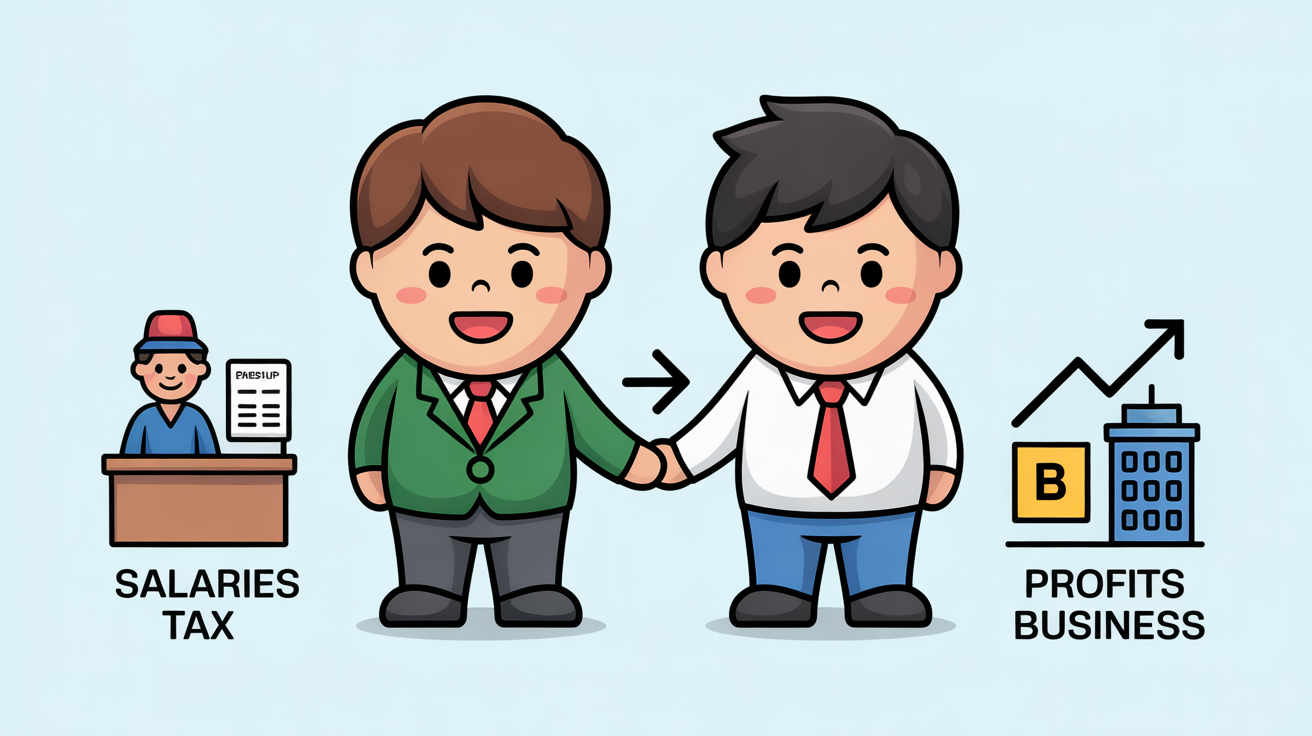
The most critical distinction between Salaries Tax and Profits Tax lies in the source of income. Understanding this fundamental difference is essential for proper tax classification and compliance.
Salaries Tax: Employment Income
Salaries Tax applies specifically to income derived from employment or holding an office in Hong Kong. This includes:
- Basic salary, wages, and overtime pay
- Bonuses, commissions, and performance incentives
- Allowances (housing, transportation, meal, etc.)
- Certain pensions and retirement scheme payouts
- Benefits-in-kind with monetary value
Profits Tax: Business Income
Profits Tax targets assessable profits arising in or derived from Hong Kong from any trade, profession, or business. This includes:
- Net income from trading goods or services
- Professional fees and consultancy earnings
- Investment income from business activities
- Rental income from property held as trading stock
| Tax Type | Income Source Targeted | What Gets Taxed |
|---|---|---|
| Salaries Tax | Employment Income | Remuneration, benefits, pensions from employment in Hong Kong |
| Profits Tax | Business Income | Assessable profits from trade, profession, or business in Hong Kong |
Who Pays What: Understanding Tax Liability
The party responsible for paying the tax differs significantly between the two systems, affecting both compliance obligations and financial planning.
Salaries Tax: Individual Responsibility
For Salaries Tax, the individual employee or office holder bears the ultimate responsibility. While employers must file employer returns and handle provisional tax payments, the individual must:
- File their personal tax return (Form BIR60)
- Declare all assessable income from employment
- Claim eligible deductions and allowances
- Pay any final tax liability after provisional payments
Profits Tax: Business Entity Responsibility
For Profits Tax, the business entity itself is liable, regardless of its legal structure:
- Limited companies: The company pays tax on its profits
- Sole proprietorships: The owner pays tax on business profits through their tax return
- Partnerships: The partnership files a return, and partners pay tax on their share of profits
| Tax Type | Who is Liable? | Filing Responsibility |
|---|---|---|
| Salaries Tax | Individual (Employee/Office Holder) | Individual files personal return |
| Profits Tax | Business Entity | Business files entity return |
Tax Rates and Calculation Methods
The calculation methods and tax rates differ dramatically between the two systems, significantly impacting your final tax liability.
Salaries Tax: Progressive vs. Standard Rates
Salaries Tax offers two calculation methods, with taxpayers paying the lower of the two results:
| Net Chargeable Income Bracket | Progressive Rate |
|---|---|
| First HK$50,000 | 2% |
| Next HK$50,000 | 6% |
| Next HK$50,000 | 10% |
| Next HK$50,000 | 14% |
| Remainder | 17% |
Standard Rate Method (2024/25):
- 15% on first HK$5 million of net income
- 16% on amount exceeding HK$5 million
Profits Tax: Two-Tier Flat Rates
Profits Tax uses a simpler two-tier system introduced in 2018/19:
| Business Structure | First HK$2M Profits | Remaining Profits |
|---|---|---|
| Corporations | 8.25% | 16.5% |
| Unincorporated Businesses | 7.5% | 15% |
Deductions and Allowances: What You Can Claim
The types of deductions and allowances available differ significantly, reflecting the nature of employment versus business income.
Salaries Tax Deductions (2024/25)
Employees can claim specific deductions and allowances:
- MPF contributions: Maximum HK$18,000 per year
- Charitable donations: Up to 35% of assessable income
- Self-education expenses: Maximum HK$100,000
- Home loan interest: Maximum HK$100,000 (up to 20 years)
- Domestic rent: Maximum HK$100,000
- Qualifying annuity/voluntary MPF: Maximum HK$60,000
Profits Tax Deductions
Businesses can deduct expenses “wholly and exclusively” incurred for producing assessable profits:
- Rent for business premises
- Employee salaries and benefits (deductible for business, taxable for employees)
- Utility bills and office expenses
- Raw materials and inventory costs
- Marketing and advertising expenses
- Capital allowances on business assets (depreciation)
- Bad debts and specific provisions
Compliance Timelines and Deadlines
Meeting compliance deadlines is crucial to avoid penalties. The schedules differ significantly between the two tax systems.
| Tax Type | Primary Filing | Filed By | Typical Deadline |
|---|---|---|---|
| Salaries Tax | Employer’s Return (IR56B) | Employers | End of May annually |
| Salaries Tax | Individual Return (BIR60) | Employees | ~1 month from issue (early June) |
| Profits Tax | Profits Tax Return (BIR51/52/54) | Businesses | 1-6 months after financial year-end |
Key Compliance Notes:
- Record retention: 7 years for both tax types
- Back assessment period: 6 years (10 years for fraud)
- Interest on held-over tax: 8.25% (from July 2025)
- Tax year: April 1 to March 31 for individuals
Employee vs. Contractor: Avoiding Misclassification
One of the most common tax pitfalls for business owners is misclassifying workers. The IRD looks at substance over form when determining employment status.
| Factor | Employee (Salaries Tax) | Contractor (Profits Tax) |
|---|---|---|
| Control | Significant control over work methods, hours, location | Controls own work methods; sets own hours |
| Integration | Part of organization’s operations | External provider; not integrated |
| Financial Risk | No financial risk; receives guaranteed salary | Bears financial risk; income depends on project success |
| Tools & Equipment | Provided by employer | Provides own tools and equipment |
| Benefits | Entitled to MPF, paid leave, benefits | No employment benefits; responsible for own MPF |
Tax Efficiency Strategies for Business Owners
Understanding the differences between Salaries Tax and Profits Tax enables strategic tax planning:
- Remuneration Mix for Directors: Consider the optimal balance between salary (deductible for company, taxable for director) and dividends (paid from after-tax profits, generally tax-free for recipients in Hong Kong).
- Timing of Income and Expenses: Businesses can strategically time profit recognition and expense claims to manage taxable profits across accounting periods.
- Leverage Double Taxation Agreements: Hong Kong has 45+ DTAs that can reduce withholding taxes and prevent double taxation on cross-border income.
- Consider Business Structure: The choice between operating as a sole proprietorship (7.5%/15% rates) versus a corporation (8.25%/16.5% rates) affects both tax rates and liability protection.
Emerging Regulatory Considerations
Stay informed about recent developments that could impact your tax planning:
- Foreign-Sourced Income Exemption (FSIE) Regime: Expanded in January 2024 to cover dividends, interest, disposal gains, and IP income. Requires economic substance in Hong Kong for exemption.
- Global Minimum Tax (Pillar Two): Enacted June 6, 2025, effective January 1, 2025. Applies 15% minimum effective tax rate to MNE groups with revenue ≥ EUR 750 million.
- Family Investment Holding Vehicle (FIHV) Regime: Offers 0% tax rate on qualifying income for family offices meeting specific requirements, including HK$240 million minimum AUM.
✅ Key Takeaways
- Salaries Tax targets employment income; Profits Tax targets business income—correct classification is critical
- Different rate structures: progressive/standard rates for individuals vs. two-tier flat rates for businesses
- More deductions available under Profits Tax for legitimate business expenses
- Employee vs. contractor status depends on substance, not just contract terms
- Strategic remuneration planning can optimize overall tax liability for business owners
- Stay updated on FSIE, Global Minimum Tax, and other regulatory developments
Navigating Hong Kong’s tax landscape requires a clear understanding of whether your income qualifies as employment earnings or business profits. The distinction affects everything from tax rates and deductions to compliance obligations and strategic planning opportunities. While this guide provides essential information, complex situations—particularly those involving mixed income streams, cross-border operations, or employee-contractor classification—warrant professional tax advice. Proper planning today can prevent costly compliance issues tomorrow while optimizing your overall tax position within Hong Kong’s favorable tax regime.
📚 Sources & References
This article has been fact-checked against official Hong Kong government sources and authoritative references:
- Inland Revenue Department (IRD) – Official tax rates, allowances, and regulations
- Rating and Valuation Department (RVD) – Property rates and valuations
- GovHK – Official Hong Kong Government portal
- Legislative Council – Tax legislation and amendments
- IRD Profits Tax Guide – Official profits tax information and rates
- IRD Salaries Tax Guide – Official salaries tax information and allowances
- IRD Two-Tiered Profits Tax FAQ – Detailed guidance on two-tier tax rates
Last verified: December 2024 | Information is for general guidance only. Consult a qualified tax professional for specific advice.