
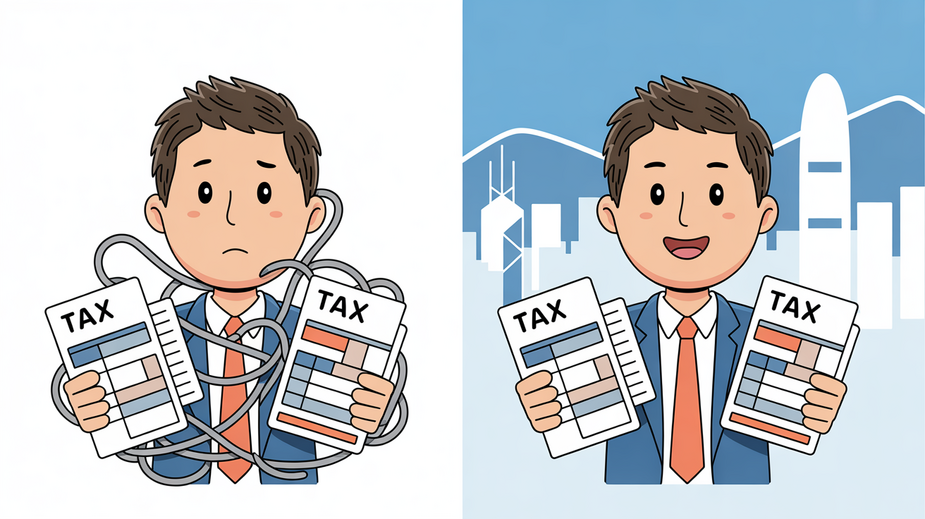
Hong Kong Tax Return Filing for Expats: Common Pitfalls and Solutions
📋 Key Facts at a Glance
- Territorial System: Hong Kong only taxes income sourced within its borders, not worldwide income
- Tax Year: April 1 to March 31 (2024/25 year ends March 31, 2025)
- Standard Deadline: Individual tax returns (BIR60) typically due early June after issuance in May
- Record Retention: Must keep tax records for 7 years from the relevant tax year
- Residency Test: 183-day physical presence rule for temporary residency determination
Are you an expat in Hong Kong wondering why your tax situation feels more complex than expected? You’re not alone. Hong Kong’s unique territorial tax system, combined with specific residency rules and deduction opportunities, creates common pitfalls that catch many foreign professionals off guard. From misunderstanding what income is taxable to missing valuable deductions, these errors can lead to unnecessary tax bills or compliance issues. This guide walks you through the most frequent mistakes expats make when filing Hong Kong tax returns and provides practical solutions to navigate the system confidently.
Understanding Hong Kong’s Territorial Tax System
One of the most fundamental yet misunderstood aspects of Hong Kong taxation is its territorial system. Unlike countries that tax residents on their worldwide income, Hong Kong only taxes income considered to have arisen in or been derived from Hong Kong. This principle applies to Salaries Tax, Profits Tax, and Property Tax, but it’s particularly crucial for expats to grasp for employment income.
The source determination depends on several factors that expats often overlook:
- Place of service performance: Where you physically work is the primary factor
- Employment contract location: Where your contract was negotiated and signed
- Remuneration structure: How and where your salary is determined
- Nature of duties: Whether services could be performed elsewhere
For example, if you’re based in Hong Kong but travel frequently for work, income for days worked outside Hong Kong might be non-taxable, but you need clear records to prove this. Conversely, if your employment contract is Hong Kong-based but you work remotely from another country, the income might still be considered Hong Kong-sourced.
Deadline Management and Extension Strategies
Missing tax deadlines is one of the most common and costly mistakes expats make. The Inland Revenue Department (IRD) issues individual tax returns (BIR60 forms) in early May each year, with deadlines typically falling in early June. However, these dates can vary, and first-time filers often receive different deadlines.
| Filer Type | Typical Timeline | Key Consideration |
|---|---|---|
| Standard Individual Taxpayers | Returns issued early May, due ~1 month later (early June) | Check exact date on your BIR60 form |
| First-Time Filers | May receive returns later with extended deadlines | Contact IRD if you haven’t received a return but believe you should file |
| Electronic Filing (eTAX) | Automatic 1-month extension available | Must file electronically to qualify |
How to Request an Extension
If you can’t meet the deadline, you can request an extension, but you must have valid reasons:
- Submit in writing: Write to the IRD explaining your situation before the deadline
- Provide evidence: Include supporting documents (medical certificates, travel itineraries, etc.)
- Valid reasons only: Absence from Hong Kong, serious illness, or other unforeseen circumstances are acceptable. “Too busy” or “forgot” are not.
- Follow up: Keep copies of your correspondence and check if your extension is approved
Residency Status Determination Challenges
Determining your tax residency status is crucial yet confusing for many expats. Hong Kong distinguishes between “ordinarily resident” and “temporarily resident” individuals, and getting this wrong can lead to incorrect tax filings.
| Residency Type | Key Test | Common Expat Pitfall |
|---|---|---|
| Temporarily Resident | 183-day physical presence rule in a tax year | Inaccurate day counting with frequent travel |
| Ordinarily Resident | Habitual abode and centre of vital interests | Assuming non-residency despite strong HK ties |
The 183-day rule is often misunderstood. Spending fewer than 183 days in Hong Kong doesn’t automatically make you non-resident. The IRD considers your “centre of vital interests” – where your family lives, where you have property, bank accounts, social ties, and where you intend to return after travel.
Overlooked Deductions and Allowances
Many expats pay more tax than necessary because they miss eligible deductions and allowances. Hong Kong offers several tax reliefs that can significantly reduce your tax bill if claimed correctly.
Personal Allowances (2024/25 Tax Year)
These reduce your chargeable income before tax is calculated:
- Basic allowance: HK$132,000 (single) or HK$264,000 (married)
- Child allowance: HK$130,000 per child (additional HK$130,000 in year of birth)
- Dependent parent/grandparent (60+): HK$50,000 each
- Single parent allowance: HK$132,000
Commonly Missed Deductions
| Deduction Type | Maximum Amount | Key Requirements |
|---|---|---|
| MPF Contributions | HK$18,000/year | Mandatory and voluntary contributions |
| Charitable Donations | 35% of assessable income | To approved charitable institutions |
| Self-Education Expenses | HK$100,000 | Courses leading to academic/professional qualifications |
| Home Loan Interest | HK$100,000 | For Hong Kong domestic property, up to 20 years |
| Domestic Rent | HK$100,000 | For rented domestic property in Hong Kong |
| Qualifying Annuity/Voluntary MPF | HK$60,000 | For qualifying deferred annuity premiums or TVC |
Housing Benefit Treatment
Expats often misunderstand how housing benefits are taxed:
| Benefit Type | Tax Treatment | Important Note |
|---|---|---|
| Cash Housing Allowance | Fully taxable as income | Reported on IR56B by employer |
| Employer-Provided Accommodation | 10% of total income (typically) | Not based on actual rental value |
Double Taxation Agreement Misapplications
Hong Kong has Comprehensive Double Taxation Agreements (CDTAs) with over 45 jurisdictions, including key expat home countries. These agreements prevent being taxed twice on the same income, but they’re often misunderstood or misapplied.
Key countries with Hong Kong CDTAs include:
- Mainland China
- United Kingdom
- Singapore
- Australia
- Canada
- United States
- Japan
- France
- Germany
When using DTAs, you must:
- Identify applicable treaties: Check if Hong Kong has a DTA with countries where you earn income
- Review specific articles: Different rules apply to employment income, dividends, interest, pensions, etc.
- Claim relief correctly: Follow Hong Kong’s procedures for claiming foreign tax credits or exemptions
- Keep documentation: Maintain proof of foreign tax paid and residency certificates
Foreign Income Reporting Complexities
While Hong Kong’s territorial system generally doesn’t tax foreign-sourced income, determining what qualifies as “foreign-sourced” and whether disclosure is required can be tricky.
Common Foreign Income Scenarios
| Income Type | General Treatment | Reporting Consideration |
|---|---|---|
| Overseas Rental Income | Non-taxable if foreign-sourced | May need disclosure if managed from HK |
| Foreign Dividends/Interest | Non-taxable if foreign-sourced | Check if considered HK-sourced based on activities |
| Capital Gains (overseas) | Non-taxable (HK doesn’t tax capital gains) | Ensure classified as capital, not trading income |
| Digital Asset Income | Depends on nature and source | Trading may be taxable; holding may be capital |
Record-Keeping Requirements for Compliance
Proper documentation is your best defense against tax issues. The IRD requires taxpayers to keep records for 7 years from the relevant tax year, and expats often underestimate what needs to be retained.
Essential Records to Maintain
- Employment records: Payslips, employment contracts, IR56B forms from employers
- Income proof: Bank statements showing salary deposits and other income
- Deduction evidence: Receipts for charitable donations, education expenses, medical costs
- Residency proof: Passport stamps, travel itineraries, utility bills, rental agreements
- Housing documentation: Rental contracts, mortgage statements, housing allowance details
- Foreign income/tax proof: Foreign tax returns, tax payment receipts, residency certificates
- MPF/retirement records: Contribution statements, annuity contracts
Navigating Audits and Dispute Resolution
Even with careful filing, your return might be selected for review. Knowing how to respond can prevent minor queries from escalating into major issues.
Common Audit Triggers
- Large fluctuations in reported income year-to-year
- Unusually high deductions relative to income
- Inconsistencies between your return and employer’s IR56B
- Late filing history
- Complex international arrangements
- Random selection
How to Handle an IRD Query
- Respond promptly: Meet the deadline specified in the IRD letter
- Provide complete information: Answer all questions fully with supporting documents
- Be cooperative but careful: Don’t volunteer unnecessary information
- Seek professional help: Consider consulting a tax advisor for complex queries
- Keep copies: Maintain records of all correspondence
Dispute Resolution Process
If you disagree with an assessment:
- Lodge written objection: Within 1 month of assessment notice
- State grounds clearly: Explain why you disagree with supporting evidence
- IRD review: The department will review and may request more information
- Appeal to Board of Review: If unresolved, appeal within 1 month of IRD’s determination
- Further appeals: To Court of First Instance and higher courts if necessary
✅ Key Takeaways
- Hong Kong taxes only Hong Kong-sourced income – location of work matters more than payment location
- Track your physical days in Hong Kong carefully for residency determination
- Claim all eligible deductions and allowances – many expats miss valuable tax reliefs
- Keep comprehensive records for 7 years to support your tax position
- Understand Double Taxation Agreements but apply them correctly
- Meet filing deadlines or request extensions with valid reasons
- Seek professional advice for complex situations or if facing an audit
Navigating Hong Kong’s tax system as an expat requires understanding its unique territorial approach and specific rules that differ from many other jurisdictions. By avoiding these common pitfalls – from misunderstanding what income is taxable to missing valuable deductions – you can ensure compliance while minimizing your tax liability. Remember that while Hong Kong’s tax system is relatively simple compared to many countries, its nuances can trip up even experienced professionals. When in doubt, consult with a qualified Hong Kong tax advisor who understands both the local system and international considerations relevant to expatriates.
📚 Sources & References
This article has been fact-checked against official Hong Kong government sources and authoritative references:
- Inland Revenue Department (IRD) – Official tax rates, allowances, and regulations
- Rating and Valuation Department (RVD) – Property rates and valuations
- GovHK – Official Hong Kong Government portal
- Legislative Council – Tax legislation and amendments
- IRD Salaries Tax Guide – Official salaries tax information and rates
- IRD Double Taxation Agreements – Information on Hong Kong’s CDTAs
- IRD Filing Deadlines – Official information on tax return filing requirements
Last verified: December 2024 | Information is for general guidance only. Consult a qualified tax professional for specific advice.