How Foreign Entrepreneurs Can Benefit from Hong Kong’s Personal Tax Allowances
📋 Key Facts at a Glance
- Territorial Tax System: Only Hong Kong-sourced income is taxed, not worldwide income
- No Capital Gains Tax: Profits from investments and asset sales are generally tax-free
- Generous Allowances: Basic allowance of HK$132,000 plus additional deductions for dependents
- Two-Tier Profits Tax: Corporations pay 8.25% on first HK$2M, 16.5% on remainder
- No VAT/Sales Tax: Hong Kong has no value-added tax or general sales tax
Are you a foreign entrepreneur considering Hong Kong as your business base? Imagine keeping more of what you earn while enjoying one of the world’s simplest tax systems. Hong Kong’s unique territorial tax regime, combined with generous personal allowances and the absence of capital gains tax, creates an environment where entrepreneurs can thrive. This guide reveals how you can legally minimize your tax burden while building your international business in Asia’s premier financial hub.
Hong Kong’s Tax Advantages: Why Entrepreneurs Choose This Hub
Hong Kong operates on a territorial tax system, meaning only income sourced within Hong Kong is subject to taxation. This fundamental principle distinguishes Hong Kong from countries like the United States that tax citizens on their worldwide income. For foreign entrepreneurs, this means income earned from business activities conducted entirely outside Hong Kong remains tax-free, regardless of your residency status.
Beyond the territorial principle, Hong Kong offers several tax-free benefits that directly benefit entrepreneurs:
- No Capital Gains Tax: Profits from selling investments, property (except residential property held for short periods), or business assets are generally not taxed
- No Dividend Withholding Tax: Dividends received from Hong Kong companies are tax-free at the individual level
- No Inheritance/Estate Tax: Wealth can be transferred to heirs without estate duty
- No Sales Tax/VAT: Unlike most developed economies, Hong Kong has no value-added tax system
| Tax Type | Hong Kong Treatment | Benefit for Entrepreneurs |
|---|---|---|
| Capital Gains | Generally Not Taxed | Keep 100% of investment profits |
| Dividends | No Withholding Tax | Full distribution from company profits |
| Interest Income | Generally Not Taxed | Keep all interest earnings |
| Sales Tax/VAT | None | Simplified pricing and compliance |
Maximizing Personal Allowances: Your Tax Reduction Toolkit
Hong Kong’s salaries tax system includes generous personal allowances that can significantly reduce your taxable income. For the 2024-25 tax year, these allowances provide substantial tax relief for foreign entrepreneurs earning Hong Kong-sourced income.
Core Personal Allowances (2024-25 Tax Year)
| Allowance Type | Amount (HK$) | Key Conditions |
|---|---|---|
| Basic Allowance | 132,000 | Available to all individual taxpayers |
| Married Person’s Allowance | 264,000 | For married couples (joint or separate assessment) |
| Child Allowance (per child) | 130,000 | For each eligible child under 18 or in full-time education |
| Child Allowance (year of birth additional) | 130,000 | Extra allowance in the year a child is born |
| Dependent Parent/Grandparent (60+) | 50,000 | For each eligible parent/grandparent aged 60+ |
| Single Parent Allowance | 132,000 | For single parents with dependent children |
Example Calculation: A married foreign entrepreneur with two children could claim: Basic Allowance (HK$132,000) + Married Person’s Allowance (HK$264,000) + 2 × Child Allowance (HK$260,000) = HK$656,000 in total allowances. This means the first HK$656,000 of their Hong Kong-sourced income would be tax-free!
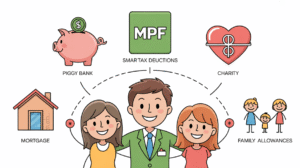
Additional Deductions You Shouldn’t Miss
Beyond personal allowances, several deductions can further reduce your taxable income:
- MPF Contributions: Maximum HK$18,000 per year for mandatory contributions
- Charitable Donations: Up to 35% of your assessable income
- Self-Education Expenses: Maximum HK$100,000 for approved courses
- Home Loan Interest: Maximum HK$100,000 per year (up to 20 years)
- Domestic Rent: Maximum HK$100,000 for rental payments
- Qualifying Annuity/Voluntary MPF: Maximum HK$60,000
Understanding Hong Kong’s Tax Rates: Progressive vs. Two-Tier Systems
Hong Kong uses different tax systems for individuals and businesses, each with its own advantages for entrepreneurs.
Salaries Tax: Progressive Rates (2024-25)
For individuals earning Hong Kong-sourced employment or business income, progressive rates apply to net chargeable income (after allowances and deductions):
| Net Chargeable Income Bracket | Tax Rate | Tax on Bracket |
|---|---|---|
| First HK$50,000 | 2% | HK$1,000 |
| Next HK$50,000 | 6% | HK$3,000 |
| Next HK$50,000 | 10% | HK$5,000 |
| Next HK$50,000 | 14% | HK$7,000 |
| Remainder | 17% | 17% of excess |
Standard Rate Alternative: From 2024-25, taxpayers can elect for a standard rate of 15% on the first HK$5 million of net income (after allowances) and 16% on amounts exceeding HK$5 million. This often benefits higher-income earners.
Profits Tax: Two-Tier System for Businesses
For business income, Hong Kong offers a competitive two-tier profits tax system:
| Business Structure | First HK$2M Profit | Remaining Profit |
|---|---|---|
| Corporations | 8.25% | 16.5% |
| Unincorporated Businesses | 7.5% | 15% |
Choosing Your Business Structure: Tax Implications
Your choice of business structure significantly impacts how you can utilize personal allowances and optimize your overall tax position.
| Feature | Sole Proprietorship | Limited Company |
|---|---|---|
| Tax Treatment | Business income taxed as personal income under Salaries/Profits Tax | Company pays Profits Tax; owners pay Salaries Tax on salary |
| Personal Allowances | Applied against total business profit | Applied against salary component only |
| Dividend Treatment | Not applicable | Generally tax-free at personal level |
| Liability Protection | Unlimited personal liability | Limited liability protection |
| Best For | Small businesses with low risk | Growing businesses, asset protection |
Recent Tax Changes: What Foreign Entrepreneurs Need to Know
Hong Kong’s tax landscape continues to evolve. Here are the most important recent changes affecting foreign entrepreneurs:
Stamp Duty Simplification (Effective February 28, 2024)
Hong Kong has significantly simplified its property stamp duty regime:
- Special Stamp Duty (SSD): ABOLISHED – No more penalty tax for selling residential property within 3 years
- Buyer’s Stamp Duty (BSD): ABOLISHED – Non-permanent residents now pay the same rates as locals
- New Residential Stamp Duty (NRSD): ABOLISHED – Simplified ad valorem rates now apply to all buyers
Property transactions now follow a simplified ad valorem stamp duty scale ranging from HK$100 for properties under HK$3 million to 4.25% for properties over HK$21.7 million.
Foreign-Sourced Income Exemption (FSIE) Regime
Phase 2 of the FSIE regime took effect in January 2024, expanding coverage to include disposal gains and intellectual property income. To qualify for exemption on foreign-sourced dividends, interest, disposal gains, and IP income, companies must maintain economic substance in Hong Kong.
Global Minimum Tax (Pillar Two)
Hong Kong enacted the Global Minimum Tax framework on June 6, 2025, effective from January 1, 2025. This applies to multinational enterprise groups with consolidated revenue of €750 million or more, requiring a minimum effective tax rate of 15%.
Double Taxation Relief and Residency Rules
Hong Kong has comprehensive Double Taxation Agreements (DTAs) with over 45 jurisdictions, including Mainland China, Singapore, the UK, and Japan. These agreements prevent the same income from being taxed twice and provide clarity on which country has primary taxing rights.
Compliance Essentials for Foreign Entrepreneurs
Staying compliant is straightforward in Hong Kong if you follow these key steps:
- Register Properly: Register your business with the Companies Registry and obtain a Business Registration Certificate
- File Tax Returns Timely: Individual tax returns are typically issued in early May and due within about one month. Profits tax returns have different deadlines based on your accounting year-end
- Maintain Records: Keep business records for at least 7 years as required by law
- Use eTAX: Register for the IRD’s electronic filing system for convenient online submissions
- Separate Business/Personal: Maintain clear separation between business and personal finances, especially important for limited companies
✅ Key Takeaways
- Hong Kong’s territorial system means only locally-sourced income is taxed – foreign income stays tax-free
- Generous personal allowances (HK$132,000 basic plus dependents) can eliminate tax on substantial income
- No capital gains tax means you keep 100% of investment profits
- The two-tier profits tax system offers 8.25% on first HK$2M for corporations
- Business structure choice (sole proprietorship vs. company) significantly impacts tax optimization strategies
- Recent stamp duty simplifications make property investment more accessible
Hong Kong offers foreign entrepreneurs one of the world’s most favorable tax environments, combining low rates with simplicity and predictability. By understanding the territorial principle, maximizing personal allowances, choosing the right business structure, and staying compliant, you can build a thriving international business while keeping more of what you earn. The combination of no capital gains tax, no dividend tax, and generous personal deductions creates a powerful platform for entrepreneurial success in Asia’s dynamic marketplace.
📚 Sources & References
This article has been fact-checked against official Hong Kong government sources and authoritative references:
- Inland Revenue Department (IRD) – Official tax rates, allowances, and regulations
- Rating and Valuation Department (RVD) – Property rates and valuations
- GovHK – Official Hong Kong Government portal
- Legislative Council – Tax legislation and amendments
- IRD Salaries Tax Guide – Personal allowances and progressive rates
- IRD Profits Tax Guide – Two-tier corporate tax system
- IRD Stamp Duty Guide – Property transaction taxes
Last verified: December 2024 | Information is for general guidance only. Consult a qualified tax professional for specific advice.